
Fixings are a small part of the cost of a deck and a large part of whether it is still sound in fifteen years, because the failure they cause is invisible until something moves.
Why plain steel fails
Modern timber preservatives are copper based, and copper in contact with plain or lightly plated steel accelerates corrosion sharply.
Add rain and constant wetting and drying, and an ordinary yellow passivated screw can be substantially corroded within two or three seasons.
Every fixing in a deck must be rated for exterior use in treated timber. The packaging states this, and if it does not, assume it is not suitable.
The coatings, in order
Bright or zinc plated: indoor only, with no place in a deck.
Electro galvanised: a thin zinc layer, marginal outdoors.
Hot dip galvanised: a thick zinc coating, the standard for joist hangers, brackets and structural nails.
Coated exterior screws: proprietary multi layer coatings designed for treated timber, and the usual choice for deck boards.
Stainless steel: the longest lasting and the most expensive. A304 inland, A316 for coastal sites and anywhere near a pool.
Do not mix stainless fixings with galvanised brackets in wet conditions, since dissimilar metals corrode one another.
Decking screws
Use screws specifically sold as decking screws, which have a coarse thread, a countersinking head and usually a reinforced shank.
Two screws per board per joist is standard, set in from the board edge by around 20mm so the timber does not split.
Pilot drill hardwood without exception, and pilot drill softwood near board ends.
Drive screws flush or slightly below the surface, not proud, and not so deep that the head crushes the fibres and creates a water trap.
Hidden fasteners and clips
Clips sit in a groove in the board edge and screw down into the joist, leaving no visible fixings.
They give a clean surface, set the board gap automatically and consistently, and avoid holes in the board face where water can sit.
They cost more, take longer to fit, and mean boards must be laid in sequence rather than being replaceable individually without lifting neighbours.
Most composite systems are designed around clips and include them.
Board ends and the first and last board usually still need face screws, so buy colour matched screws for those.
Structural fixings
Joist hangers need the correct hanger nails in every hole. Screws are not a substitute, since hanger nails are designed for shear.
Framing connectors, straps and angle brackets should be galvanised and fully nailed.
Beams and posts want coach bolts or structural screws with washers, not nails.
The ledger board against a house wall needs masonry bolts or resin anchors specified for the load, into sound masonry.
Nails and their place
Ring shank nails hold far better than smooth ones and suit framing and blocking.
Nails are not suitable for deck boards, which need to be held down against cupping and need to be removable.
Practical points
Buy considerably more screws than you calculate. A medium deck takes a surprising number, and running out mid-board is the classic Sunday afternoon problem.
Use an impact driver with a torque setting rather than a drill, and use fresh driver bits, since a worn bit chews screw heads and coated screws are easily damaged.
Damaged coating means an unprotected screw, so discard anything that has been badly cammed out.
Keep a magnet handy for dropped screws, particularly where children and bare feet will use the deck.
Checking later
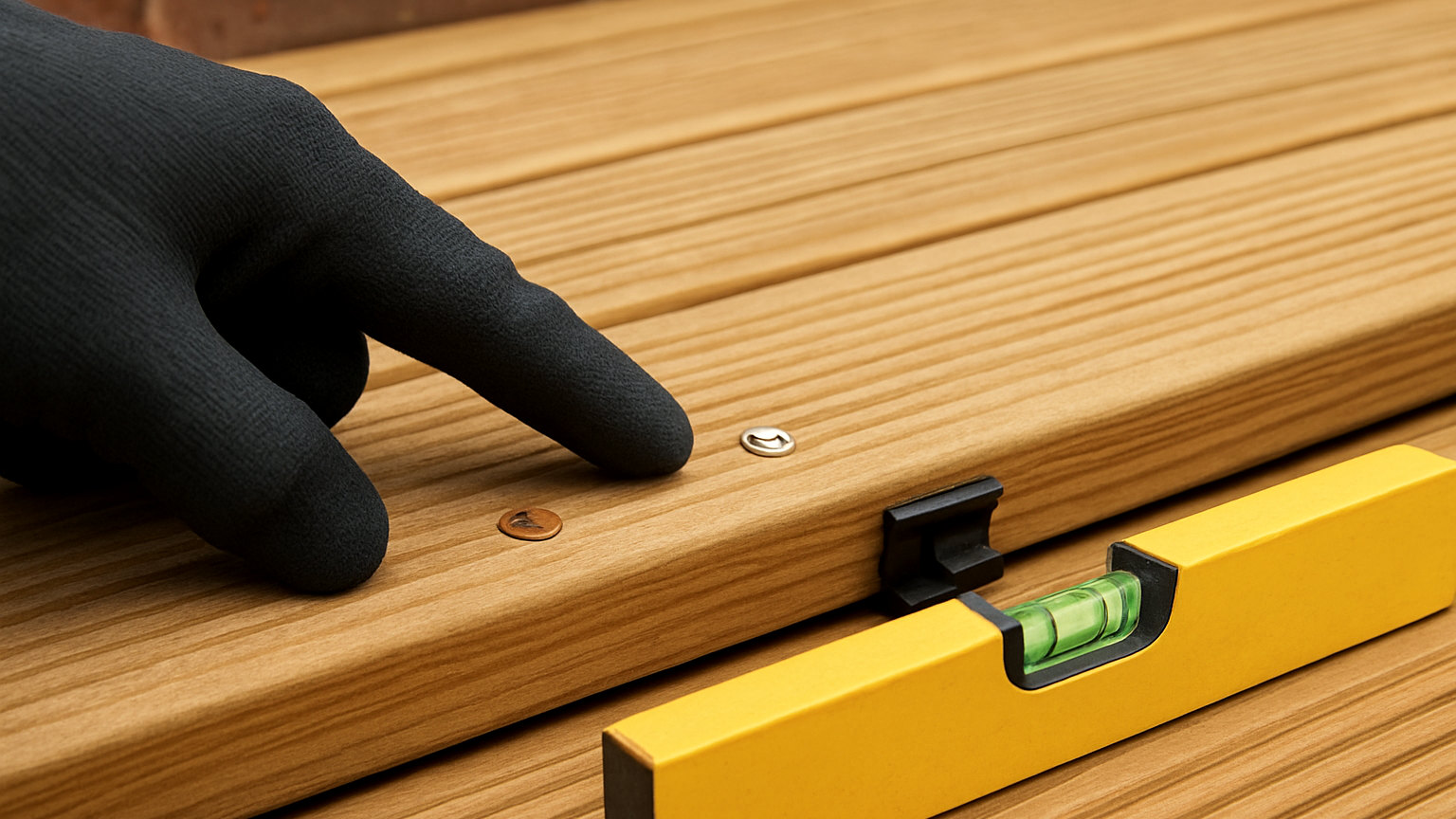
Screws work loose slightly as boards shrink in the first year. Walk the deck barefoot after the first summer and check for proud heads, which are both a snag hazard and a sign the board beneath has moved.
Replace any screw that has corroded visibly rather than leaving it, since one failing fixing usually means the whole batch was the wrong specification.
Where a board has to come up, drive the screws out rather than levering the board, which splits the timber around the fixing and ruins it for refitting.


