
Sheds rot from the bottom up and from the roof down, and the middle usually stays sound for years. That pattern is what makes repair worthwhile rather than replacement.
Where sheds rot
The floor and bearers, where timber is closest to the ground and air moves least.
The bottom 300mm of the walls, which takes splash from the ground and sits against wet soil or vegetation.
The roof boards and barge boards, where failed felt has let water in.
The back wall is frequently the worst, because it is pushed against a fence, never treated and never seen.
Testing what is sound
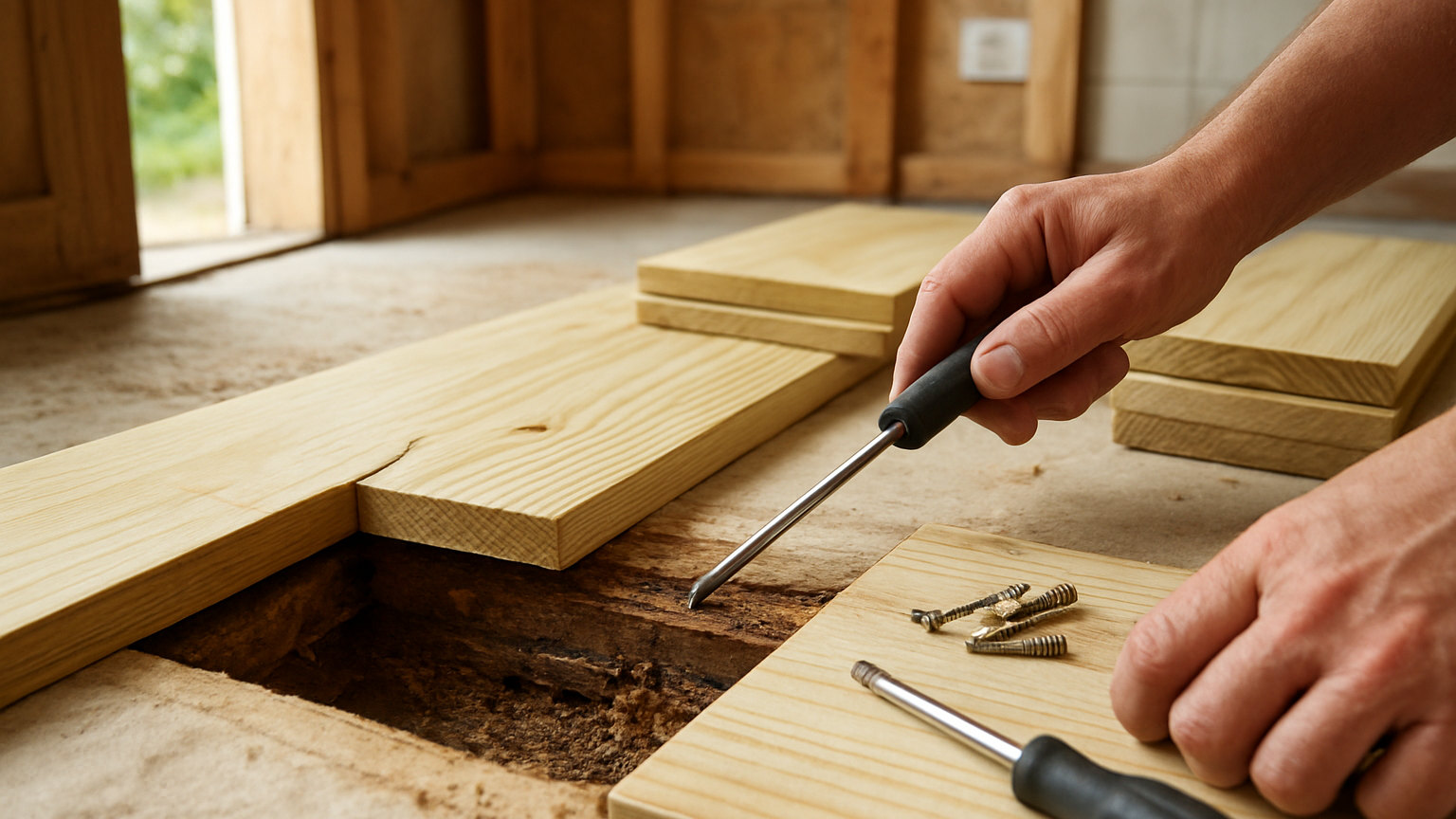
Push a screwdriver into the timber. Sound wood resists; rotten wood takes the blade easily and comes away as soft fibre.
Test at the base of every corner post, along the bottom rail, and across the floor near the door where most traffic falls.
Tap boards and listen for a dull, dead sound.
Look for staining, fungal growth and a musty smell, all of which indicate active damp.
Judge the frame separately from the cladding. Rotten cladding on a sound frame is a straightforward repair; a rotten frame is a different question.
Is it worth repairing
Repair where the frame is sound and the damage is confined to boards, floor or roof covering.
Replace where several corner posts have gone, where the building is racked out of square, or where the roof structure has failed.
A shed that has been neglected for a decade and is soft in multiple places is usually beyond economic repair, and the cost of materials starts approaching the cost of a new building.
Replacing floor boards
Clear the shed completely.
Cut out the affected boards back to the centre of a sound bearer, so the new board has something to fix to at each end.
Check the bearers underneath while the floor is open, since floor rot usually means bearer rot.
Cut replacement boards from pressure treated timber of the same thickness.
Treat all four faces and every cut end before fitting, since the underside is never accessible again.
Fix into the bearers with exterior grade screws.
Replacing bearers
Bearers can usually be replaced one at a time without lifting the whole shed.
Support the floor with a prop or a car jack and a spreader board, take the weight, and slide the old bearer out.
Use a ground contact use class timber, treated generously, and set it on pads or a damp proof membrane rather than directly on the base.
Where several bearers have gone, it is frequently easier to empty the shed, lift it with help, and redo the base properly.
Patching cladding
Individual boards can be cut out and replaced, which is easier with shiplap and tongue and groove than with overlap.
Cut the damaged section back to the centre of a frame upright at each end.
Prise the board out carefully, working from the bottom, since the board above overlaps it.
Fit the replacement, treat it, and expect it to be a different colour for a season.
Where the bottom of every board has gone, cutting a horizontal line across the whole wall and replacing the lower boards in one operation is neater than patching individually.
Repairing the frame
A corner post rotted only at the base can be cut back to sound timber and spliced, with a new section bolted alongside and set on a pad clear of the ground.
Support the walls before cutting anything structural.
Where two or more posts have gone, reconsider whether repair is the right answer.
Stopping it happening again
Get the floor up off the ground with bearers and an air gap.
Make sure the base sheds water and the ground around slopes away.
Clear vegetation and stored items from against the walls.
Fit or repair a gutter so roof water is taken away rather than splashing the base.
Treat every two to three years, paying attention to the bottom 300mm, the back and all cut ends.
Replace failed felt promptly rather than waiting for the boards to soften.


