
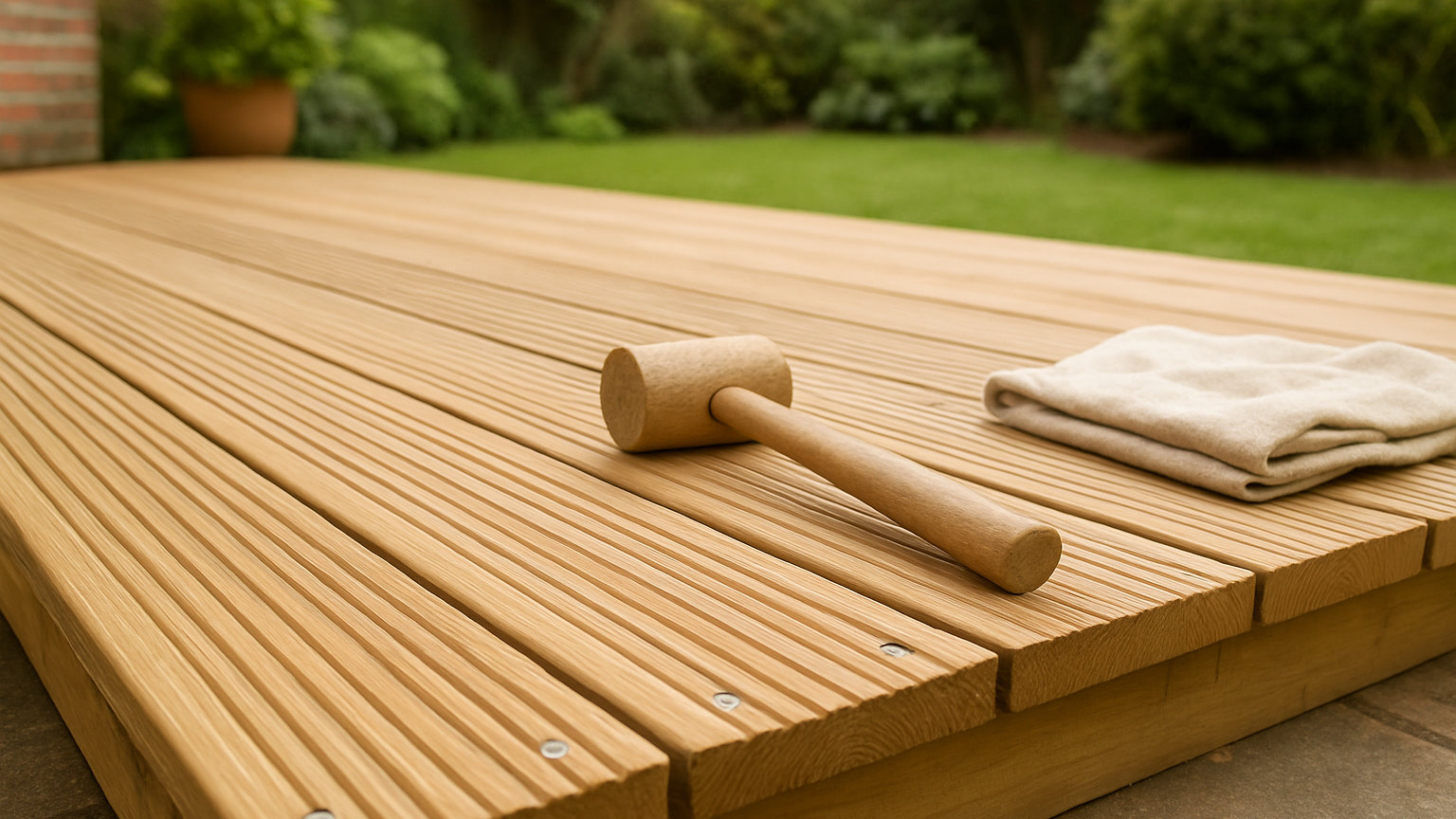
This is the most argued about question in decking, and the answer is less dramatic than either side claims. Both faces are usable, and the grooves do not do what most people think they do.
What the grooves are actually for
Reeded or grooved decking boards were originally produced as a machining and appearance feature rather than a safety one.
The ridges are not an anti-slip surface. Slipperiness on a deck comes almost entirely from a film of algae or lichen on the surface, and that film forms just as readily on a ridge as on a flat board.
Where the surface is clean, both faces grip adequately when wet. Where it is not, both are dangerous.
Some manufacturers now state plainly that the grooved side offers no slip advantage, and a number have stopped producing grooved boards altogether.
The case for grooves up
It is the traditional look and what most people picture when they think of decking.
The ridges channel water along the board, which does help surface water clear on a deck laid with a fall in the right direction.
Scuffs and light wear show less on a textured surface.
The case for smooth up
Grooves hold dirt, leaf debris and moisture. That is the practical objection, and it is a real one. Anything that sits in a groove stays wet longer, which is exactly what algae needs.
A smooth surface is far easier to sweep, wash and clear of leaves.
It is much more comfortable underfoot, particularly barefoot, and easier on furniture legs.
It can be sanded back and refinished later. A grooved face effectively cannot.
Most people who have lived with both end up preferring smooth.
What matters more than the choice
Keeping the deck clean, which is what genuinely controls slip resistance.
Building in a fall so water runs off rather than sitting.
Leaving proper gaps between boards so water drains through.
Ventilating the underside so boards dry from both faces.
A clean smooth deck is safer than a dirty grooved one, and the reverse is also true.
Growth rings and cupping
There is a second orientation question that matters more than the grooves and gets far less attention.
Look at the end grain of a board. The growth rings curve in one direction.
As timber takes up and loses moisture it tends to cup away from the heart of the tree, so the face nearer the outside of the log becomes concave.
Laying boards so any cupping is convex upwards means water sheds off rather than collecting in a trough along the middle of each board.
In practice, that usually means laying boards with the growth rings curving downwards when viewed from the end.
This matters more on wide boards and on softwood than on narrow or dense hardwood.
Being consistent
Whatever you choose, do the whole deck the same way.
Mixed orientation is visible immediately in raking light, and it looks like a mistake rather than a choice.
Sort boards before starting and mark the face to be laid up, since it is easy to lose track halfway across.
If the deck is already down the other way
A grooved deck can be lifted, turned over and refixed, though the existing screw holes need care and the underside may be rougher than expected.
It is worth doing only if the boards are otherwise sound and reasonably new.
The cheaper answer is usually to clean it properly and keep it clean.
Improving grip on any deck
Clean annually with a deck cleaner and a stiff brush, and treat algae with a fungicidal wash rather than only brushing it.
Fit anti-slip strips or inserts on steps and thresholds, which is where almost all deck falls happen.
Keep the deck clear of leaves in autumn, since a layer of wet leaves is more slippery than anything the timber does.
Prune back overhanging planting so the surface gets light and air and can dry.


