
Deck finishes divide into two families that behave in opposite ways, and choosing the wrong one commits you to a much harder job in three years.
Penetrating finishes
Decking oil soaks into the timber, replaces natural oils lost to weathering, repels water and feeds the wood.
Penetrating stain does the same with added pigment for colour and UV protection.
These wear away gradually from the surface rather than peeling, so recoating is a clean and a coat rather than a strip and a rebuild.
They are the right choice for almost every deck.
Film forming finishes
Deck paint and some heavy solid stains form a layer on top of the timber.
They give strong colour and hide a multitude of surface defects, which is their appeal on a tired deck.
The problem is what happens next. A film on a horizontal surface walked on in all weathers cracks, lifts and peels, and water that gets underneath cannot escape.
Once a deck is painted it is committed to being stripped and repainted, and stripping a deck is a genuinely unpleasant job.
Pigment and UV
Clear finishes offer very little protection from ultraviolet light, which is what turns timber grey.
Pigment is what blocks UV, so a coloured stain protects the timber for considerably longer than a clear oil.
Semi transparent finishes are a reasonable compromise, keeping the grain visible while carrying enough pigment to slow the greying.
When new timber is ready
Pressure treated softwood arrives wet with preservative.
Leave it several months, often a full season, before applying any finish. Coating too early traps moisture and nothing keys properly.
Test with water. Droplets that sit on the surface mean the timber is still too wet or too oily; droplets that soak in mean it is ready.
Hardwood decking is dense and oily and needs a finish formulated for it, applied sparingly.
Treat cut ends with preservative immediately regardless, since that is a different product doing a different job.
Preparing
Clear the deck completely and clean the gaps between boards.
Wash with a deck cleaner and treat any algae with a fungicidal wash, since finishing over algae seals it in.
Sand where the surface is furred or where an old coating is failing.
Drive down proud screws and replace corroded ones.
Let the deck dry fully, which means several dry days rather than a few hours.
The weather you need
Dry timber, dry weather, and no rain forecast for at least twenty four hours afterwards.
Above the minimum temperature on the tin, usually eight to ten degrees.
Not in direct hot sun, which dries the finish on the surface before it can penetrate and leaves a patchy, sticky result.
Early morning or late afternoon on a mild dry day is ideal. Late spring and early autumn are the best windows.
Applying it
Stir thoroughly, and keep stirring during the job since pigment settles.
Decant from several tins into one container and mix, so any batch variation is evened out.
Work along whole boards from one end to the other, two or three boards at a time, and never stop halfway along a board. A lap mark in the middle of a board is permanent.
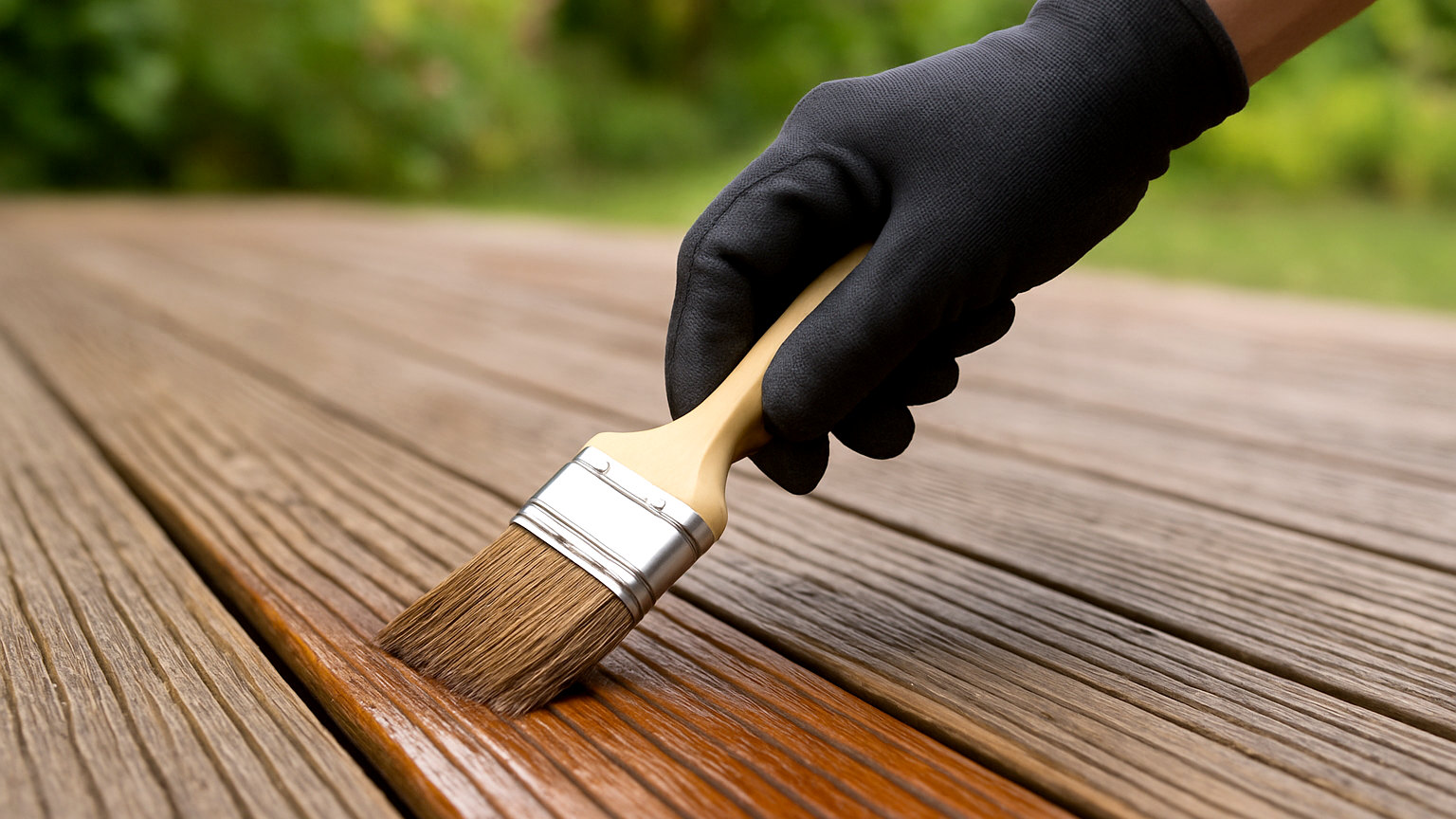
A brush or a pad gives the best penetration. Rollers are faster but need brushing out into the gaps.
Apply thinly. Excess oil that does not soak in stays tacky and collects dirt.
Two thin coats beat one heavy one, with the second applied once the first has soaked in.
Do the step treads and the edges, and get into the board ends where water gets in first.
Afterwards
Keep off it for the time stated, usually at least a day, and longer before replacing furniture.
Oily rags can self heat and catch fire. Spread them out to dry outdoors or soak them in water before disposal rather than leaving them in a bin.
Recoat every one to three years, judged by whether water still beads on the surface.


