
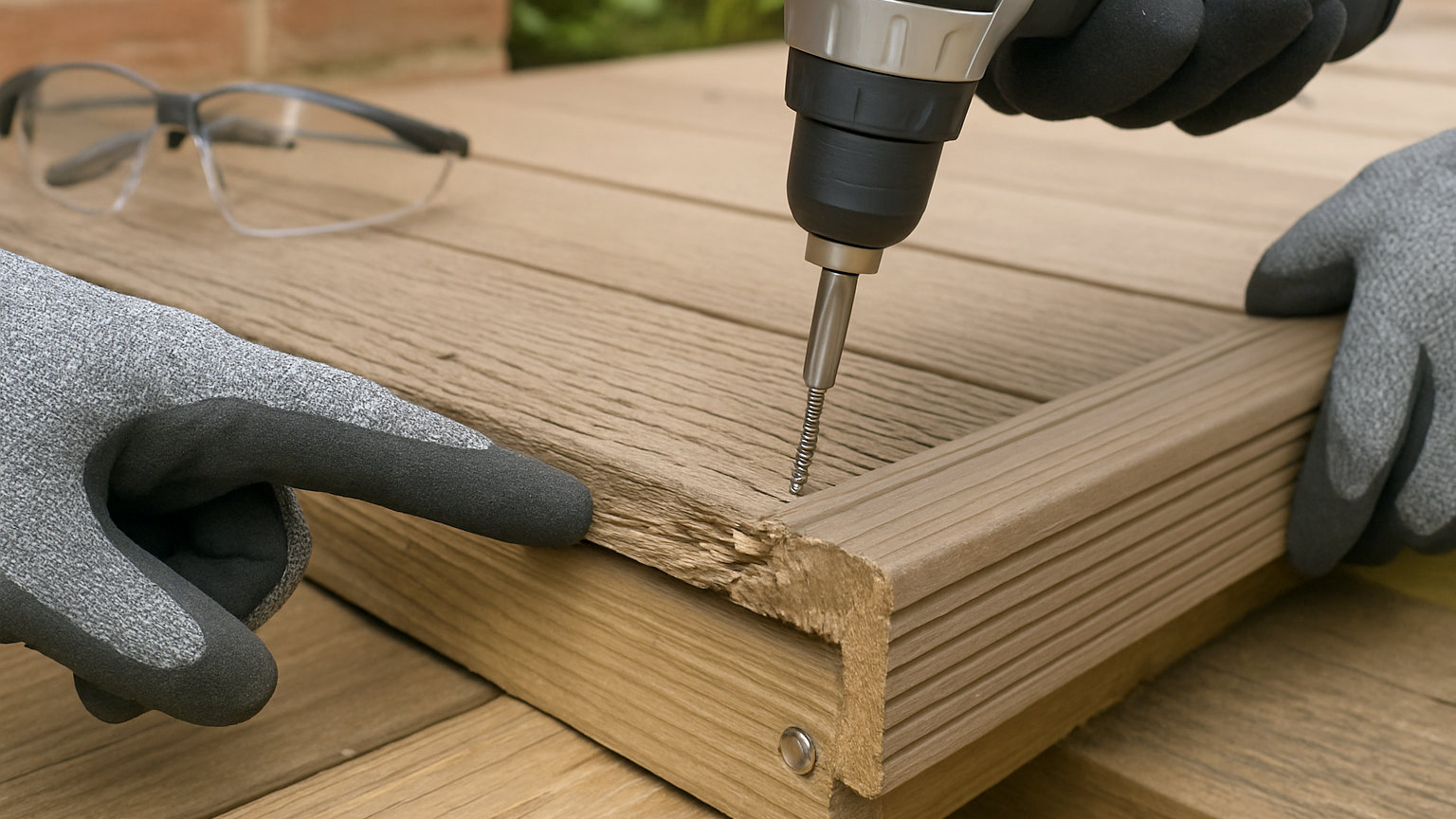
The decision is usually framed as natural versus low maintenance, which is broadly right but misses the practical differences that matter once the deck is built.
Softwood decking
Pressure treated pine or spruce, the cheapest and most widely available option.
It is easy to cut, fix, shape and repair with ordinary tools, and boards can be replaced individually at any time.
It needs regular attention. Cleaning annually and recoating every one to three years is realistic, and a neglected softwood deck greys, splits and grows algae quickly.
Expect ten to fifteen years from a well built and maintained softwood deck, and rather less from one that is ignored.
Hardwood decking
Dense tropical and temperate hardwoods, considerably more expensive and considerably more durable.
Naturally resistant to rot and insects without treatment, and structurally stable with minimal movement.
Hard on tools. Every fixing needs a pilot hole, and blunt blades are the normal result of a hardwood deck.
Left untreated it silvers to a grey that many people prefer. Oiled, it keeps its colour but needs doing annually.
Check the sourcing. Look for credible certification, since the supply chain for tropical hardwood is not uniformly reputable.
Composite decking
Wood fibre bound in recycled plastic, either solid or hollow, and either uncapped or capped with a bonded polymer shell.
No painting, staining or oiling, and no rot. Cleaning is the whole maintenance schedule.
Costs two to three times softwood for the boards, though the frame beneath costs the same either way.
Expect twenty to thirty years, and most carry long guarantees.
What the composite specification actually means
Capped composite has a bonded outer shell that resists staining, fading and mould. Uncapped composite does not, and it is the cheap stuff that disappoints.
Uncapped boards absorb some water, stain from food and leaves, and fade noticeably in the first two seasons.
Hollow boards are lighter and cheaper; solid boards feel and sound better underfoot and are less prone to damage at the ends.
Wood fibre content varies, and higher plastic content generally means better moisture resistance and more thermal movement.
Heat in the sun
This is the composite drawback people are least prepared for.
Dark composite boards in direct summer sun get genuinely hot underfoot, hotter than timber, and uncomfortably so for bare feet and for dogs.
Lighter colours are noticeably cooler. On a south facing deck used by children, this is worth weighing seriously.
Slip resistance
Both materials become slippery when algae grows, which is a cleanliness issue rather than a material one.
Grooved timber is not meaningfully less slippery than smooth timber, despite the marketing. Groove direction matters more for drainage than for grip.
Composite boards with an embossed or brushed surface generally grip better than smooth ones when wet.
Anti-slip inserts and strips can be added to either.
Movement and fixing
Composite expands and contracts along its length with temperature considerably more than timber does.
Expansion gaps at board ends are critical and specified by the manufacturer, and ignoring them causes buckling in the first hot spell.
Composite also usually needs closer joist spacing than timber, commonly 300mm rather than 400mm, which adds to the frame cost and is easy to overlook when budgeting.
Most systems use hidden clips, giving a clean surface with no visible screws.
Repair and change
Timber boards are replaced easily with anything from the same merchant.
Composite systems are proprietary. A discontinued range means a damaged board cannot be matched, so buying a few spares at the outset is sensible.
Timber can be sanded and recoloured. Composite cannot be refinished at all.
Choosing
Choose softwood where budget matters most and you will do the maintenance.
Choose hardwood where appearance matters and you want longevity from a natural material.
Choose capped composite where you want to build it once and clean it occasionally, and where the higher upfront cost is acceptable.
Whatever goes on top, the frame underneath decides how long the deck lasts.


