
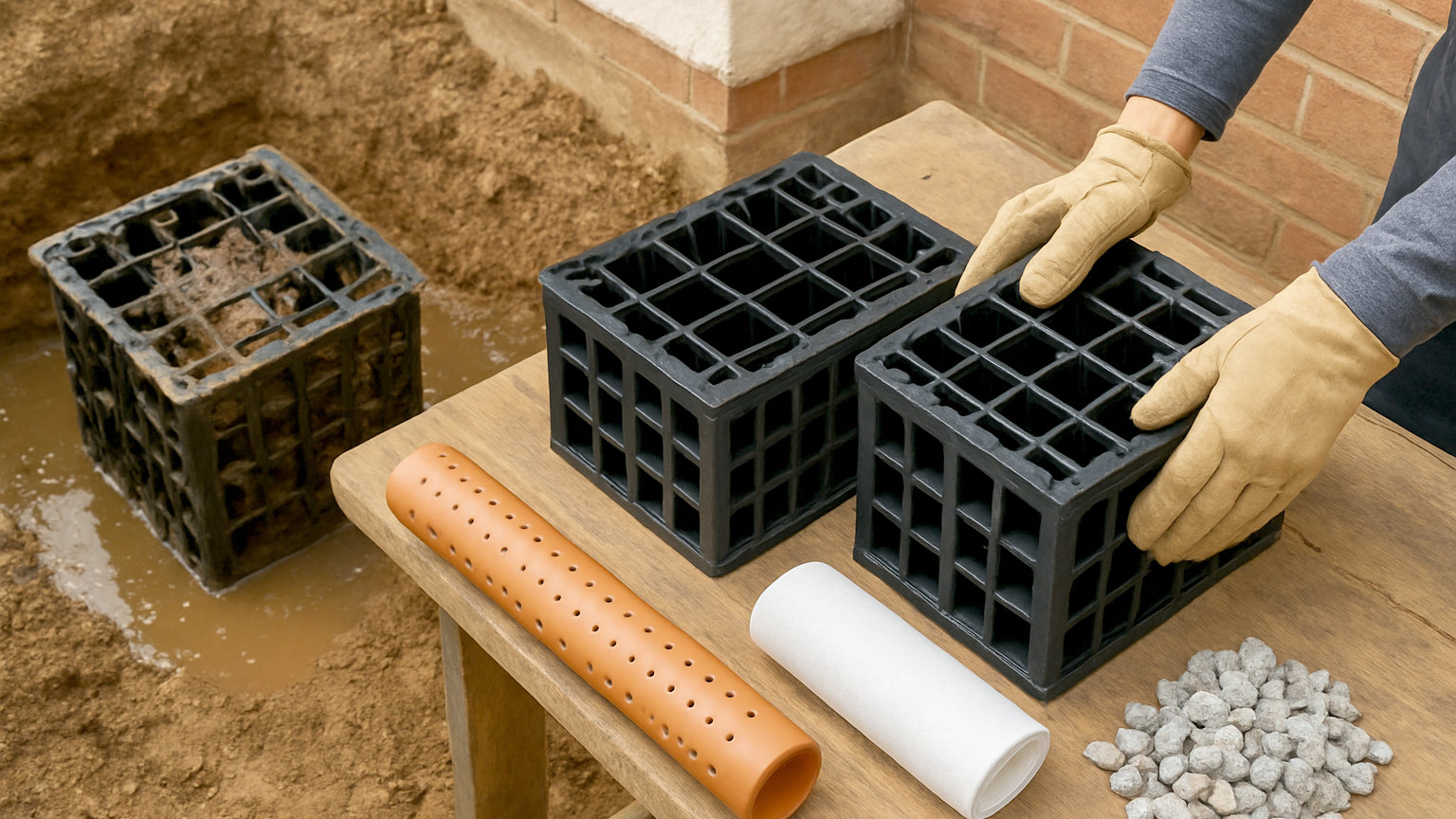
A soakaway lets rainwater infiltrate into the ground rather than running to a sewer. It is the preferred method for new surface water drainage, and it works only where the ground will take the water.
Test the ground first
This comes before anything else.
A soakaway in heavy clay is a hole that fills up and stays full, which is worse than useless.
A percolation test measures how fast water drains away and is the basis of the design. Without it you are guessing.
Also check the water table by digging a trial hole and leaving it. If water stands in the hole, the ground is saturated and a soakaway will not function.
Where it can go
Siting rules exist to protect buildings and are not optional.
At least five metres from any building, including your own house, the neighbours' and any outbuilding with foundations.
Well clear of boundaries, so water does not infiltrate onto adjoining land.
Clear of trees and their root systems.
Not over or near a public sewer, a septic tank drainage field or a private water supply.
Downhill of the building where possible, and never uphill of a basement or a cellar.
On sloping ground, further away rather than closer.
Sizing it
The soakaway has to store the water arriving in a storm until the ground can absorb it.
The calculation uses the area draining into it, a design rainfall event and the infiltration rate from the percolation test.
As a rough guide only, a domestic roof soakaway is frequently in the region of a cubic metre of storage for a modest roof area, and considerably more on slow draining ground.
Undersizing is the usual mistake, and the symptom is a soakaway that surcharges and floods the garden in autumn.
Where it serves an extension or new paving, building control will want the calculation.
Crates or rubble
Modular plastic crates are the modern approach. They give around ninety five per cent void space, so a much smaller excavation stores the same volume.
They are quick to install, consistent, and easy to size by counting units.
A rubble filled pit using clean angular stone gives perhaps thirty per cent void space, so it needs roughly three times the excavation for the same storage.
Rubble is cheaper per cubic metre and far more digging.
Never use builders' rubble, broken concrete with fines, or anything containing soil, which clogs immediately.
The geotextile wrap
This is the detail that decides whether the soakaway lasts.
Wrap the whole storage volume in a permeable geotextile membrane, overlapping generously at the joins.
It lets water through and keeps silt and fine soil out. Without it, the voids fill with silt within a few years and the soakaway stops working.
Do not use plastic sheet, which stops the water escaping entirely.
Building it
Excavate to the required size, keeping the sides as vertical as the ground allows.
Do not smear or compact the base and sides, which seals the infiltration surface. Loosen the base if it has been smeared by a machine bucket.
Line the excavation with geotextile, leaving generous overlaps at the top.
Place the crates or stone.
Bring the inlet pipe in at the top of the storage, laid to a fall, with a silt trap or a catchpit upstream.
Fold the geotextile over the top, backfill with granular material then topsoil.
Fit an inspection or access point where the design allows, so it can be checked.
Keeping silt out
Silt is what kills soakaways.
Fit leaf guards on gutters and a gully with a silt trap on the inlet run.
Clean the trap annually, which takes minutes and saves the whole system.
Never connect a drive or a path directly without a trap, since paving washes grit down the pipe.
When a soakaway is not the answer
Heavy clay, a high water table, a steep slope, or too little space to keep five metres from buildings.
The alternatives are a lined attenuation tank releasing slowly to a drain, a discharge to a watercourse with the necessary consent, or a connection to a surface water sewer where the undertaker permits it.


