
Drain runs are invisible, shallower than people expect, and expensive to break. Finding out where they are is the first job on any project involving a spade.
Start with what is visible
Walk the property and mark every inspection chamber cover, gully, downpipe, air brick and vent pipe on a sketch.
Covers are frequently buried under turf, gravel or a patio. Probe suspect areas with a thin steel rod pushed into the ground, listening for the ring of a metal cover.
Look for a rectangular depression or a patch of grass that dries out first in summer, both of which indicate something hard beneath.
Note the soil vent pipe, since the foul drain runs from the base of it.
Reading a chamber
Lift a cover carefully, levering with a proper key or two screwdrivers, and take a photograph before doing anything else.
Look at the channel in the base. The main flow runs straight through, with branches entering at the sides.
The direction the branches point tells you which way the flow goes, and the number of branches tells you how many runs converge there.
Note the depth to the channel, which tells you roughly how deep the pipes are.
Replace the cover immediately after looking, and never leave an open chamber unattended.
Getting hold of plans
The sewerage company holds records of public sewers and will supply a plan, usually for a fee or free online.
The local authority building control department holds approved drawings for anything built or extended under the regulations, which for a recent house shows the full private layout.
A drainage and water search from the conveyancing file, if you still have it, includes a sewer plan.
Plans show public sewers accurately and private drains poorly or not at all, so treat them as a starting point.
The water test
The simplest practical method.
Lift the covers on all chambers, then run water into one downpipe, gully or fitting at a time.
Watch which chamber it appears in and how quickly.
Work through every fitting in turn and build up the map.
A dye tablet makes it far easier to distinguish, and a different colour for each run avoids confusion.
Drain rods
Rods pushed along a run from a chamber tell you the direction and the approximate distance to the next feature.
Count the rods as they go in, since each is a known length, and mark the surface above where you think the rod end has reached.
Always turn rods clockwise as you push and pull, or the sections unscrew and you lose them in the drain.
Rods find bends and junctions by feel as much as anything.
Cameras and locators
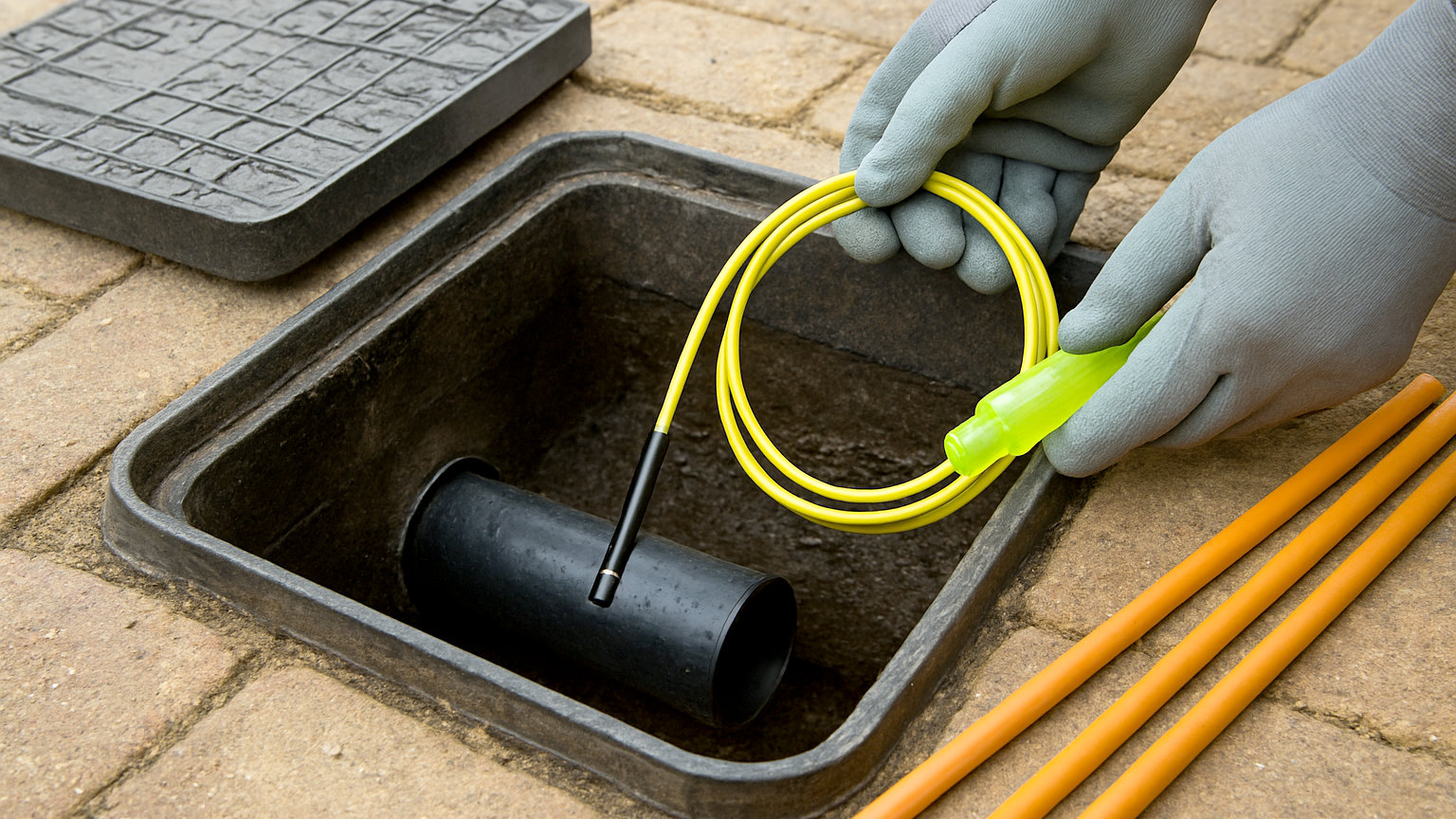
A drain camera on a flexible rod is inexpensive to hire and shows the condition as well as the route.
A camera with a sonde, paired with a locator wand above ground, traces the exact position and depth of a run, which is what you want before excavating.
A full CCTV survey by a contractor is worth the cost before any substantial project, and is frequently recommended before buying an older property.
Cable and pipe detectors find metal services rather than clay or plastic drains, so they do not locate drainage directly.
Recording it
Mark runs on the ground with spray paint or pegs before work starts.
Draw a plan with measurements taken from two fixed points, such as building corners, so the runs can be found again.
Note depths at each chamber.
Keep the plan with the house paperwork. Every future project will use it, and so will the next owner.
Digging near a drain
Hand dig within a metre of any known run rather than using a machine.
Assume drains are shallower than expected, since older runs frequently have very little cover.
Breaking a drain is expensive, unpleasant and sometimes reportable, and repairing one properly means a compatible pipe and correct bedding.
Never build over a chamber or a public sewer without agreement from the water company.


