
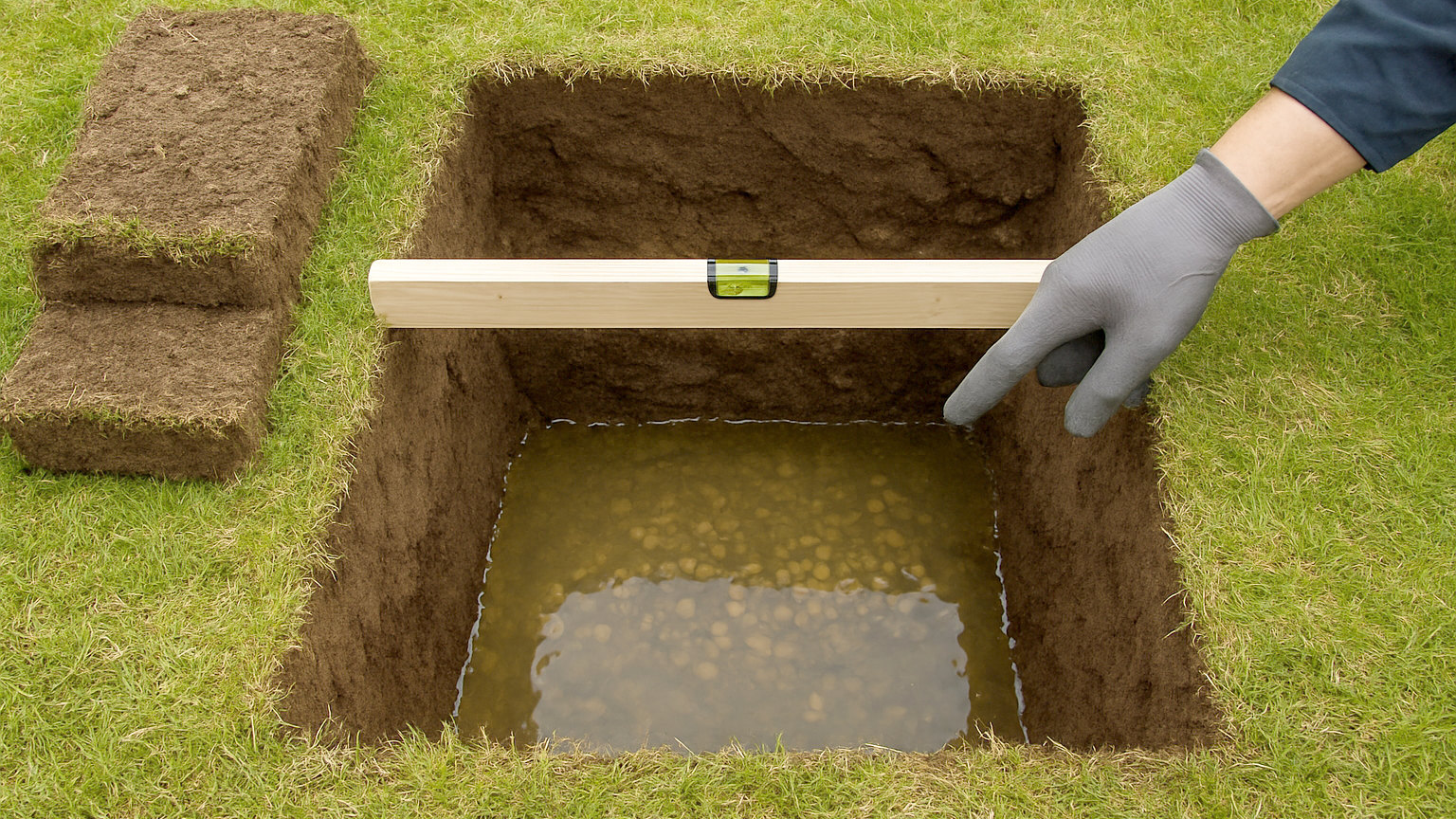
A percolation test measures how quickly the ground accepts water. It is the difference between a soakaway that works and an expensive hole that fills up every autumn.
Why it is worth doing
Soil varies enormously over short distances. A garden can be free draining sand at one end and clay at the other.
The test gives a number that sizes the soakaway properly, rather than guessing and building something too small.
Building control will ask for it where a soakaway serves new work, and the test method is set out in the drainage approved document.
It also tells you when not to build one at all, which saves the cost of finding out the hard way.
Where to test
Test in the position the soakaway will occupy, not somewhere convenient.
Keep to the siting rules: at least five metres from buildings, clear of boundaries, trees, sewers and drainage fields.
Check for buried services before digging.
Dig more than one pit if the garden is large or the soil looks variable.
Digging the trial pit
Dig a pit roughly 300mm square in plan and down to the depth the soakaway base will sit, commonly between one and two metres.
Keep the sides vertical.
Do not smear the sides with a spade or a machine bucket, since a smeared face seals the soil and gives a falsely poor result. Scrape the faces lightly with a fork to open them up.
Note whether groundwater seeps in and at what level, which is important on its own.
Leave the pit open and covered securely overnight, since an open hole is a serious hazard.
Presoaking
Fill the pit with water to at least 300mm above the base and let it drain away completely.
This wets up the soil so the test measures steady conditions rather than the first rush into dry ground.
Do this the day before the test proper.
If the water is still standing the following morning, the test is already answered. The ground will not take a soakaway.
Running the test
Fill the pit again to 300mm above the base.
Record the time taken for the water to fall from 75 per cent to 25 per cent of the effective depth, which for a 300mm depth is the fall from 225mm to 75mm.
Use a rule fixed across the pit with a mark at each level, and a watch.
Repeat the whole test three times and take the average.
Do not test in frost, during heavy rain, or when the ground is already saturated, since the result will not represent normal conditions.
Working out the infiltration rate
Divide the average time in seconds by the depth of fall in millimetres, which for a 300mm test is 150mm.
That gives the soil infiltration rate in seconds per millimetre.
A lower number means faster drainage.
Sandy and gravelly soils typically give fast rates. Clay gives very slow rates or none at all.
The figure feeds into the soakaway sizing calculation along with the area draining into it.
Reading the result
Fast drainage means a modest soakaway will cope, and crates or a stone pit both work.
Moderate drainage means a larger soakaway, and crates become the practical choice because the excavation for rubble would be very large.
Very slow drainage, or water standing, means a soakaway is not viable. Consider an attenuation tank releasing slowly to a drain, a watercourse discharge with consent, or a connection to a surface water sewer.
Do not build a soakaway anyway and hope. It will surcharge, and the water will find the lowest point, which is frequently the house.
Recording it
Write down the pit location and depth, the dates, the three timings and the calculated rate.
Photograph the pit with a rule in shot.
Building control will want this, and it is worth keeping with the house records regardless.
Safety
An open trial pit is a genuine hazard, particularly to children and animals.
Board and weight the cover whenever you are not working.
Never enter a pit deeper than about a metre without support, since unsupported excavations collapse without warning and a collapse at chest height is fatal.
Work with someone else present rather than alone.


