
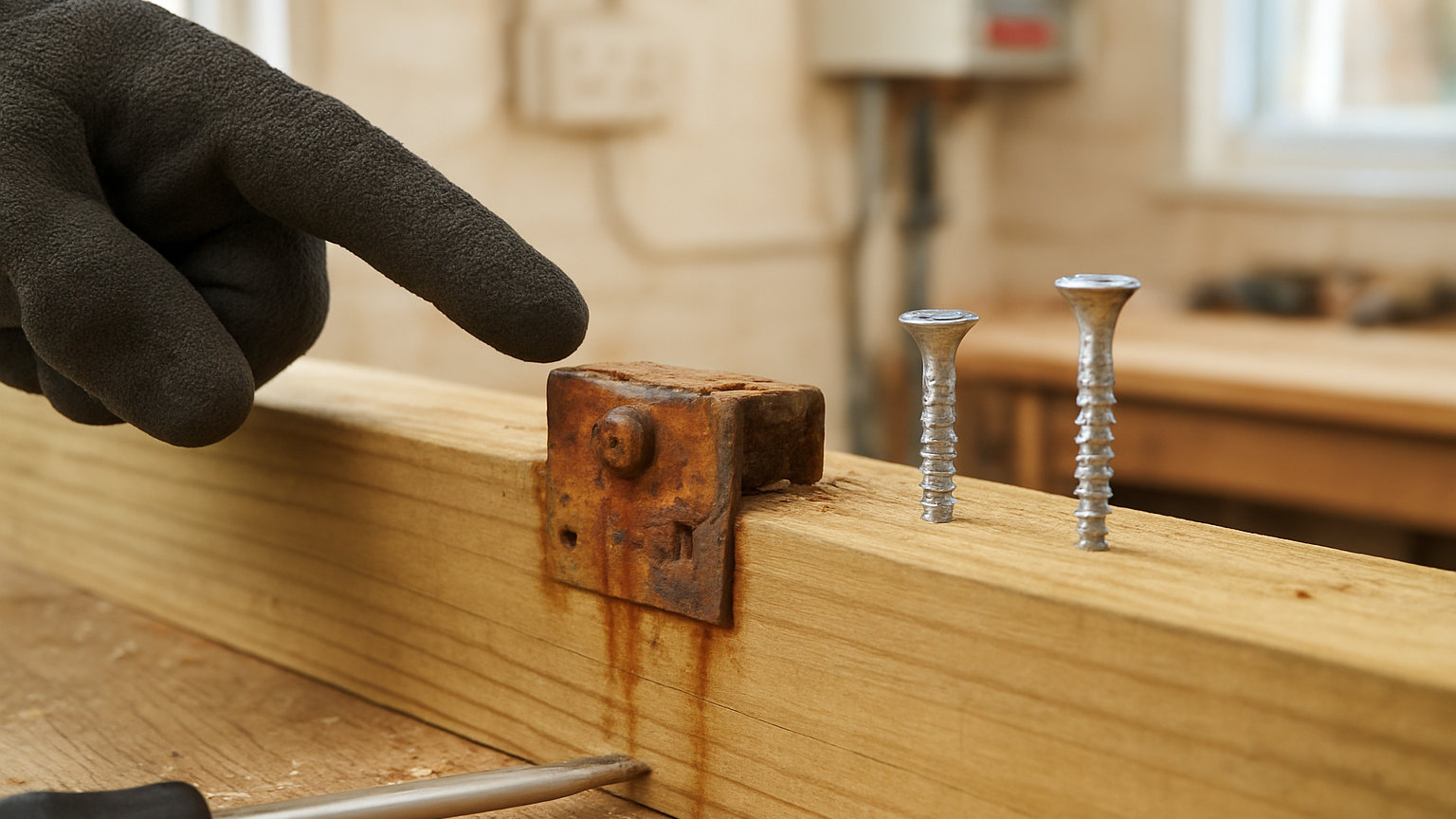
Using indoor fixings outdoors is one of the quietest ways to ruin a good fence, because the failure is invisible until the day a panel comes off in the wind with the screw heads still in the post.
Why ordinary screws fail outdoors
Modern timber preservatives are copper based, and copper in contact with plain or lightly plated steel accelerates corrosion considerably.
Add rain, and a yellow passivated screw designed for indoor joinery can be significantly corroded within two or three years.
Every fixing in a fence needs to be rated for external use in treated timber, and the packet will say so.
The coatings, in order of durability
Bright or zinc plated: indoor only. No place in a fence.
Electro galvanised: a thin zinc layer, adequate for short term outdoor use and not much more.
Hot dip galvanised: a thick zinc coating, the normal standard for fence ironmongery, nails and coach bolts. Good outdoor life.
Organic or ceramic coated exterior screws: proprietary multi layer coatings, designed for treated timber, and the usual choice for fence screws.
Stainless steel: the longest lasting. A304 is fine inland, A316 is the marine grade for coastal sites.
Never mix stainless fixings with galvanised brackets in a wet location, since the dissimilar metals corrode each other.
Nails or screws
Nails flex slightly and cope well with timber movement, which is why close board fencing is traditionally nailed.
Ring shank nails grip far better than smooth ones and are the right choice for feather edge boards.
Screws hold harder, resist withdrawal better, and can be undone, which matters when a board or panel needs replacing.
For panels and brackets, use screws. For feather edge boards, either works and nails are faster.
Panel clips and brackets
U shaped panel clips screw to the face of a timber post and hold the panel frame. Simple, cheap and easy to replace.
Arris rail brackets support a rail against a post without cutting a mortise, and repair brackets do the same job for a rail that has broken at the post.
Fence panel security clips lock a panel into concrete post slots so it cannot be lifted out.
Gravel board cleats give a proper fixing surface rather than screwing into end grain.
Post supports
Driven spikes avoid digging and suit firm, stone free ground and low fences only.
Bolt down bases fix a post to existing concrete or paving, and need a suitable expansion or resin anchor into sound concrete.
Repair spurs, concrete or metal, support a post that has rotted at the base.
All of these keep timber out of the ground, which is a genuine advantage where they are appropriate.
Bolts and washers
Coach bolts, with a domed head and a square collar that bites into the timber, are the standard for gate hinges and anything carrying real load.
Always use a washer under the nut, and under the head where the head bears on timber, or the fixing pulls into the wood as it shrinks.
Coach screws suit situations where you cannot get to the back of the timber.
Expect to retighten bolts after the first year as the timber dries and shrinks.
Gate ironmongery
Match the hinge to the gate weight and use three on anything tall or heavy.
Band and gudgeon or reversible strap hinges for heavy gates; tee hinges for light ones only.
Use bolts rather than screws wherever the timber allows, since screws in end grain and softwood pull out under a swinging load.
Galvanised or stainless throughout, and keep the same metal family for hinges, bolts and latches.
Practical points
Pilot drill hardwood and any fixing close to an end or edge, since splitting a board wastes it.
Buy more fixings than you think you need, as they are the cheapest part of the job and the most annoying thing to run out of.
Keep a magnet handy for collecting dropped nails and screws out of the grass.


