
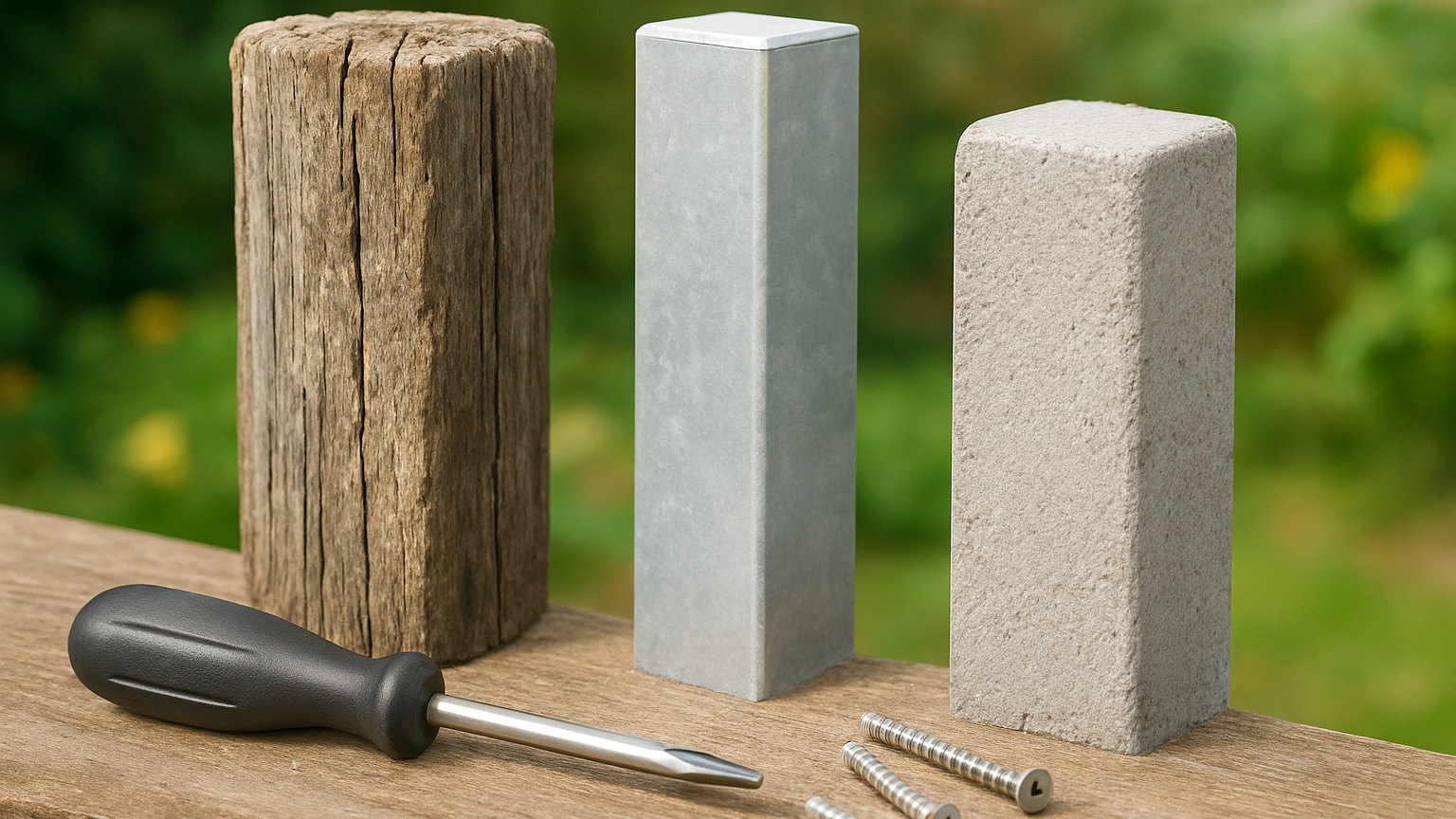
When a fence blows down, the panel is rarely the thing that failed. In almost every case a post rotted at ground level, or the concrete around it was never adequate, and the panel simply went with it.
Timber posts
The traditional choice, usually 75mm or 100mm square softwood, pressure treated.
They look right with timber panels, take fixings anywhere, and are easy to cut, trim and work on site.
The weakness is predictable. Timber posts rot at the point where they meet the ground, where moisture and oxygen are both present, and they usually snap there in a gale while the rest of the post is sound.
Specify a use class rated for ground contact, not the same grade as the panels. A 100mm post lasts noticeably longer than a 75mm one because there is more timber to lose before it fails.
Cut ends must be treated with end grain preservative, since cutting exposes untreated wood and the guarantee usually depends on it.
Concrete posts
Reinforced concrete, slotted so panels drop straight in, usually used with a concrete gravel board.
They do not rot, and a concrete post fence outlasts every timber component several times over. Panels can be lifted out and replaced without touching the posts, which makes long term maintenance much cheaper.
They are heavy, awkward to handle and need a bigger hole and more concrete. Two people are realistically needed.
Aesthetically they divide opinion, and they are hard to hide.
The real drawback is brittleness. A concrete post that takes a knock from a vehicle or a falling tree tends to crack rather than bend, and replacing one in the middle of a run means dismantling the panels either side.
Metal post systems
Galvanised or powder coated steel and aluminium systems, either as full posts or as spikes and repair spurs.
Slim, strong and rot proof, and they suit slatted and composite panels which are frequently designed around them.
Cost is higher, and the systems are usually proprietary, so panels and posts have to come from the same range. Cutting or drilling galvanised steel breaks the coating and the exposed metal needs treating.
Driven metal spikes are a separate case. They are quick and avoid digging, and they work acceptably in firm, stone free ground for a low fence. In soft, wet or stony soil, or on anything approaching 1.8 metres, they loosen within a few seasons.
Concrete spurs
A short concrete post bolted to the lower part of an existing timber post, set in concrete alongside it.
This is a repair rather than a system, and it is the cheapest way to save a fence where the post has rotted at the base but is otherwise sound.
It is unattractive and it works, sometimes for another decade.
Cost over time rather than on the day
Timber posts are cheapest to buy and most likely to need replacing within ten to fifteen years.
Concrete posts cost perhaps twice as much installed and frequently outlast three sets of panels.
Metal systems cost most and need the least attention.
On a long boundary the arithmetic usually favours concrete posts with timber panels, which is why so many trade installations are built that way.
Post spacing and size
Spacing follows the panel, normally 1.83 metres between post centres.
Post length should allow roughly a quarter to a third of the total in the ground. A 1.8 metre fence therefore needs a post around 2.4 metres long, not 2.1.
Skimping here is the reason most fences fail early, and the extra cost of longer posts is trivial against the cost of rebuilding.
Mixing systems
Timber panels in concrete posts is the most common combination and works well.
Composite panels generally need the manufacturer's own posts, and mixing brands rarely fits.
Where an existing run is part timber and part concrete, match the new posts to the neighbours either side so panel widths stay consistent, since concrete and timber posts take up different amounts of the run.
The practical conclusion
For a boundary that has to last and where appearance is secondary, concrete posts and gravel boards with timber panels is difficult to beat.
Where the fence is a feature, use timber or metal and accept either the maintenance or the cost.


