
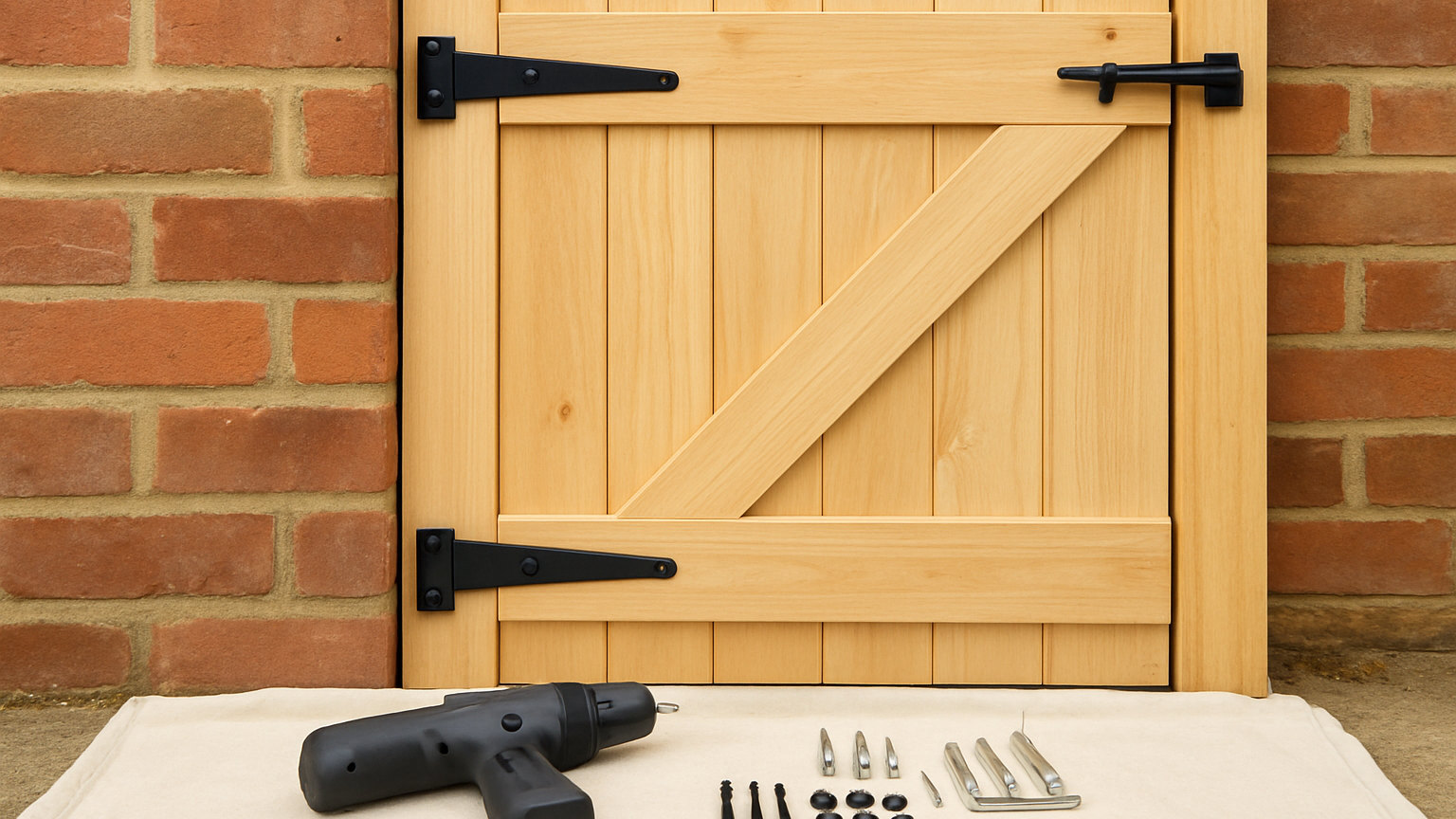
A gate that drops within a year has usually failed in one of two places: the hanging post has moved in the ground, or the gate itself has racked out of square because it was braced the wrong way round.
The hanging post does all the work
A gate hangs off one post as a permanent cantilever, and that post takes far more load than anything else in a fence run.
Use a larger section than the fence posts, 100mm minimum for a pedestrian gate and 150mm for anything wide, heavy or double.
Set it deeper, with at least a third of its length in the ground and more for a tall gate. A metre in the ground is not excessive.
Use a bigger hole and more concrete than elsewhere, and let it cure fully before hanging anything.
The closing post carries only the latch and can be lighter, though matching the pair looks better.
Which way the brace goes
This is the detail that decides whether a gate stays square, and it is got wrong constantly.
A braced gate has a diagonal timber across the frame. The brace must run upwards from the hinge side to the latch side, so it works in compression, pushing the latch corner up.
Fitted the other way round it works in tension, relying on the joints and fixings alone, and the gate sags within a season.
The simple test is that the low end of the diagonal should be at the bottom hinge.
Clearances
Leave a gap at the hinge side of around 6mm to 10mm so the gate can swing without binding as timber swells in winter.
Leave a similar gap at the latch side, checked with the gate held in position rather than measured off the drawing.
Leave clearance at the bottom, at least 50mm, more where the ground rises towards the opening or where leaves and snow gather. A gate that scrapes wears its own bottom rail away.
Check the swing over the ground for the full arc before fixing hinges, since ground is rarely level.
Hinges
Match the hinge to the weight, and err heavier. Undersized hinges are the second commonest cause of a dropped gate.
Band and gudgeon hinges, where a long strap fits over a pin driven or bolted into the post, suit heavy timber gates and take a lot of abuse.
Reversible or double strap hinges bolt right through the gate and the post, spreading the load, and are the strongest common option.
Tee hinges are adequate for light gates only, and the screws should be replaced with coach bolts wherever the timber allows.
Fit three hinges on a tall or heavy gate rather than two.
Use galvanised or stainless ironmongery throughout, and bolt rather than screw wherever possible.
Latches and catches
A simple thumb latch or a ring gate latch suits most garden gates.
An automatic gravity catch is useful where children or dogs are a consideration, since it latches on closing without anyone needing to remember.
Fit a drop bolt into a socket in the ground for a double gate, or for any gate that needs to be held open.
Consider a gate stop or a check strap to stop the gate swinging past its intended arc, which is what pulls hinges out of the post.
Hanging it
Prop the gate in the opening on blocks at the exact height and clearance you want, and check it is plumb and level before marking anything.
Mark hinge positions from the propped gate rather than measuring independently from the post.
Drill pilot holes for coach bolts, fit washers under nuts, and tighten progressively.
Test the swing fully before removing the props, since adjusting is far easier while it is still supported.
Stopping it dropping later
Fit a post cap and keep the hanging post treated, since a post that softens loses its grip on the hinge bolts.
Check bolt tightness every year. Timber shrinks and bolts loosen.
Where a gate has already dropped slightly, an adjustable anti-sag kit with a cable and turnbuckle across the frame will pull it back square, fitted on the same diagonal as a compression brace would run.
Never let anyone swing on a gate, which sounds obvious and accounts for a remarkable proportion of failures.


