
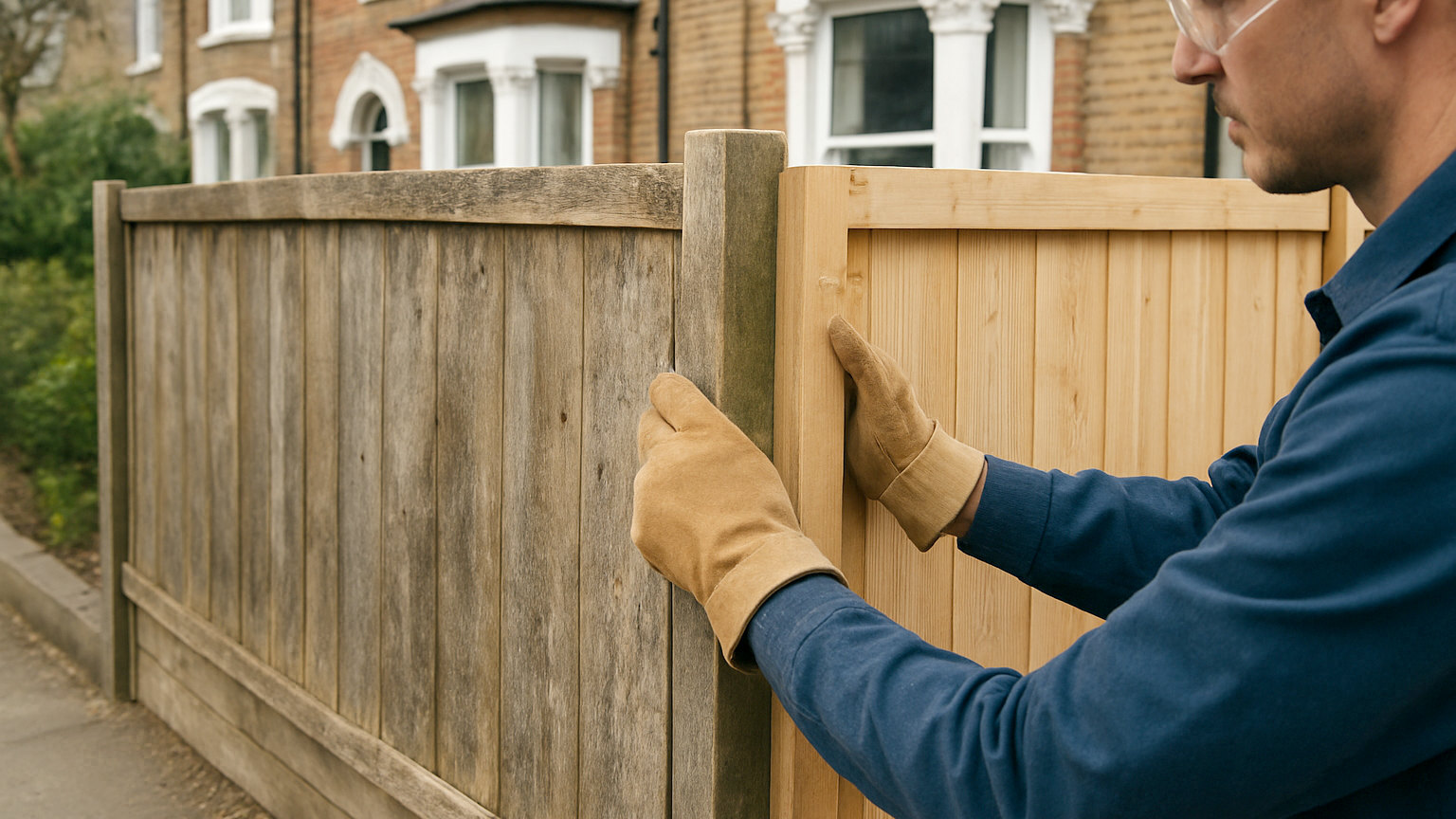
Fence height is one of the few parts of garden building that is genuinely governed by planning law, and the commonly quoted two metre figure carries an exception that catches people out on front boundaries.
The general limit
In England, you can normally put up a fence, wall or gate up to two metres high without applying for planning permission, provided it is not next to a highway.
Where the boundary adjoins a highway used by vehicles, or the footpath beside one, the limit drops to one metre.
A highway in this context includes the ordinary road outside a house and its pavement. It does not usually include a private drive shared between a few properties, though that is worth checking rather than assuming.
This is why so many front gardens have low walls and so many back gardens have tall fences. It is not taste, it is the permitted development limit.
How the height is measured
Height is measured from ground level on the higher side where the ground differs, which matters on a sloping plot.
The measurement includes anything fixed on top. Trellis counts. A 1.8 metre panel with 300mm of trellis above it is a 2.1 metre fence and needs permission, which is the single most common accidental breach.
Post caps and finials that project above the panel line are generally included as well.
A gravel board at the base counts towards the total, so a 1.8 metre panel on a 150mm gravel board is close to the limit before anything else is added.
Where the limits are different
Several situations remove or reduce permitted development rights, and they are common enough to be worth checking every time.
Listed buildings. Any fence or wall within the curtilage of a listed building may need listed building consent as well as planning permission, and the threshold is much lower.
Conservation areas. Height limits are the same, but article 4 directions frequently remove permitted development rights for boundary treatments on front boundaries specifically.
Article 4 directions can apply anywhere, not only in conservation areas.
New estates. Planning conditions on the original consent frequently control fencing, and these bite regardless of permitted development rights.
Covenants in the deeds. These are not planning law at all, but they are enforceable by whoever has the benefit of them, and open plan front garden covenants are widespread on post war estates.
Scotland, Wales and Northern Ireland have their own systems, and the detail differs.
Repairs and replacements
Maintaining or improving an existing fence that is already over the limit is generally permitted, provided you do not increase its height.
Replacing a fence like for like is not usually a problem. Replacing a collapsed 1.2 metre fence with a 1.8 metre one on a front boundary is a change, and the new height is what counts.
Other things that are not about height
Visibility splays. A fence at the end of a drive that blocks the view of the pavement can be a genuine hazard and may breach a planning condition even below one metre.
Boundaries with a public right of way other than a highway are treated differently and the two metre limit usually applies.
Barbed wire and spikes facing a public place can attract action from the local authority where they present a danger, regardless of the height of the fence carrying them.
How to check properly
Look at the planning conditions attached to the original permission for the estate, which are on the local authority planning portal and searchable by address.
Check whether the property is in a conservation area or subject to an article 4 direction. Local authorities publish maps of both.
Read the covenants in the title register, which is a separate exercise from planning entirely.
Where there is any doubt, the local planning authority will confirm the position, and many offer a pre-application or duty planner service. A short email with an address and a description is usually enough.
If you build it too high
The authority can serve an enforcement notice requiring the fence to be reduced or removed, and the cost falls on the owner.
Enforcement is discretionary and frequently complaint driven, which means a fence stands for years until a neighbour objects.
Applying retrospectively is possible but there is no guarantee of approval, and the fee and the risk both sit with you. Checking first takes ten minutes.


