
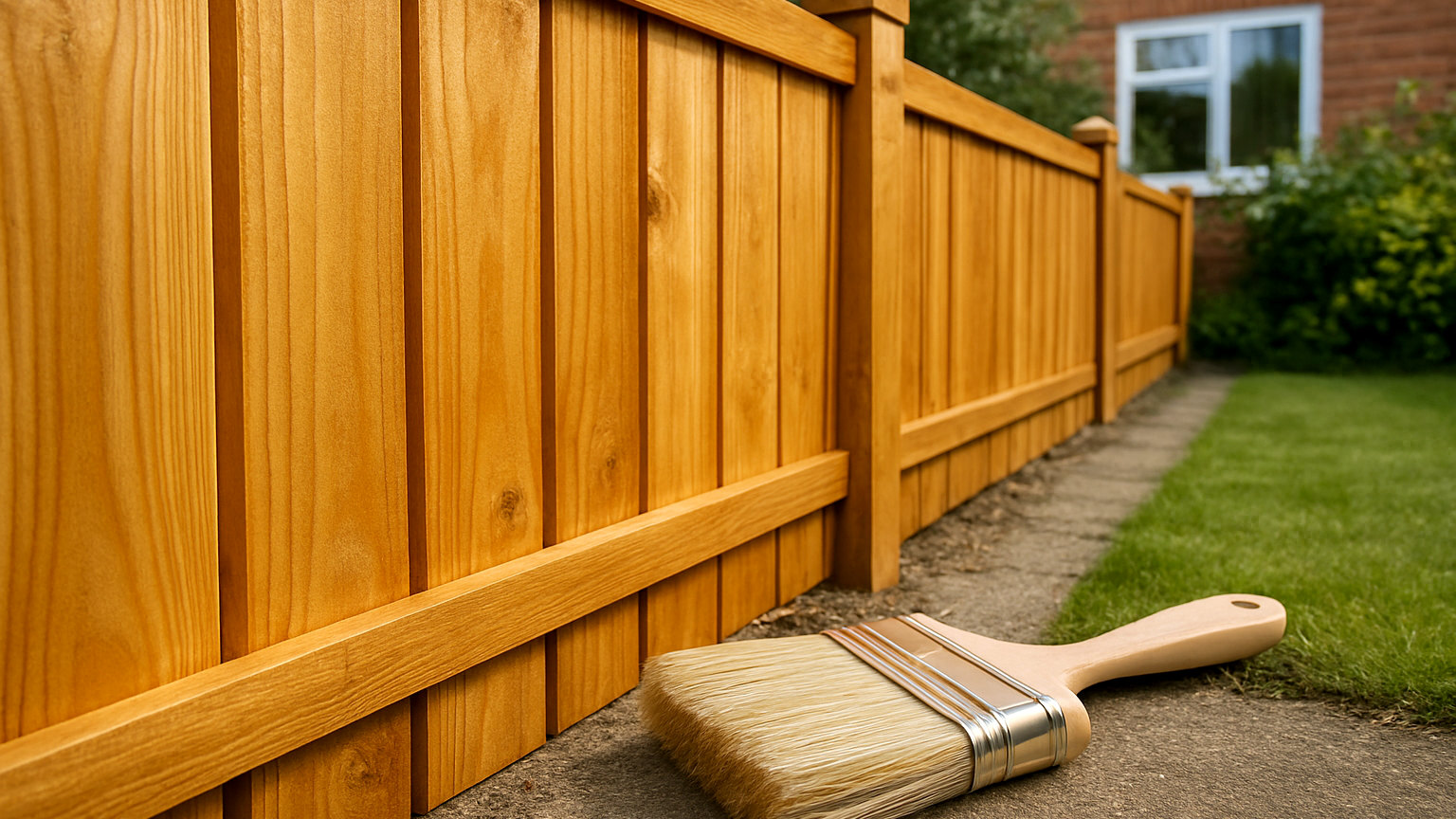
Fence treatment is one of those jobs where doing it at the wrong moment wastes both the product and the day, and the timing depends on what the timber has already had done to it.
New pressure treated timber
Pressure treated timber arrives wet with preservative and frequently green or orange.
Leave it to weather before applying anything. Most manufacturers suggest waiting several months, sometimes a full season, until the surface has dried and greyed slightly.
Coating too early traps moisture and the finish will not key properly, so it peels within a year.
The exception is cut ends, which should be treated with end grain preservative immediately, because cutting exposes untreated timber that the pressure process never reached.
New dip treated timber
Dip treated timber has only a surface coating and much less protection.
It should be coated within the first year, and many suppliers recommend the first season.
If a panel arrives bright orange and light in weight, assume dip treated and plan to treat it early.
How often afterwards
As a working rule, every two to three years for a stain or preservative, and annually for anything on the sunny or weather facing side.
Rather than counting years, look at the timber. Water that soaks straight in rather than beading is the clearest sign that the finish has gone.
Grey, fibrous surfaces and visible splitting mean it is overdue.
Choosing a product
Preservative protects against rot and insect attack and penetrates the timber. It is the functional choice, and some are colourless.
Fence stain or treatment combines colour with water repellency and some preservative action. This is what most people use, and it soaks in rather than forming a film.
Fence paint forms an opaque film on the surface. It covers well and hides weathering, but films crack and peel, and once painted a fence is committed to being repainted.
Spirit based products penetrate better; water based ones are easier to use and clean up.
Check compatibility before changing products. Stain will not take over an old paint film without stripping.
Preparation
Brush the fence down with a stiff brush to remove dirt, cobwebs, loose fibres and flaking coating.
Treat green algae and mould with a fungicidal wash and let it work before coating, since colouring over algae simply seals it in.
Cut back plants and tie back climbers, and clear soil and mulch away from the bottom 300mm, which is the part that most needs attention and least often gets it.
Repair or replace anything broken first.
Pressure washing is popular and should be used carefully, since a strong jet raises the grain and drives water deep into softwood. Use a wide fan, keep your distance, and allow several dry days afterwards.
The weather you need
Dry timber, dry weather and no rain forecast for at least a day afterwards.
Above the minimum temperature on the tin, usually around eight to ten degrees, and not in direct hot sun, which dries the coating before it penetrates.
Not on a windy day if spraying, for obvious reasons.
Late spring and early autumn are usually the best windows.
Applying it
A sprayer is fastest on a long run, a brush gives the best penetration, and a combination works well: spray then brush out.
Pay particular attention to end grain, the tops of posts, the bottom 300mm and the back faces of rails, which are where water gets in.
Work panel by panel to a natural break so there are no visible joins.
Two thinner coats penetrate better than one heavy one, with the second applied once the first has soaked in.
Protecting what is nearby
Sheet the ground, and cover plants and paving, since fence stain marks patios permanently.
Check the product is safe near ponds and for pets, and keep animals away until it is fully dry.
Wear gloves and eye protection, and work with the wind behind you when spraying.


