
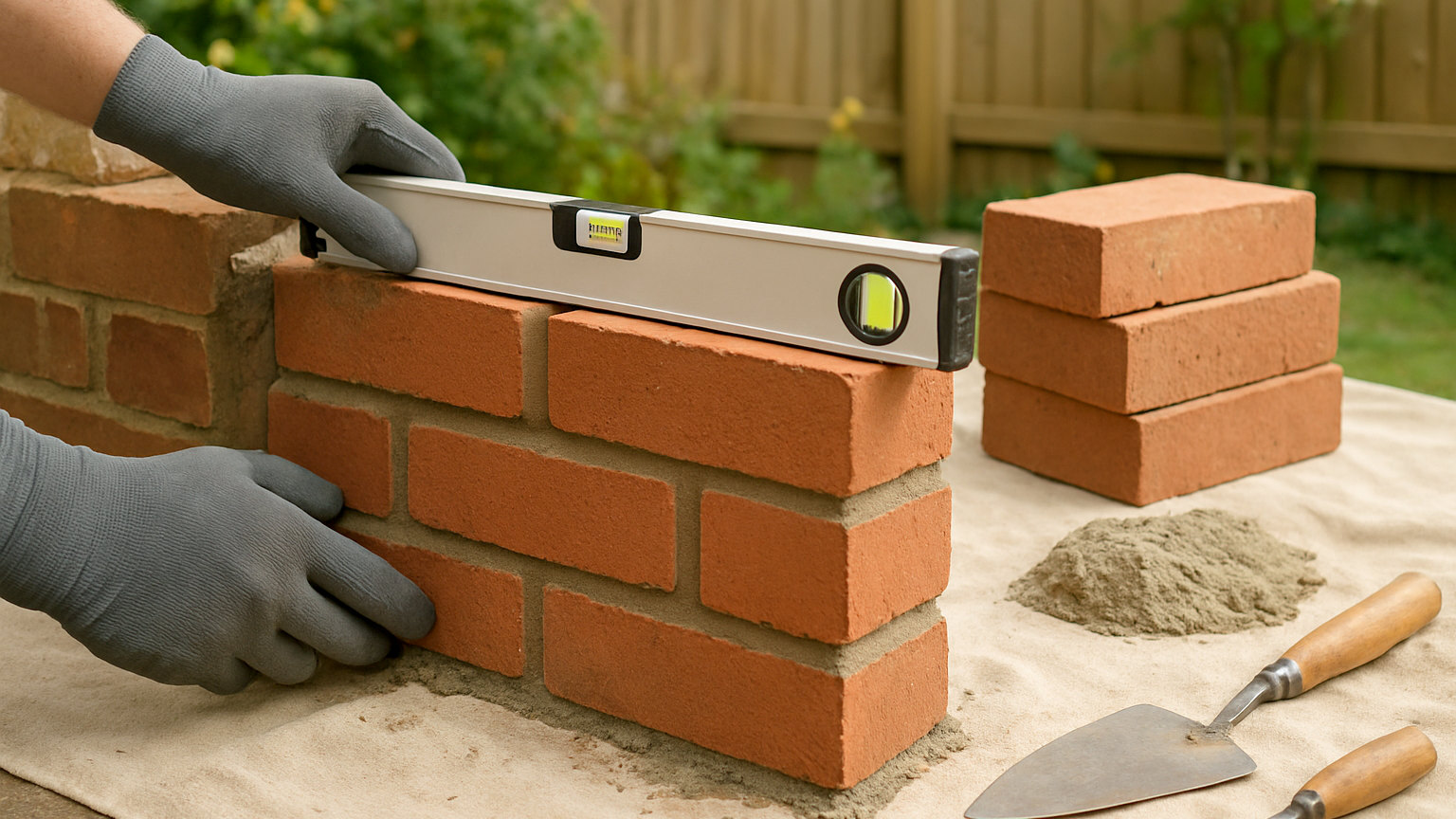
A bond is the pattern in which bricks overlap, and the pattern exists for a structural reason. Bricks that line up vertically create a continuous joint, which is a line of weakness running through the wall.
The principle
Every course overlaps the one below so that loads are distributed sideways as well as down.
Vertical joints should never line up in consecutive courses. Where they do, the wall behaves as separate columns rather than a single structure.
The overlap is usually a quarter or a half brick, achieved by starting alternate courses with a cut brick.
The vocabulary
A stretcher is a brick laid with its long face showing.
A header is a brick laid with its end showing.
A queen closer is a brick cut lengthways to a half width, used at the end of a course to set the overlap.
A perpend is the vertical joint, and keeping perpends lined up vertically every other course is what makes brickwork look right.
Stretcher bond
All stretchers, each course offset by half a brick.
This is a half brick wall, 102mm thick, and it is the bond used for the outer leaf of a cavity wall and for most modern single skin work.
Simple, quick and economical, with very few cuts.
For a garden wall it is only suitable at low heights or with piers, because a 102mm wall has very little resistance to being pushed over sideways.
English bond
Alternating courses of headers and stretchers.
This produces a one brick wall, 215mm thick, and it is the strongest of the traditional bonds.
The headers tie the two skins together on every other course, so the wall acts as a solid unit.
Used historically for engineering work, retaining walls and anywhere strength mattered more than appearance.
A queen closer next to the corner brick sets the overlap on the header courses.
Flemish bond
Headers and stretchers alternating within each course, with each header centred over the stretcher below.
Also a one brick wall, slightly weaker than English bond and generally considered better looking.
This is the traditional bond for domestic brickwork and for garden walls of any quality.
It needs more cutting and more care to keep the pattern consistent, and mistakes are very visible.
Garden wall bonds
These are economical variations that reduce the number of headers while keeping a one brick wall.
English garden wall bond uses three or five courses of stretchers between each header course.
Flemish garden wall bond uses three stretchers between each header within the course.
Both are quicker and cheaper than the full bonds and slightly weaker, and both were developed precisely for free standing garden walls.
They also hide small variations in brick length better than full Flemish bond does.
Header bond
All headers, producing a half brick wall with a distinctive small scale pattern.
Used on curved walls, because short units follow a radius far better than long ones.
Expensive in bricks for the wall area covered.
Stack bond
Bricks stacked directly above one another with no overlap at all.
It is a purely decorative arrangement with no structural bond, and it needs bed joint reinforcement or a supporting structure behind it.
Not suitable for a free standing garden wall built conventionally.
Choosing for a garden wall
For a low wall up to around half a metre, stretcher bond in a half brick wall is usually adequate.
For anything taller, go to a one brick wall in Flemish or English garden wall bond, or use a half brick wall with piers at intervals.
Match an existing wall where you are extending or repairing, since a change of bond is immediately obvious.
Setting out the bond
Lay the first course dry to check the bond works over the wall length.
Work out where cuts fall and keep them away from the most visible positions.
Mark the perpend positions on the foundation so each course can be checked against them.
Keep a gauge rod at each end and check the perpends with a level held vertically every few courses, since drift is gradual and hard to see close up.


