
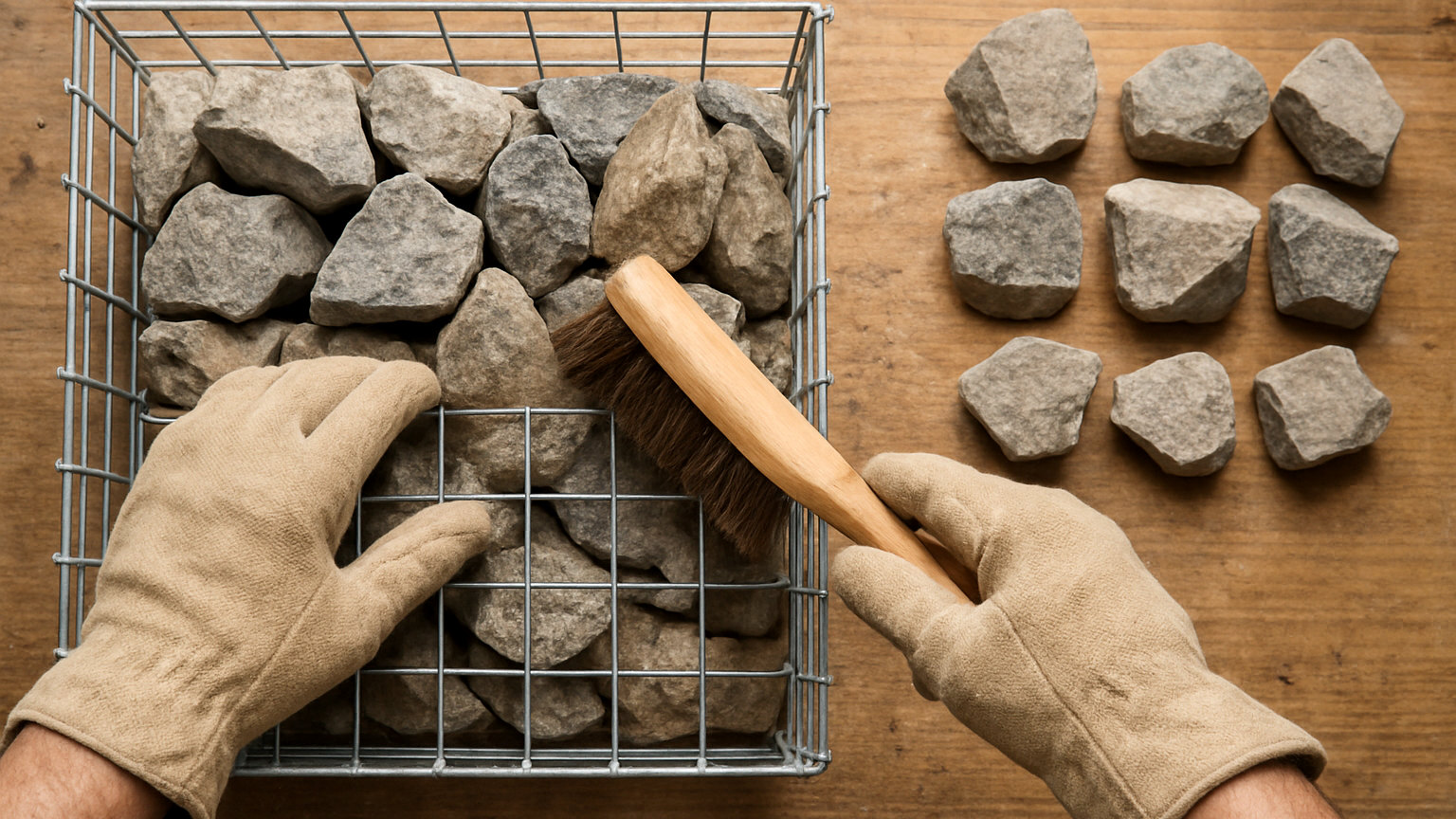
Both of these build a wall from loose stone with no mortar, and both work by mass and friction rather than adhesion. That makes them free draining, tolerant of movement, and quite unlike brickwork.
How dry stone walling works
A traditional dry stone wall is two faces of stone with a core of smaller stone between them, built so every stone is held by the weight of those above and around it.
It has no mortar, so it drains completely and moves slightly without cracking.
It is wider at the base than the top, a taper known as batter, which is what gives it stability.
Done properly it lasts for centuries, and a great many field walls prove it.
The rules of dry stone
These are not stylistic preferences and a wall that ignores them falls down.
Lay every stone with its length into the wall, not along the face. A stone laid lengthways along the face is a facing panel that will fall off.
Cross every joint. One stone over two, never one over one, exactly as in brickwork.
Keep the courses level and work in horizontal beds rather than building one end up.
Fill the core properly with small packed stone, not soil, and pack it tight as you go.
Use through stones that span the full width of the wall, at intervals, usually at around mid height. These tie the two faces together and their absence is the commonest cause of a bulging wall.
Finish with a coping of stones set on edge across the top, which locks everything below.
Building one
Dig a shallow trench to firm ground, around 150mm to 200mm deep, and set the largest stones as foundation stones. There is no concrete foundation.
Set up a batter frame and string lines at each end to control the taper, which is typically around 1 in 6 on each face.
Sort the stone before starting into face stones, through stones, hearting for the core, and copings. Sorting saves far more time than it takes.
Work along the wall in courses rather than building a section to full height.
Tap wedges of small stone under any rocking stone until it is completely stable before moving on.
It is slow, heavy work and genuinely skilled, and a course or two watching an experienced waller is worth a great deal.
Gabion walls
Gabions are wire mesh baskets filled with stone, stacked and tied together.
They are quick, need no skill in stone selection, and are strong in mass.
They are entirely free draining, which makes them useful for retaining ground where drainage is the main problem.
The look is industrial, which suits some gardens and not others.
Building with gabions
Prepare a level, compacted base. A concrete foundation is not usually required, but the ground must be firm and not soft or made up.
Assemble the baskets in position and tie adjoining baskets together with the correct lacing wire or spiral binders.
Fill by hand along the visible faces, placing flat stones neatly, and tip the interior fill. Tipping the whole basket gives a messy face.
Use angular stone larger than the mesh aperture, commonly 100mm to 200mm.
Fit internal bracing wires as the basket fills, which stops the faces bulging outwards.
Slightly overfill so the stone settles level with the lid, then close and lace the lid securely.
Set each course back slightly on a retaining application, giving the stack a batter.
Mesh quality matters
Galvanised mesh has a limited life outdoors. Heavily galvanised, polymer coated or stainless mesh lasts far longer.
The wire is the structure, so the wall lasts exactly as long as the mesh does.
Check the gauge and the coating before buying on price.
Where each suits
Dry stone suits rural and traditional settings, and is beautiful where local stone is available.
Gabions suit contemporary schemes, difficult drainage, and anywhere you need mass quickly without skilled labour.
Both are excellent for wildlife, since the voids provide habitat that a mortared wall never can.


