
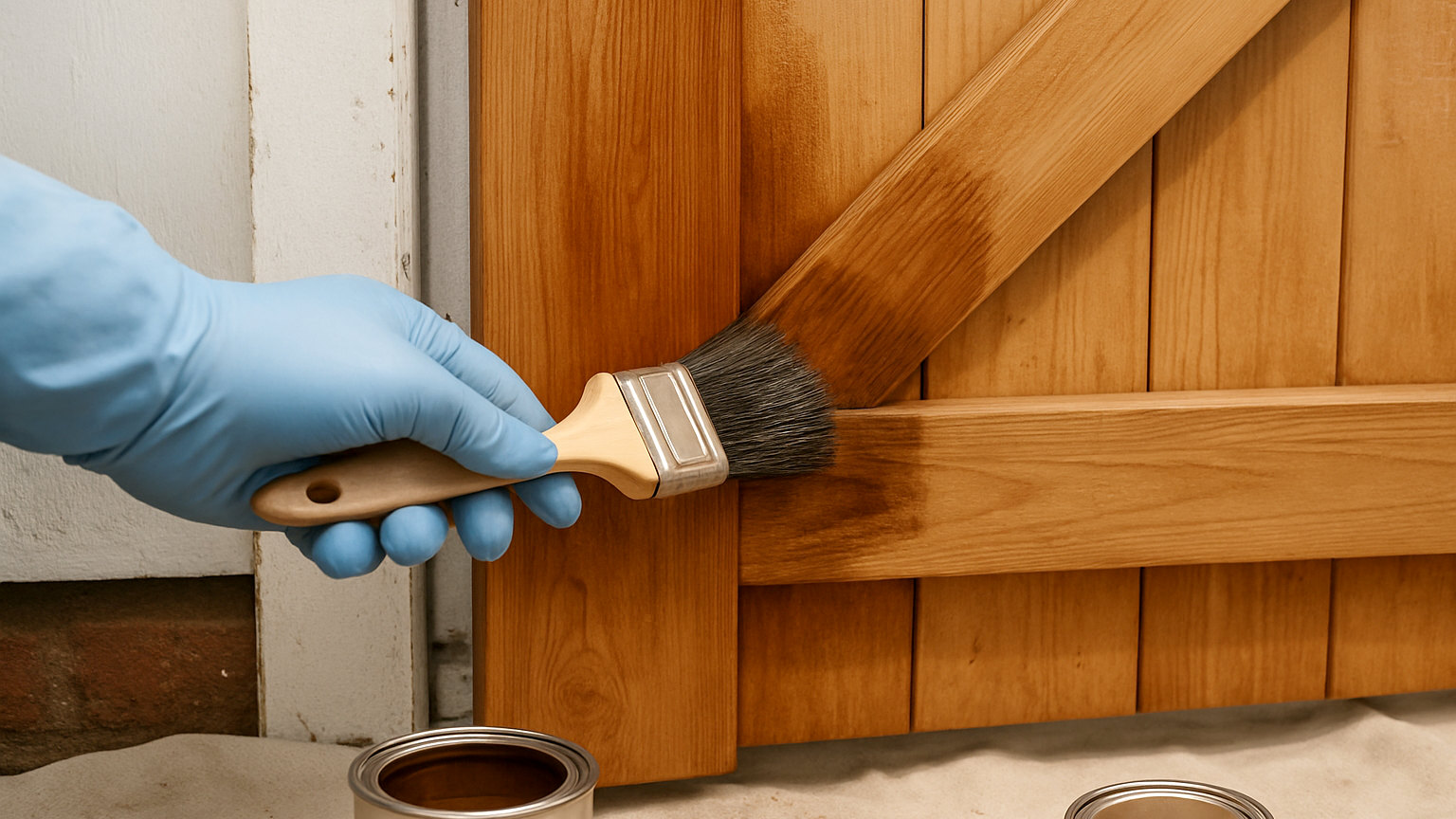
Exterior wood finishes divide into two families that behave in opposite ways, and the choice determines what maintaining the timber looks like for the next twenty years.
Penetrating finishes
Oils soak into the timber, replace natural oils lost to weathering, repel water and feed the wood. They do not form a film.
Penetrating stains do the same with pigment added for colour and ultraviolet protection.
Because there is no film, they wear away gradually from the surface rather than cracking and peeling.
Recoating is therefore a clean and a coat, with no stripping and no sanding back to bare wood.
The trade off is frequency. Expect to recoat every one to three years, and annually on a south facing or heavily exposed surface.
Film forming finishes
Paint and heavy solid stains form a layer on the surface.
They give strong opaque colour, hide the timber underneath, and offer the best protection while the film is intact.
They last longer between coats, typically five to ten years on good joinery.
The problem is what happens at the end. Films crack, water gets underneath, and the coating lifts. Once a surface is painted it is committed to being stripped and repainted, and stripping exterior timber is slow work.
A film that traps moisture in the timber also causes the rot it was meant to prevent.
Varnish outdoors
Exterior varnish gives a clear film and looks superb for about two years.
It then breaks down under ultraviolet light, crazes and flakes, and the only remedy is stripping back to bare timber.
Marine grade varnishes last longer and need annual maintenance coats to stay ahead of the degradation.
For most garden joinery it is a commitment people regret. A pigmented oil gives a similar look with far less work.
Why pigment matters
Ultraviolet light is what breaks timber down at the surface and turns it grey.
Clear finishes offer very little UV protection, whatever they claim.
Pigment is what blocks UV, so a coloured stain protects the timber considerably longer than a clear oil of the same type.
Semi transparent finishes are a reasonable compromise, keeping the grain visible while carrying enough pigment to slow the greying.
Matching finish to timber
Pressure treated softwood, such as fencing and decking, suits a penetrating stain. It arrives wet and needs several months to weather before anything is applied.
Planed softwood joinery, such as doors, windows and barge boards, is usually painted, since it needs the fuller protection of a film and the appearance suits it.
Hardwood, including oak and iroko, is best oiled or left to silver naturally. Paint on hardwood frequently fails because the timber moves and the oils interfere with adhesion.
Cedar and other naturally durable timbers need no protection to survive and are usually oiled only to keep the colour.
Changing from one to the other
Going from stain to paint is possible once the stain has weathered back, with thorough cleaning, sanding and a suitable primer.
Going from paint to stain means removing every trace of the paint, since stain cannot penetrate through a film and will sit in blotches wherever residue remains.
That is the practical reason the paint decision is the bigger one.
Test compatibility on a hidden area before committing.
Preparation for either
Clean thoroughly and treat any algae with a fungicidal wash, since coating over growth seals it in.
Let the timber dry properly, which after rain means several dry days.
Sand where the surface is furred or a previous film is failing.
Treat every cut end with preservative regardless of the finish chosen, since end grain is where water gets in.
A practical summary
Choose a penetrating stain or oil for fences, decking, sheds, garden structures and hardwood, accepting more frequent light maintenance.
Choose paint for joinery, doors, windows and anything where colour and a crisp finish matter, accepting a harder job at the end of its life.
Whichever you choose, the timber lasts longer if water can get out again, which is why penetrating finishes suit anything in contact with the weather on all sides.


