
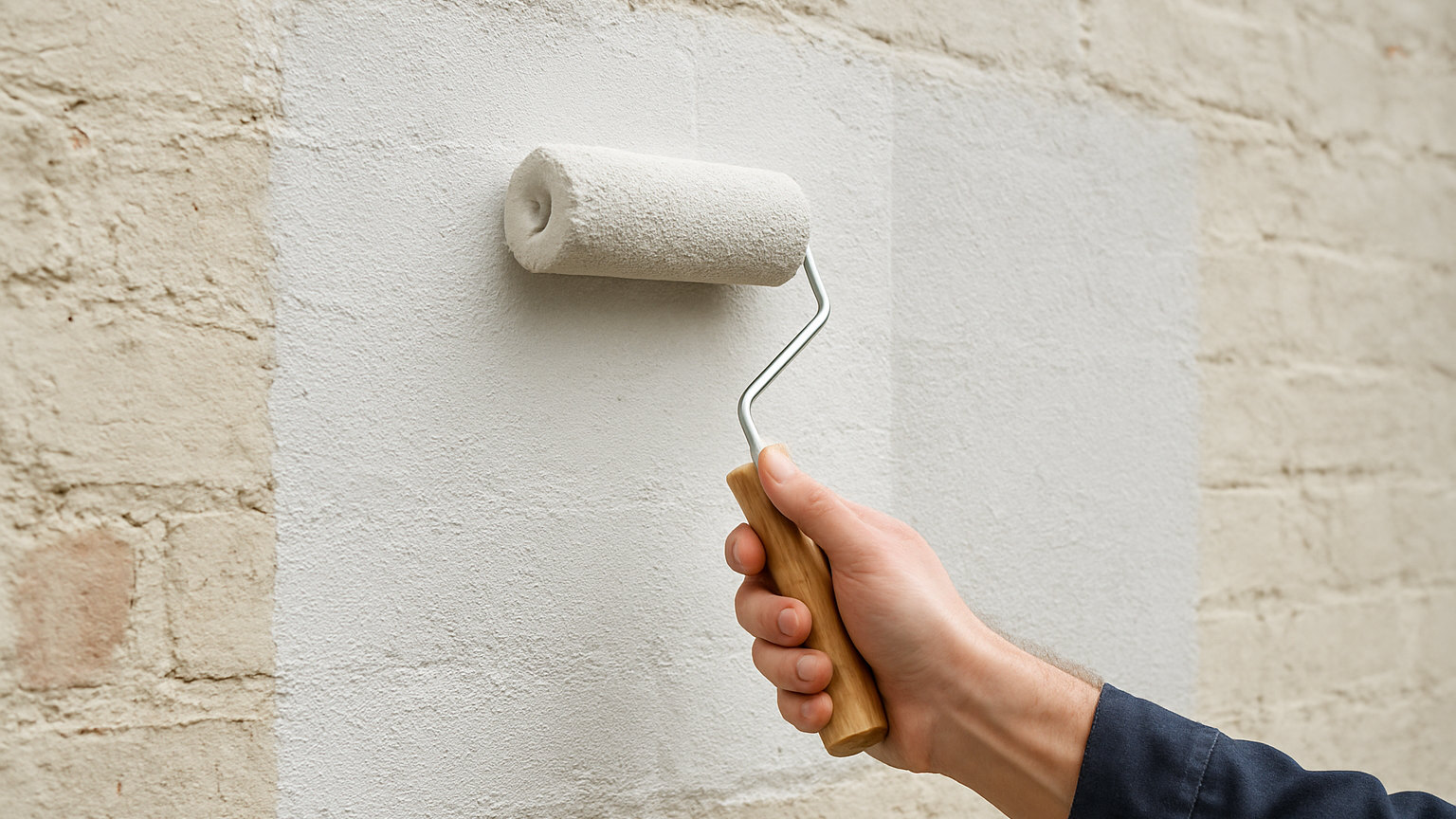
Masonry paints look interchangeable on a shelf and differ enormously in how they behave on a wall, particularly on an older building where the wall needs to breathe.
Smooth masonry paint
The standard water based acrylic product, and what most people buy.
Easy to apply, available in every colour, and reasonably priced.
It gives a flat even finish and shows surface defects rather than hiding them, so the preparation has to be good.
Expect five to ten years on a reasonably sheltered elevation, and less on an exposed one.
Textured masonry paint
A thicker product containing fine aggregate, giving a rough finish.
It hides minor surface imperfections and hairline cracking, which is its main appeal on a wall that has seen better days.
It goes further towards bridging small cracks, though it is not a repair.
It is very difficult to remove or paint over neatly later, and it holds dirt and algae in the texture.
Coverage is much lower than smooth paint, so allow considerably more material.
Pliolite and solvent based paints
Resin based paints that penetrate rather than sitting on the surface.
Their practical advantage is the weather window. Pliolite can usually be applied at lower temperatures and on slightly damp surfaces, which extends the painting season considerably in the UK.
They are more durable on exposed and high level work, and they bond well to chalky or difficult surfaces.
They smell strongly, need solvent for cleaning, and come in a narrower colour range.
Worth considering for exposed elevations, coastal properties and work late in the season.
Breathable and mineral paints
This is where the choice genuinely matters rather than being a preference.
Silicate, lime and silicone based mineral paints allow water vapour to pass through while shedding liquid water.
Solid wall buildings, particularly older ones built with lime mortar, need to breathe. They manage moisture by absorbing it and releasing it, and a plastic film coating stops that.
Trapped moisture behind an impermeable paint causes blistering, frost damage to the masonry and damp inside the building.
If the property is pre-1920, solid walled, or lime rendered, use a breathable paint and check the vapour permeability figure rather than trusting the marketing word.
Silicone and water repellent paints
Silicone modified emulsions shed water strongly while remaining breathable, which is a useful combination on exposed walls.
Dirt sticks less readily, so they stay cleaner for longer.
They cost more and are worth it on a weather facing elevation.
Anti-mould and fungicidal versions
Most exterior masonry paints contain a biocide. Some contain considerably more.
On a north facing or shaded wall, or under trees, a paint with a strong fungicidal package is worth the extra.
It delays regrowth rather than preventing it, and the wall still needs washing periodically.
Coverage and how many coats
Coverage figures on the tin assume a smooth, sealed, non-absorbent surface, which almost no exterior wall is.
Expect to achieve considerably less than the stated figure, particularly on render, pebbledash and bare masonry.
Two coats is the normal specification, and a porous or previously unpainted surface usually needs a thinned or primed first coat as well.
Buy all the paint in one batch and box it together if using more than one tin, since colour varies between batches.
Choosing for the situation
Modern cavity walled house, sheltered: smooth acrylic is fine.
Exposed or coastal: pliolite or silicone.
Old solid wall or lime render: a breathable mineral paint, without exception.
Tired render with hairline cracking: textured, accepting the commitment.
Shaded and green: something with a strong fungicide.
What the guarantee means
Masonry paints are frequently sold with a fifteen or twenty year guarantee, and the figure does a lot of work in the marketing.
Read what it actually covers. Most cover the film against flaking and peeling only, and exclude colour fade, dirt pick up, algae growth and anything caused by damp in the wall.
Nearly all are conditional on the surface having been prepared and primed exactly as the manufacturer specifies, which is difficult to evidence years later.
Treat the number as a statement of expected quality rather than an insurance policy, and keep the receipt and a note of the product and batch.


