
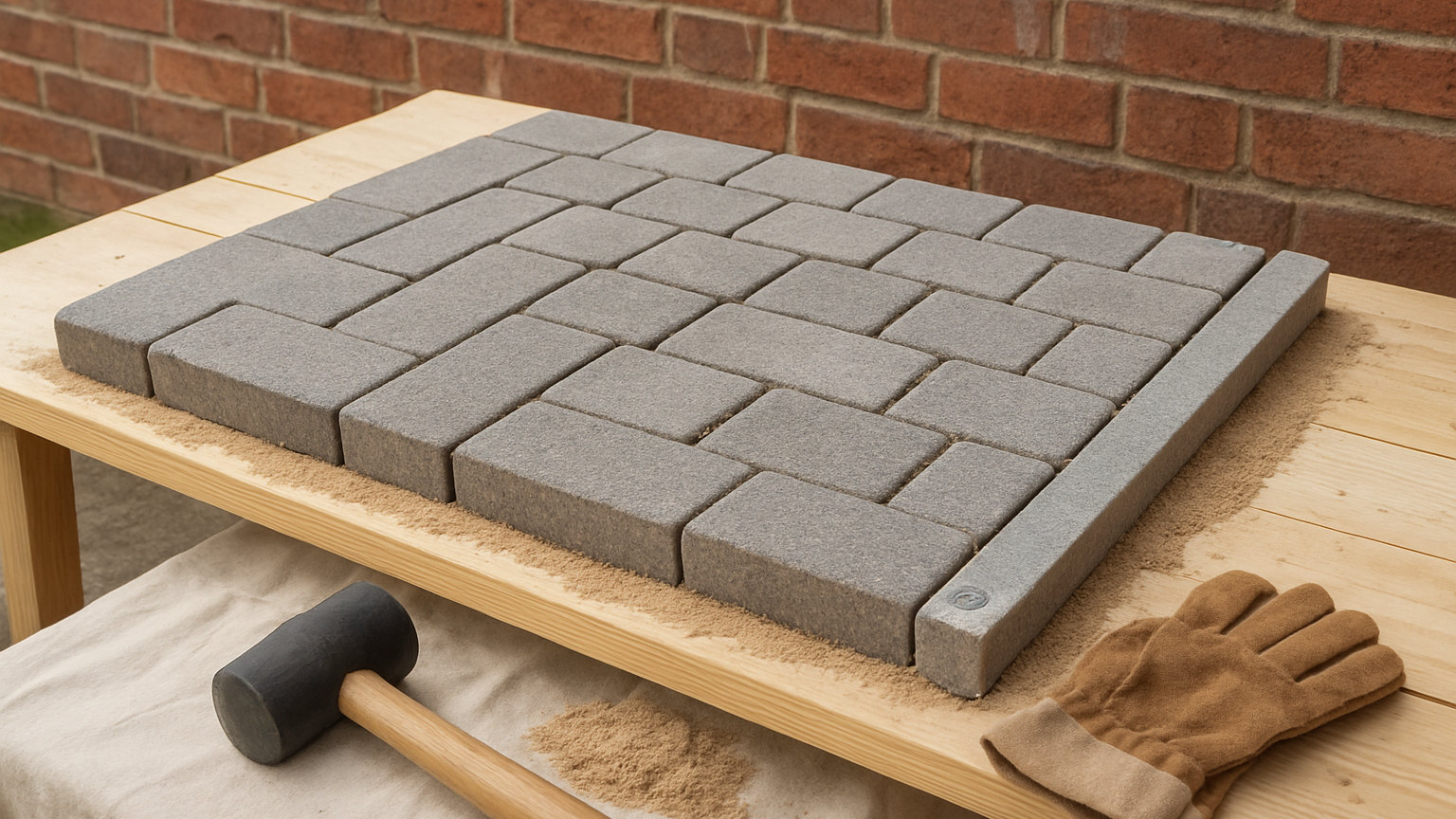
Block paving looks like a smaller version of slab paving and works on a completely different principle. Understanding that principle explains almost every rule about laying it.
It works by interlock
Blocks are not bonded to anything. They are held by friction between the blocks, sand in the joints, and restraint at the edges.
Load applied to one block is transferred through the joints to its neighbours and spread across a wide area.
That is why block paving handles vehicles well, flexes without cracking, and can be lifted and relaid.
It is also why edge restraint is not optional. Remove the restraint and the whole surface gradually spreads and loses its interlock.
The laying course
Blocks sit on a layer of sharp sand, usually around 30mm to 40mm thick when screeded and before compaction.
The sand is screeded, not compacted, before laying. Blocks are placed on the loose screed and the whole surface is vibrated afterwards, which beds them in evenly.
Do not walk on the screeded sand. Work from the laid blocks forwards.
Use sharp sand, not building sand, and keep it at a consistent moisture content across the job.
Edge restraint
Every edge needs a kerb, edging block or course haunched in concrete, set before the field is laid.
The haunching should come up the back of the edging but stay below the finished surface.
Edgings are laid on concrete, unlike the blocks themselves, and they set the level and line everything else works to.
Where the paving runs against a wall or a building, that acts as the restraint, though the level against the house must still sit below the damp proof course.
Patterns
Herringbone, at 45 or 90 degrees, gives the best interlock and is the pattern to use anywhere vehicles run. The blocks cannot slide relative to one another in the direction of travel.
Stretcher bond, like brickwork, is simple and suits paths and patios but is weaker under turning vehicles.
Basketweave is decorative and the weakest of the common patterns, best kept to foot traffic.
Herringbone generates more cuts at the edges; stretcher bond generates fewer.
Laying
Set out from a straight edge and use string lines to keep courses true, checking every few rows.
Place blocks against each other rather than sliding them, which drags sand up into the joint.
Leave a joint of around 2mm to 5mm, which happens naturally from the spacer nibs on most blocks.
Leave all the cutting until the field is complete, then cut and fit the edges in one operation.
Cut with a block splitter where possible, which is quiet and dust free, or a wet cut-off saw.
Jointing and compacting
Brush kiln dried sand across the surface and work it into every joint.
Run a plate compactor with a rubber mat or sole plate over the whole area, which beds the blocks and vibrates sand down into the joints.
Brush in more sand and compact again, repeating until the joints stay full.
Never run a compactor over blocks with empty joints, which chips the edges and can crack them.
Top the sand up again after a few weeks, since it settles.
Where block paving suits better than slabs
Driveways and anywhere carrying vehicles, because it flexes rather than cracking.
Curved and irregular shapes, which are far easier in small units.
Anywhere services may need to be accessed later, since blocks lift and relay.
Permeable construction, where specific permeable blocks and an open graded sub-base allow water through.
Maintenance differences
Joint sand needs topping up periodically, particularly after pressure washing, which blasts it out.
Weeds germinate in the joints and are managed rather than eliminated.
Individual blocks can be lifted and replaced if stained or damaged, which is a real advantage over a bonded patio.
Keep a box of spare blocks from the original batch, since colours change between production runs and a repair made years later will otherwise stand out.
Common mistakes
Compacting the laying course sand before laying the blocks, which prevents them bedding evenly.
Laying without edge restraint and adding it afterwards, by which point the blocks have already spread.
Using building sand in the joints, which holds water and encourages weed growth.
Pressure washing hard enough to strip the joints, then leaving them empty over winter.


