
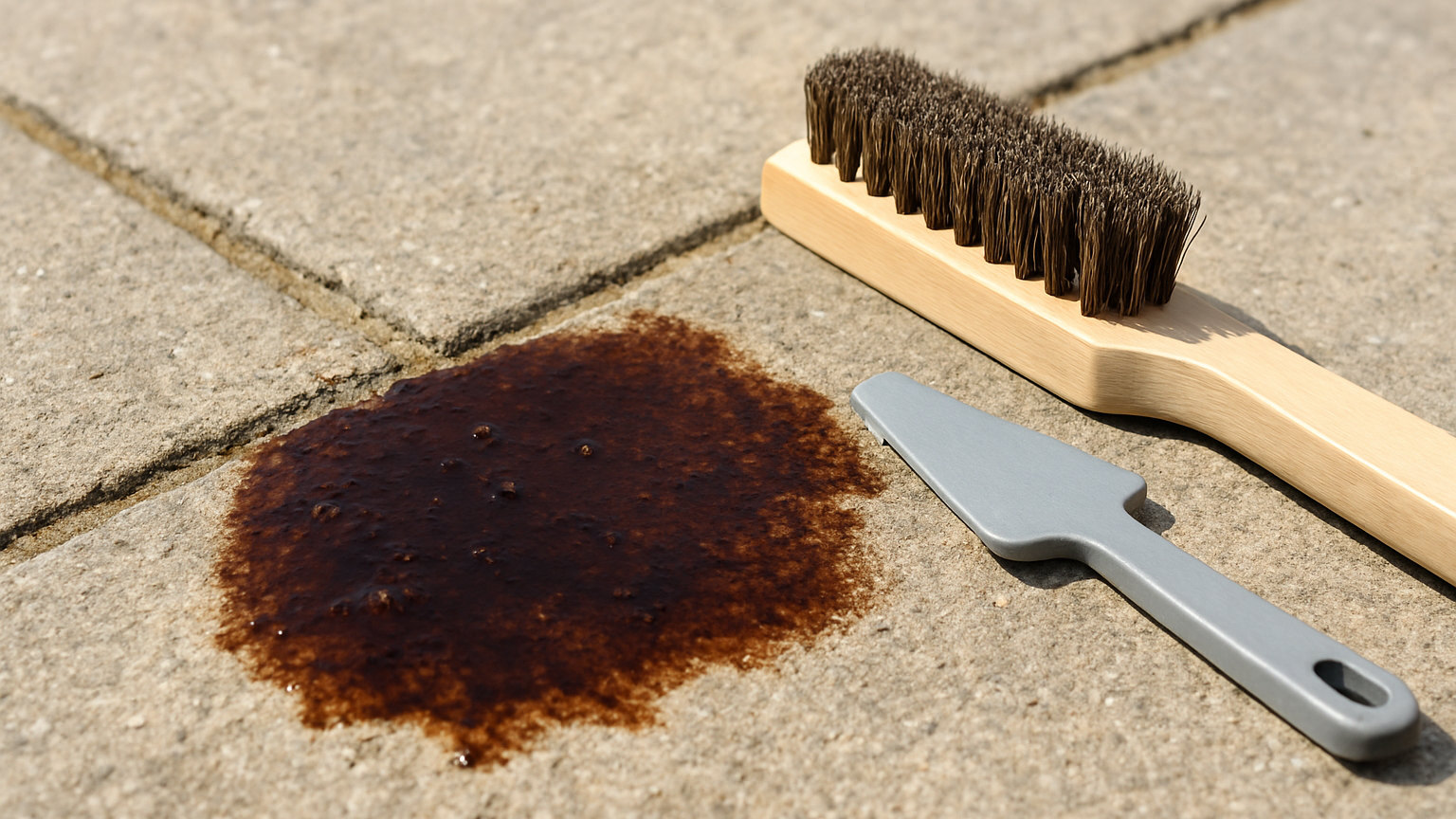
Stains on paving are easier to treat in the first hour than in the first year, and using the wrong product on the wrong stone turns a temporary mark into a permanent one.
Two rules before anything else
Test on a hidden area first, and wait a day before judging the result.
Never use acidic cleaners on limestone, on polished surfaces, or on anything you have not identified. Acid etches calcareous stone permanently, and the damage looks worse than the stain did.
Work outwards from the edge of a stain towards the middle, which stops it spreading into a larger ring.
Oil and grease
Common from vehicles, barbecues and garden machinery, and it soaks in quickly on porous stone.
Absorb anything fresh immediately with cat litter, sawdust or a proprietary absorbent granule. Do not wipe it, which spreads it.
Follow with a degreaser or a strong washing up liquid solution, agitated with a stiff brush and hot water.
For a stain that has soaked in, a poultice works better than surface cleaning. Mix an absorbent powder with a solvent or degreaser to a paste, spread it thickly, cover with plastic sheet taped down, and leave for a day or two. It draws the stain out as it dries.
Repeat rather than escalating to something more aggressive.
Rust
Usually from metal furniture, tools left out, or reinforcement in nearby concrete.
Rust removers for stone are usually oxalic or phosphoric acid based, which works well on sandstone and concrete and damages limestone badly.
On limestone, a dedicated non-acidic rust remover is the only safe route, and results are slower.
Prevent recurrence by putting feet or pads under metal furniture, which is far easier than treating the stain each year.
Barbecue and food stains
Fat is the problem, and it behaves like any other oil stain.
Treat quickly with a degreaser and hot water, and use a poultice for anything that has soaked in.
Wine, fruit and sauces are organic stains and usually respond to an oxygen based cleaner or a dilute hydrogen peroxide solution, left to dwell and rinsed.
A sheet or a board under the barbecue costs nothing and avoids the whole exercise.
Leaf tannin and organic staining
Brown or black marks left where leaves have lain over winter.
An oxygen based patio cleaner or a proprietary tannin remover usually lifts these, applied and left to dwell.
Stubborn marks on porous stone may need repeating over several treatments.
Clearing leaves promptly in autumn prevents almost all of it.
Efflorescence
A white powdery bloom that appears on new paving as it dries, caused by salts migrating to the surface.
It is not a defect and not dirt.
It usually weathers away over a season or two and is best left alone.
Where it persists, a proprietary efflorescence remover works, but it is acid based and unsuitable for limestone.
Brushing off the dry powder repeatedly is the gentlest approach.
Paint and cement
Fresh paint should be lifted immediately with the appropriate thinner for its type, blotting rather than rubbing.
Dried emulsion often softens with hot water and a scraper.
Dried gloss usually needs a paint remover suitable for masonry, tested first.
Cement splashes are best removed while wet. Once set, a cement remover will take them off sandstone and concrete but will damage limestone, and mechanical removal risks scarring the surface.
Moss, algae and lichen
Not really stains, and treated with a fungicidal wash rather than a stain remover.
Lichen is tenacious and usually needs a dedicated product and repeat treatment.
Scraping lichen off soft stone takes the surface with it.
When a stain will not come out
Some stains on porous stone are permanent, particularly deep oil on light coloured sandstone.
Where the paving is otherwise sound, lifting and swapping the affected slab with one from a less visible position is frequently the neatest answer.
This is one of the practical arguments for keeping a few spare slabs from the original batch.


