
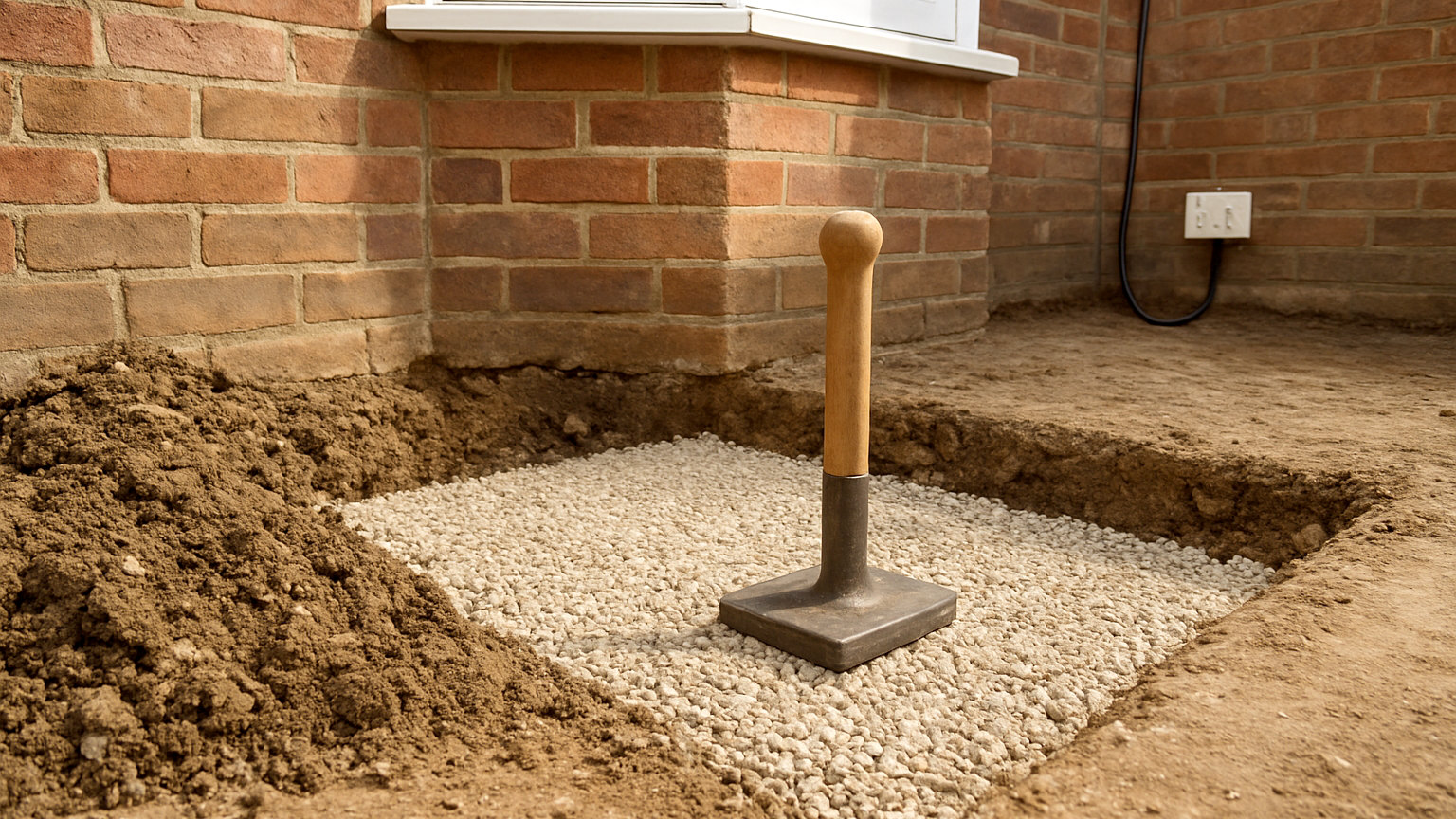
Everything visible about a patio depends on a layer nobody ever sees. Sub-base failure is behind almost every sunken, rocking or cracked patio, and it cannot be corrected from the surface.
What the sub-base does
It spreads load from the paving over a wider area of subsoil, so no single point is overstressed.
It provides a stable, non-shrinking platform that will not move with moisture or frost.
It drains, taking water away from beneath the paving rather than holding it there.
The paving itself contributes almost nothing structurally. A slab is a wearing surface sitting on the thing that actually does the work.
Material
MOT Type 1 is the standard choice: a crushed graded aggregate with a range of particle sizes from around 40mm down to dust.
The range of sizes is the point. Small particles fill the gaps between large ones, so the material locks together under compaction and becomes almost solid.
Single sized gravel does not do this. It stays loose, rolls under load and is not a sub-base.
Recycled Type 1 made from crushed concrete works well and is cheaper. Avoid unscreened rubble, builders' waste and anything containing plaster, wood or soil.
Type 3 is a more open graded version used where drainage matters, such as around trees or in permeable construction.
How deep
Depth depends entirely on what will use the surface and on the ground beneath.
Foot traffic only, on firm ground: 100mm of compacted Type 1 is generally adequate.
Foot traffic on soft or clay ground: 150mm.
Occasional light vehicle: 150mm minimum.
Regular parking: 200mm or more, and driveways are a different design problem from patios.
These figures are compacted depths, not loose. Type 1 reduces by roughly a fifth when properly compacted, so allow for that when ordering.
Compaction is the critical part
An uncompacted sub-base of any depth is worse than a thinner compacted one.
Compact in layers of no more than 75mm to 100mm, running the plate compactor over each layer several times in different directions before adding the next.
A single 150mm layer cannot be compacted through with a domestic plate, however long you run it. The bottom stays loose and settles later.
Hire a plate compactor, or a heavier vibrating roller for a large area. Hand tamping is realistic only for very small patches.
Slightly damp material compacts far better than bone dry material, which simply moves around.
The finished surface should ring solid underfoot and show no footprints.
The formation beneath
Dig down to firm undisturbed subsoil, removing all topsoil, turf and organic material.
Topsoil rots and compresses, so anything left under a sub-base will cause settlement.
Where soft spots appear, dig them out and fill with additional compacted Type 1 rather than levelling over them.
On soft clay or made ground, a geotextile membrane laid on the formation before the sub-base stops the aggregate being pushed down into the subsoil, and is cheap insurance.
Extending beyond the paved area
Take the sub-base at least 100mm to 150mm beyond the edge of the finished paving on all sides.
Edges are where patios fail first, because there is nothing restraining the material sideways.
Where the patio has no wall or kerb against it, an edge restraint haunched in concrete is needed to stop lateral spread.
When a sub-base is not enough
Very soft ground, recent fill, or a patio carrying real load may need a concrete slab rather than a granular sub-base.
Building over a former pond, a filled trench or a demolished structure is asking for settlement and needs more than Type 1.
Where a tree is close, roots will eventually lift anything laid over them, and the answer is usually to move the patio rather than to build deeper.
Ordering the material
Work out the volume in cubic metres by multiplying the area by the compacted depth, then add roughly twenty per cent for consolidation.
Type 1 weighs in the region of two tonnes per cubic metre, so a 20 square metre patio at 100mm needs around four tonnes.
Bulk delivery is far cheaper than bulk bags once you need more than a couple of tonnes, provided there is somewhere to tip it and a barrow route to the job.
Check the delivery can reach the site, since a loose tip blocking a shared drive causes more trouble than it saves.


