
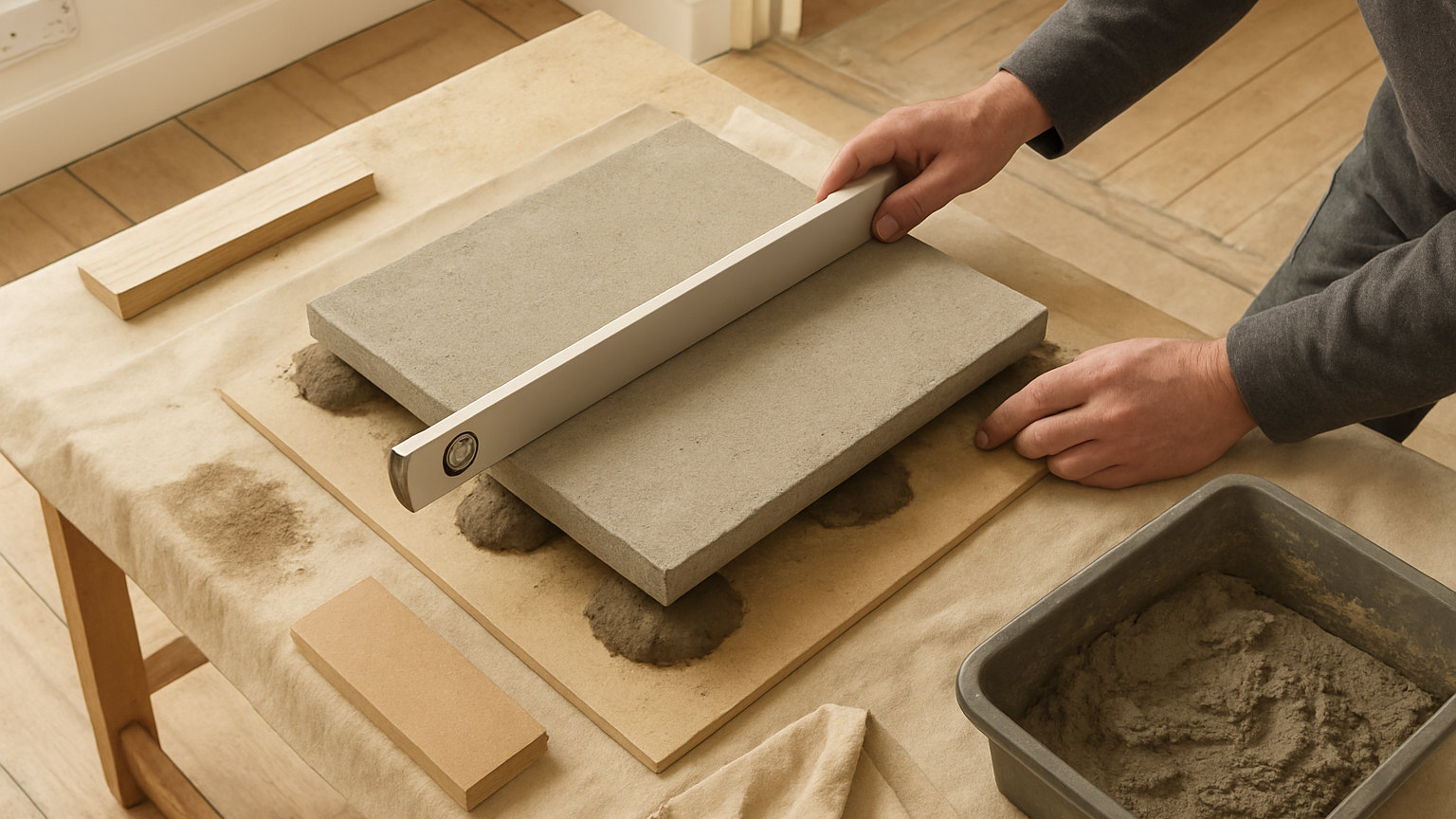
The five spot method, sometimes called dot and dab or blobbing, puts a dollop of mortar under each corner and one in the middle of the slab. It is quick, it is widespread, and it is the reason a very large number of patios fail.
What the method actually does
The slab ends up supported at five points with voids covering most of its underside.
Those voids are the whole problem, and everything that follows comes from them.
It persists because it is fast, uses less mortar, and makes it easy to adjust a slab to level. The patio looks fine for a season or two, which is long enough for the mistake to spread.
Water collects in the voids
Water finds its way through the joints, as it does in every patio, and instead of draining through a bed into the sub-base it pools in the hollows under the slab.
It has nowhere to go, so it sits.
That standing water keeps the slab permanently damp from below, which encourages efflorescence, staining and algae growth working up through porous stone.
Then it freezes
Water trapped under a slab expands when it freezes, and it pushes against the underside with considerable force.
This is what lifts and cracks slabs over winter, and why a patio that looked sound in October is rocking by March.
The damage is usually blamed on frost damaging the stone, when the real cause is the void that let the water sit there.
The slab cracks under load
A slab supported at five points is a bridge spanning between them.
Put a weight in the middle of an unsupported span, whether a person, a planter or a table leg, and the slab flexes.
Stone and concrete are strong in compression and weak in bending, so the slab cracks across the middle.
A patio with cracks running corner to corner or straight across individual slabs has almost always been laid on dabs.
It rocks
Five small contact points give five potential failure points.
If one dab is slightly low, or crushes, or loses its bond, the slab rocks and there is nothing else supporting it.
Rocking slabs are both an irritation and a genuine trip hazard, and they cannot be fixed without lifting.
Pointing cracks out
Movement in the slab breaks the bond at the joints.
Pointing cracks and falls out, which lets more water in, which fills more voids. The failure accelerates.
Repointing a patio that moves is a recurring job that never solves anything.
It creates a habitat
Voids under paving are attractive to ants, which excavate the bedding sand and bring spoil up through the joints.
Larger voids are attractive to rodents, and a network of connected hollows under a patio is difficult to deal with once established.
What to do instead
Lay every slab on a full, continuous mortar bed with complete contact across the entire underside.
A moist mix of around 5 or 6 parts sharp sand to 1 part cement, spread to roughly 40mm and screeded to the fall, then tapped down with a rubber mallet.
Wet the back of porous slabs before laying, or prime porcelain with a bonding slurry, so the mortar actually bonds rather than simply touching.
If a slab sits low, lift it and add mortar. Never pack underneath.
It uses more mortar and takes longer, and it is the difference between a patio that lasts twenty years and one that needs relaying in five.
If your patio is already on dabs
Isolated problem slabs can be lifted individually, the dabs cleaned off, and the slab relaid on a full bed.
Check the neighbouring slabs at the same time, since they were laid the same way.
Where cracking and rocking are widespread, the honest answer is that the patio needs relaying, and patching will only ever chase the problem around.
The sub-base is usually still sound, which makes relaying considerably less work than starting from scratch.
The related shortcut
Laying slabs on sand alone, with no mortar, has similar problems in a different form.
It is acceptable for some informal paths and for block paving, which is designed to work that way with proper edge restraint and jointing sand.
It is not suitable for large format slabs, which need continuous support.


