
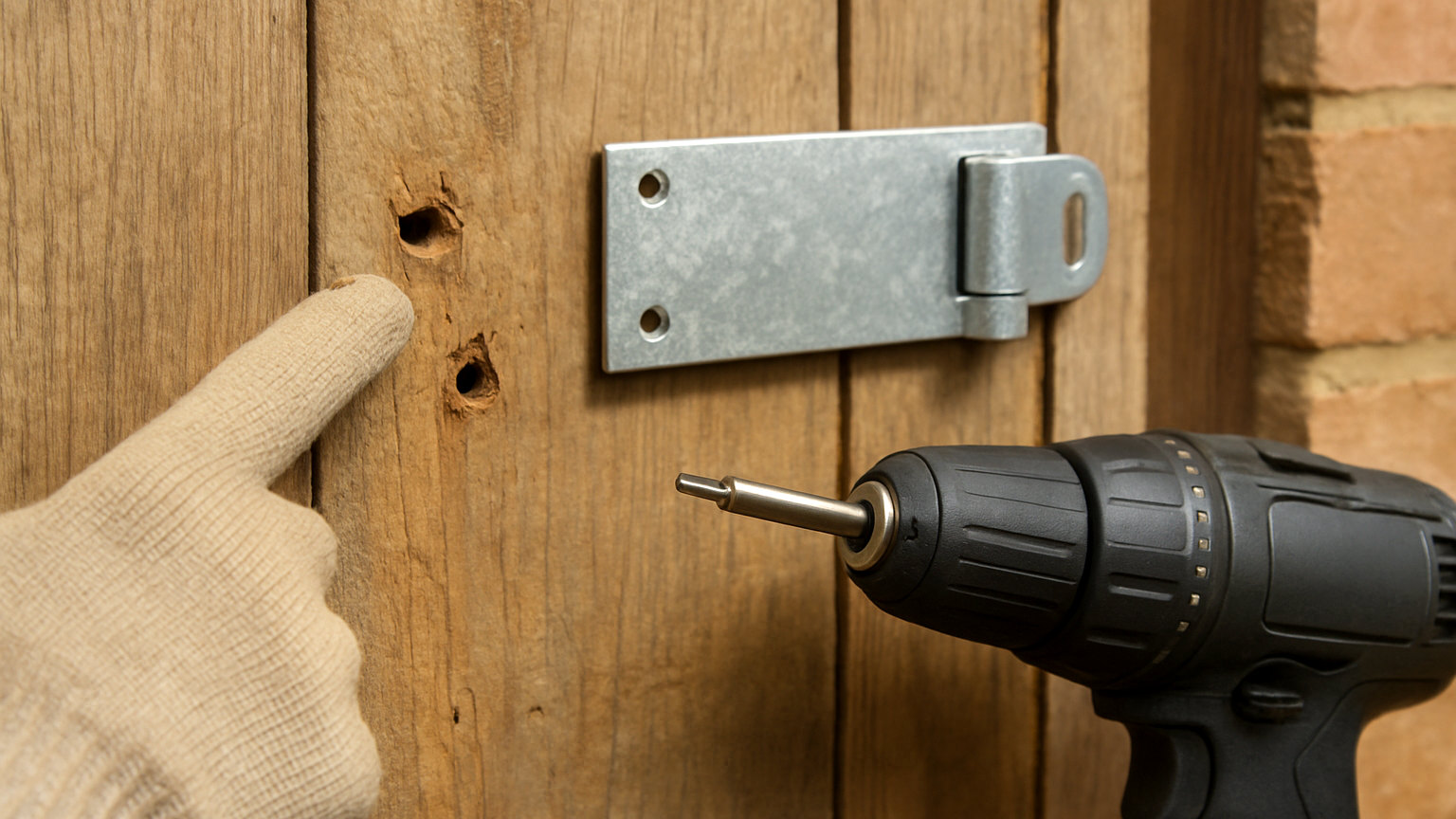
Sheds are broken into because they are easy, not because they are valuable, and almost all of that ease comes down to the fittings supplied with the building.
The screws are the problem
Most sheds arrive with a hasp and staple fixed with short screws into thin cladding.
A screwdriver or a single pull removes the whole fitting with the padlock still locked to it.
Replace every security fixing with coach bolts right through the door, with large washers and nuts on the inside.
Burr the thread or use shear nuts so the bolts cannot simply be undone from outside.
This single change costs a few pounds and is the most effective thing you can do.
Hasps and padlocks
Use a closed shackle or shrouded hasp, where the padlock body is protected and there is nowhere to get a bar or bolt cutters in.
Look for a hasp rated for outdoor security rather than a general purpose one.
Match the padlock to the hasp. A heavy padlock on a weak hasp achieves nothing, and neither does the reverse.
Choose a padlock with a hardened shackle and a decent security rating, and one described as weatherproof.
Two hasps, one near the top and one near the bottom, are far better than one in the middle, since a single central fixing lets the door be levered at the corners.
Hinges
External hinges with exposed screws or pins are a common entry route, since the door can be lifted off without touching the lock.
Replace hinge screws with coach bolts through the door and frame.
Fit hinge bolts, which are steel pins on the hinge side that engage into the frame when the door closes, so the door cannot be removed even if the hinges are defeated.
Where hinges are on the outside, security screws or clutch head screws stop them being undone.
Doors and frames
A shed door is usually the weakest part of the whole building.
Adding a ledge and brace, or a sheet of ply screwed to the inside face, stiffens it considerably.
Fit a hasp into the frame rather than into the cladding, and reinforce the frame behind it with a timber block.
Double doors need a shoot bolt top and bottom on the closing leaf.
Windows
Windows make a shed pleasant and make it less secure, since they show the contents and provide an entry point.
Net curtain, frosted film or a simple screen stops anyone seeing what is inside, which removes most of the motive.
Fit a grille or mesh on the inside where the shed contains anything worth taking.
Seal window beading from the inside so the glazing cannot be removed from outside.
Securing the contents
Bolt a ground anchor to a concrete base and chain bikes, mowers and machinery to it.
Anchor a tool chest to the floor or the frame.
Mark valuable items with a UV pen or a property marking system, and photograph them with serial numbers.
Keep the most valuable items in the house rather than the shed where possible.
Never leave ladders, crowbars or spades outside, which supply the tools for the break in and for a burglary of the house.
Lighting and visibility
A motion activated light covering the shed door is a strong deterrent and cheap to fit.
Keep the approach visible from the house rather than screened by planting, and cut back shrubs that give cover.
Gravel on the approach path makes a quiet approach impossible.
Any mains electrical work in an outbuilding is notifiable under the building regulations and needs an electrician, so battery or solar lights are the straightforward option.
Alarms
Standalone battery shed alarms are inexpensive and surprisingly effective, since noise is what an opportunist least wants.
Position the sounder where it cannot be reached quickly through the door.
Check the batteries twice a year.
Insurance
Check what your policy says about outbuildings, since many limit cover for contents in a shed and some require a specified lock standard.
Photograph the contents and keep receipts for anything substantial.


