
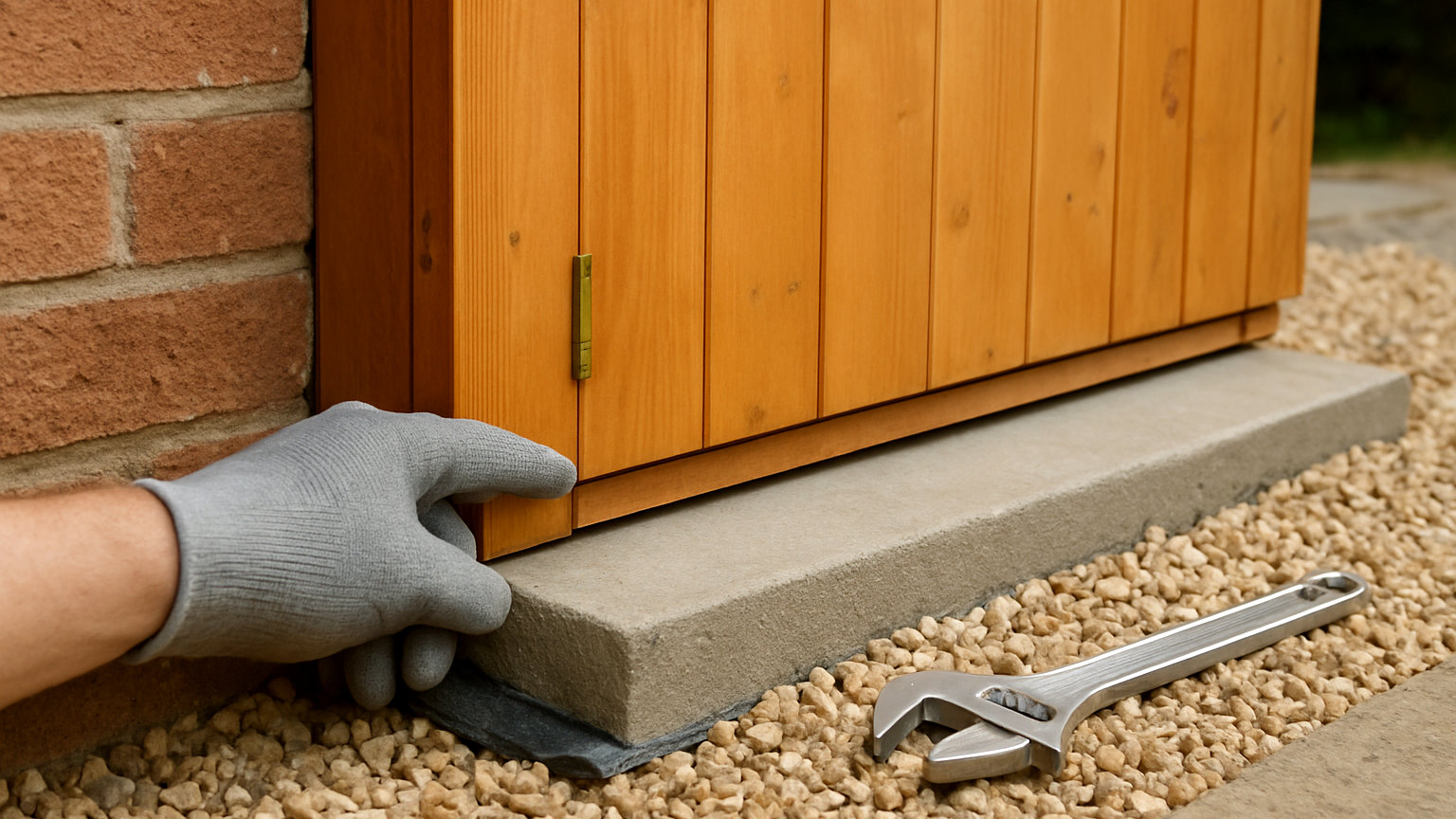
Almost every shed problem traces back to the base. A shed is a light structure with no real rigidity of its own, so it takes its shape from whatever it stands on.
What the base has to do
Be flat and level, so the walls stand square and the doors and windows close.
Be stable, so it does not settle unevenly and rack the frame.
Keep the timber off the ground, since a shed floor in contact with soil rots within a few years.
Allow air to move underneath, so the floor dries out between wettings.
Drain, so water does not pool around or under the building.
Concrete slab
A cast concrete pad on a compacted sub-base is the most durable option.
Completely stable, takes any load, and lasts indefinitely.
It is the most work and the least reversible, and it is the right answer for a large shed, a workshop with machinery, or anywhere the ground is soft.
Cast the slab slightly smaller than the shed footprint, or provide a fall, so rain running off the roof does not sit against the wall. A slab larger than the shed collects water at the edges.
Set timber bearers on the slab rather than standing the floor directly on concrete, so air can move beneath.
Paving slabs
The most common domestic choice and perfectly adequate for a typical garden shed.
Slabs bedded on a compacted sub-base, either as a full pad or as pads under each bearer position.
Cheaper and easier than concrete, and individual slabs can be lifted and re-levelled if something settles.
The sub-base matters as much as it does under a patio. Slabs laid straight onto soil will move.
Timber bearers on pads
Pressure treated bearers spanning between concrete pads or slabs, with the shed floor fixed on top.
Quick, uses less material, and lifts the shed clear of the ground with excellent ventilation.
Bearers must be a ground contact use class timber, and they are a replaceable component rather than a permanent one.
Good on uneven ground, since pad heights can be varied to level the frame.
Plastic grid bases
Interlocking recycled plastic grids filled with gravel, laid on a compacted and levelled bed.
Permeable, quick to install, and they need no concrete or mortar.
They spread load reasonably and drain very well.
Best suited to small and medium sheds on ground that is already reasonably firm. They do not fix a soft or sloping site.
What not to use
Bare soil or grass, which is damp, uneven and settles.
Loose slabs on unprepared ground, which rock and drop.
Railway sleepers or untreated timber laid directly on earth.
A slab that slopes towards the shed or holds water.
Sizing the base
Check the actual footprint rather than the advertised size, since shed dimensions are frequently quoted to the roof overhang or the eaves rather than the wall line.
Make the base the same size as the shed floor, or very slightly smaller. A base that projects beyond the walls collects rain and directs it against the timber.
Allow working space around the perimeter for assembly and future maintenance. Pushing a shed hard against a fence makes it impossible to treat the back.
Getting it level
This matters more than which base you choose.
Check across both diagonals as well as along each side, using a long straight edge and spirit level.
A base out by 15mm across a shed will show as doors that will not latch and a roof that does not sit down properly.
Correct the base before assembly rather than packing the shed afterwards.
Drainage and ventilation
Site the shed where water does not naturally collect, and grade the surrounding ground so it sheds away.
Leave an air gap under the floor. A shed sealed to the ground all round will rot from the floor up, whatever the timber treatment.
Keep planting, compost heaps and stacked materials away from the walls.
Where the shed sits on a slab, a strip of gravel around the perimeter stops splashback marking the cladding.


