A shower puts a large quantity of water vapour into the air in a few minutes. If it is not removed it condenses on the coldest surfaces in the house, which is how bathroom moisture becomes mould in a bedroom.
What is required
The building regulations require ventilation in bathrooms.
The usual figure for a bathroom is 15 litres per second of intermittent extract, and 6 litres per second for a separate WC.
Where there is no openable window, an overrun timer is normally required so the fan continues after the light is switched off.
Check the current requirements, since they are revised periodically.
An openable window does not remove the need to deal with moisture in practice, whatever the regulations permit, because nobody opens a window in January.
Why fans underperform
The stated extract rate on a fan is measured in free air with no ducting at all.
In a real installation with a duct and a grille, the actual rate is considerably lower.
Every metre of duct, every bend and every restriction costs airflow.
This is why a fan rated well above the requirement may still fail to clear a bathroom.
Duct routing and sizing
The most important part of the installation and the least considered.
Use the largest duct the fan accepts, commonly 100mm for a standard axial fan and 150mm for larger units.
Keep the run short and straight. Every bend costs airflow, and two ninety degree bends can halve the performance.
Use rigid duct rather than flexible. Flexible duct has a ribbed inner surface which creates turbulence, and it sags into low points where condensate collects and blocks the airflow.
Where flexible must be used, pull it taut and keep it short.
Insulate any duct passing through a cold space such as a loft. Warm moist air condenses inside a cold duct and runs back into the fan.
Give horizontal runs a slight fall towards the outside.
Seal all joints.
Never duct into a loft
This is the most damaging and most common mistake.
Discharging warm moist air into a loft, a cavity or a void causes condensation, rot and mould in the roof structure.
The duct must terminate at an external wall, a soffit, or a proper roof tile vent.
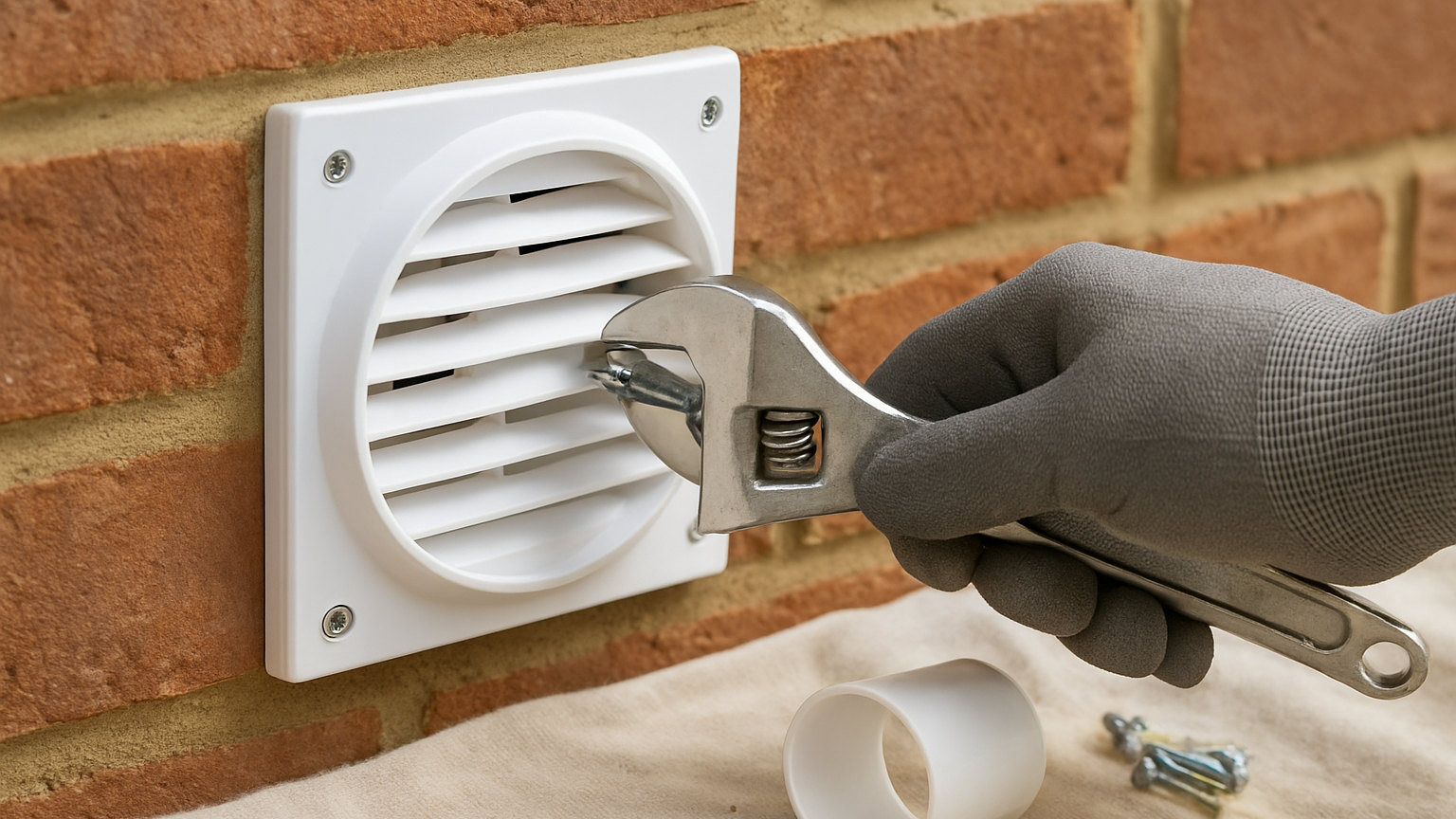
Fit a proper external grille with a backdraught flap.
Types of fan
Axial fans are the standard, suitable for short duct runs of a few metres through a wall.
Centrifugal and mixed-flow fans develop more pressure and are the right choice for longer runs, several bends, or a route through a loft.
Inline fans mount in the duct itself, usually in the loft, with only a grille visible in the ceiling. Quiet in the room and powerful.
Choose by the duct run, not by price.
Controls
Overrun timer: runs on after the light goes off, typically for 15 to 20 minutes. This is what actually clears the moisture, since most of it is still in the air when you leave.
Humidity sensing: switches on when humidity rises and off when it falls, which handles a bath as well as a shower and does not depend on the light being used.
Pull cord on the fan itself.
A humidity-sensing fan with an overrun is the most effective arrangement in most bathrooms.
Making it work
Air has to get in as well as out. A fan in a sealed room with a well-fitting door achieves very little. Leave a gap under the door of around 10mm, or fit a vent.
Keep the bathroom door closed while showering and for a while afterwards, so moist air is extracted rather than distributed.
Clean the grille and the fan regularly, since dust and lint block them.
Check the external flap opens.
Fitting
Bathroom electrical work is notifiable, so the connection is a job for a registered electrician.
A fan in zone 1 needs an appropriate IP rating, and many are low voltage for that reason.
Signs the ventilation is inadequate
Condensation running down the walls and windows.
Black mould in the corners, on the ceiling and in the silicone.
The mirror staying misted long after a shower.
A musty smell, and paint peeling from the ceiling.
Mould appearing in adjacent rooms, which means the moisture is moving through the house rather than out of it.