The handle and latch are the parts of a door that are touched every day, so a latch that catches or a handle that sits crooked is noticed constantly.
Setting out
Handle height is conventionally around 1000mm from the floor to the centre of the spindle, and anywhere between 900 and 1050mm looks normal.
Match the height of existing doors in the house.
The backset is the distance from the edge of the door to the centre of the spindle, and it is fixed by the latch you buy. Common backsets are 57mm and 76mm.
Choose the backset so the handle does not foul the architrave or your knuckles do not hit the frame.
A wider backset suits a door with a deep architrave close to the edge.
Drilling the latch mortice
The hole in the edge of the door for the latch body.
Mark the centre of the door thickness accurately and square across the edge.
Use a flat bit or an auger of the same diameter as the latch body, usually around 22mm.
Drill square in both planes. This is the hard part, because a hole that wanders emerges through the face of the door.
Use a drilling jig if you have one, or have someone sight from the side while you drill.
Mark the depth on the bit with tape and drill slightly deeper than the latch body.
Withdraw the bit periodically to clear the waste.
The faceplate recess
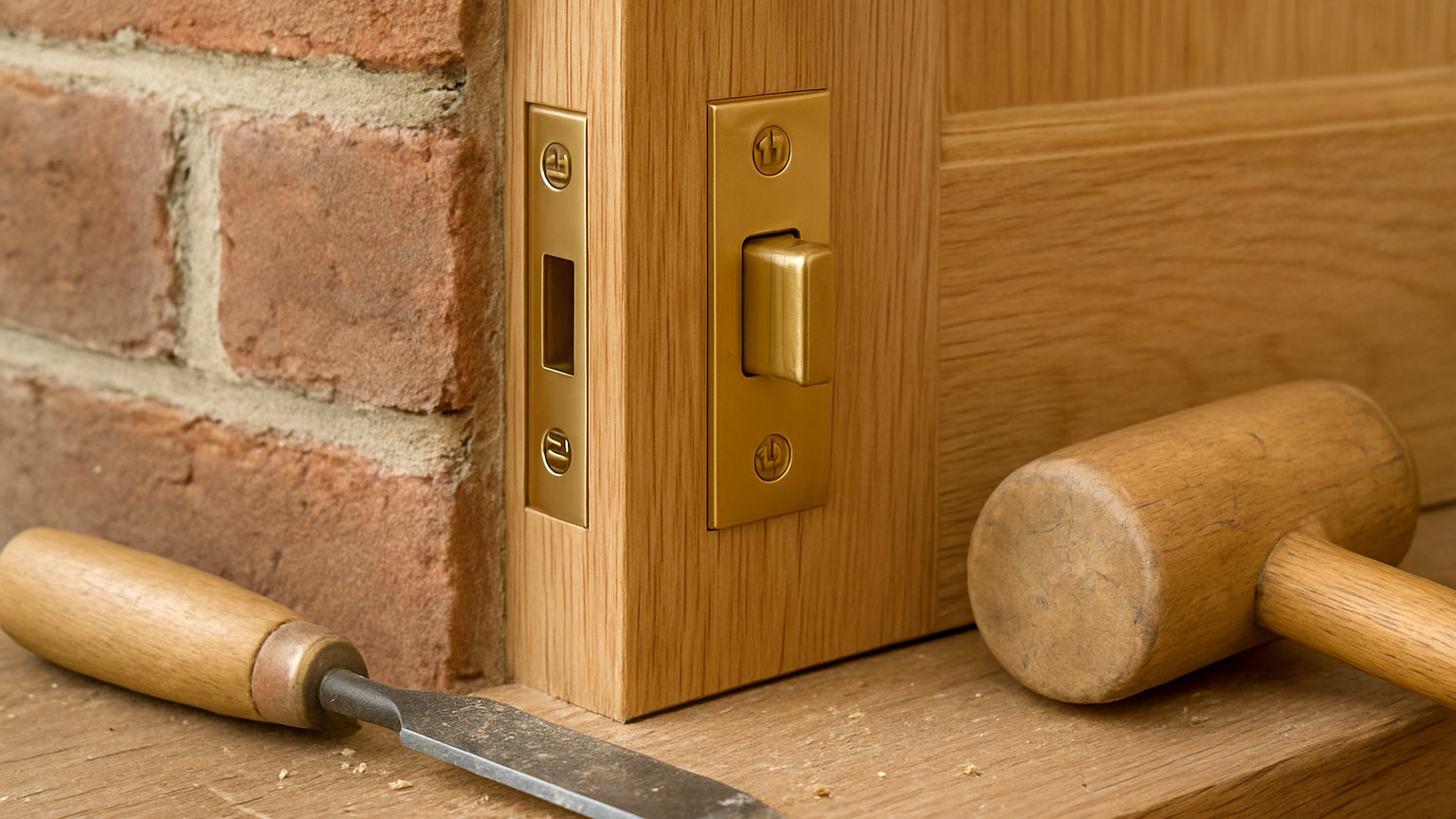
Push the latch in, mark round the faceplate with a knife, and chisel a recess so it sits flush.
Too proud and the door will not close; too deep and the latch is pulled out of line.
Drilling the spindle hole
Insert the latch and measure to the centre of the spindle hole.
Mark it on both faces of the door, measuring from the same edge each time.
Drill from both sides towards the middle, rather than straight through. Drill until the point just breaks through, then finish from the other face.
This prevents the veneer blowing out on the exit face, which cannot be repaired invisibly.
Check the hole lines up with the latch before fitting the handles.
Fitting the handles
Cut the spindle to length if necessary, so it does not project past the handles.
Fit the latch, then the spindle, then the handles on each side.
Check the handles are level and square before tightening.
Operate it before finally tightening, and check the latch withdraws fully.
The striker plate
The part most often misaligned.
Close the door until the latch touches the lining and mark the latch position on the frame, top and bottom.
Alternatively, smear a little lipstick or pencil on the latch and close the door, which transfers the exact position.
Mark the plate position, chisel the recess so it sits flush, and cut the mortice behind it for the latch bolt.
Set the plate so the door pulls up tight against the stop, without rattling and without having to be forced.
Where a door rattles, the striker plate is slightly too far out. Where it needs slamming, it is slightly too far in.
Adjusting afterwards
Small misalignments can frequently be corrected by filing the striker plate aperture rather than moving it.
Where the door has dropped, check the top hinge screws before adjusting the plate.
A latch that sticks usually needs the plate moving fractionally, or a spot of lubricant on the latch.
Privacy and other latches
Bathroom locks use a turn on the inside and an emergency release outside, needing a second hole for the follower.
Use the template supplied, which sets both hole positions.
Check the emergency release works from outside before the door is in use.
Tubular and mortice latches
A tubular latch fits a round drilled hole and is the usual domestic choice.
A mortice latch or lock needs a rectangular mortice chopped in the edge, which is more work and gives a stronger fixing.
Match the latch to the door: a hollow-core door has a limited lock block, and a heavy mortice lock may not fit.
Handle types
Lever handles on a backplate cover a larger area and hide minor drilling errors.
Lever on rose is neater and less forgiving, since the small rose leaves nothing hidden.
Knobs need a wider backset so knuckles clear the frame, and are awkward on a door with a tubular latch.