A hinged door needs a quarter circle of clear floor to open into. Where that space is doing something else, sliding or folding gear is the answer.
The options
Surface-mounted sliding, often called barn door. The door hangs from a track on the wall face and slides across the opening. Simple to fit and needs a clear wall the width of the door beside the opening.
Pocket door. The door slides into a cassette within the wall and disappears completely. The neatest result and the most work, since the wall has to be built or rebuilt around it.
Bifold. Two or more leaves folding back against the reveal. Needs less side space than a slider and projects into the room when open.
Sliding wardrobe gear, running top and bottom in tracks, used for cupboards rather than doorways.
What each costs you
Be clear about the compromises before choosing.
Sliding doors do not seal. There is a gap all round, so sound, light and smells pass. They are unsuitable where privacy or acoustic separation matters, and they cannot be fire doors.
Barn door gear needs clear wall beside the opening, with no switches, sockets, radiators or pictures in the way.
Pocket doors are difficult to service. If the gear fails, or the door needs adjusting, access means opening the wall. Buy a good quality kit with serviceable gear.
A pocket door cassette also means nothing can be fixed to that section of wall, and no sockets or cables can run in it.
Bifolds have more moving parts and a leaf that projects into the room.
Sliding door gear
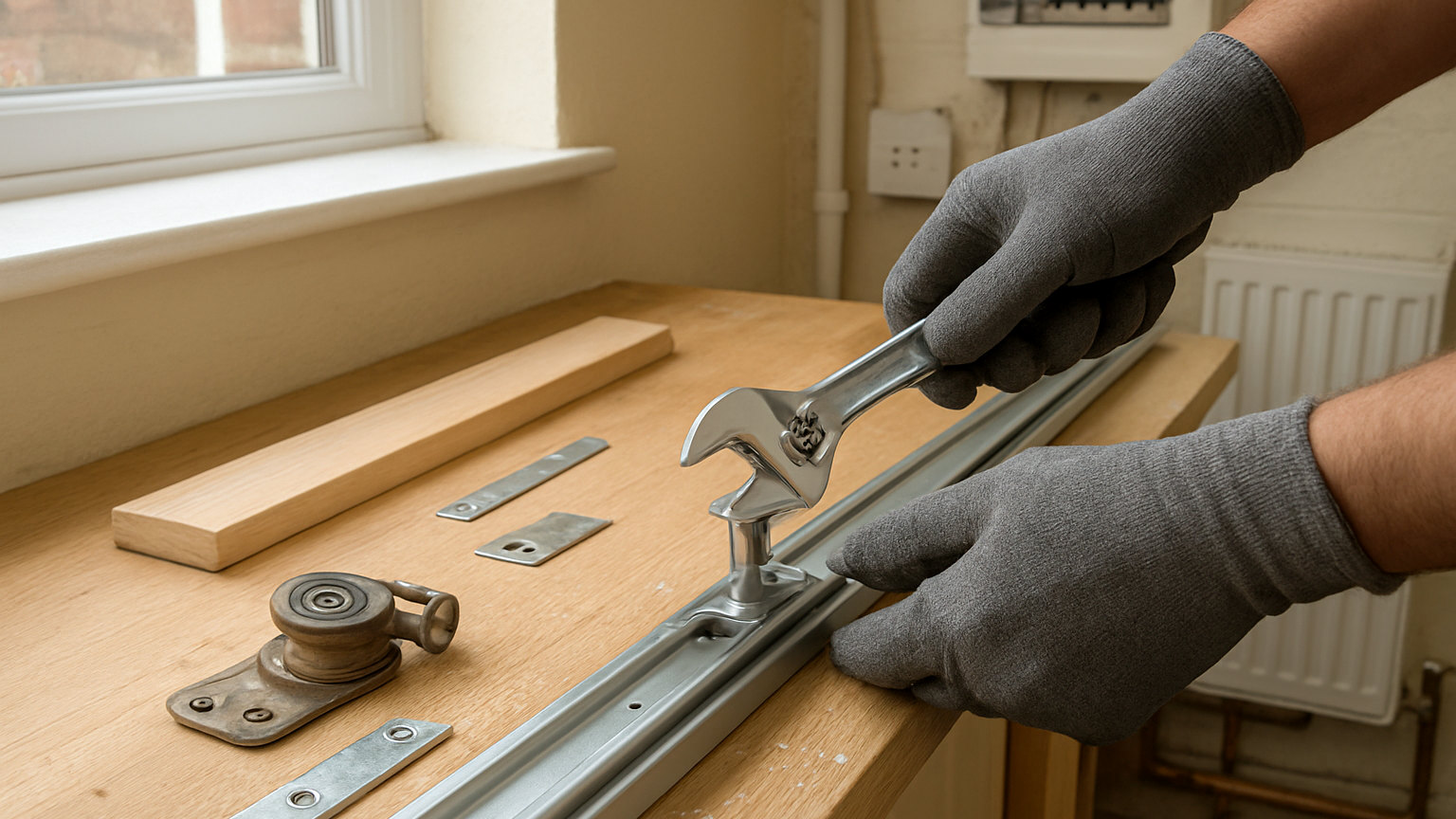
The track carries the whole weight of the door.
Fix into structure, not plasterboard. Fit a substantial timber batten or a steel plate across the wall, fixed into the studs or into masonry, and mount the track to that.
Check the track's stated door weight limit against the actual door, since solid timber doors are heavy.
The track must be level along its full length, or the door will run to one end on its own.
Allow for the door to overlap the opening by around 50mm each side, so it covers properly.
Fit a floor guide to stop the door swinging, and end stops at both ends of the track.
Pocket doors
The cassette is a metal or timber frame that replaces a section of stud wall.
The wall must be built around it, so this is a job for a new wall or a substantial alteration.
Check the wall thickness, since a pocket needs a wall thick enough to take the door plus the cassette.
Check the wall is not load bearing before altering it, and check for services in it.
Follow the kit instructions exactly for the aperture size, since the frame dimensions are critical.
Fit the door and adjust it before boarding the wall, and check it runs freely.
Bifold gear
Top-hung or bottom-rolling systems, with a pivot at one side.
The track needs a solid head, and the pivot corner carries the load.
Check the leaf widths against the opening, since the two leaves plus the gaps must match.
Allow for the leaves to fold back without hitting the architrave or a wall.
Headroom and clearances
All these systems add height above the opening.
Measure from the top of the opening to the ceiling or the coving before choosing, since some tracks need 100mm or more.
Check the floor covering, since a slider needs a consistent clearance along its whole travel and a sloping floor causes it to catch at one end.
Handles
Sliding doors need flush pulls, since a projecting handle fouls the wall or the pocket.
Fit an edge pull on a pocket door so it can be drawn out of the wall.
Privacy locks are available for sliding doors, and are less positive than a latch.
Where a swing door is still better
Bathrooms and bedrooms where privacy matters.
Anywhere a fire door is required.
Anywhere sound separation matters.
Buying the gear
Cheap sliding gear runs roughly, rattles and wears quickly, and it is not easy to replace once the wall is finished.
Buy a system with a stated weight rating comfortably above the door weight, soft-close if available, and available spares.
Check what is included, since tracks, hangers, guides and stops are sometimes sold separately.