
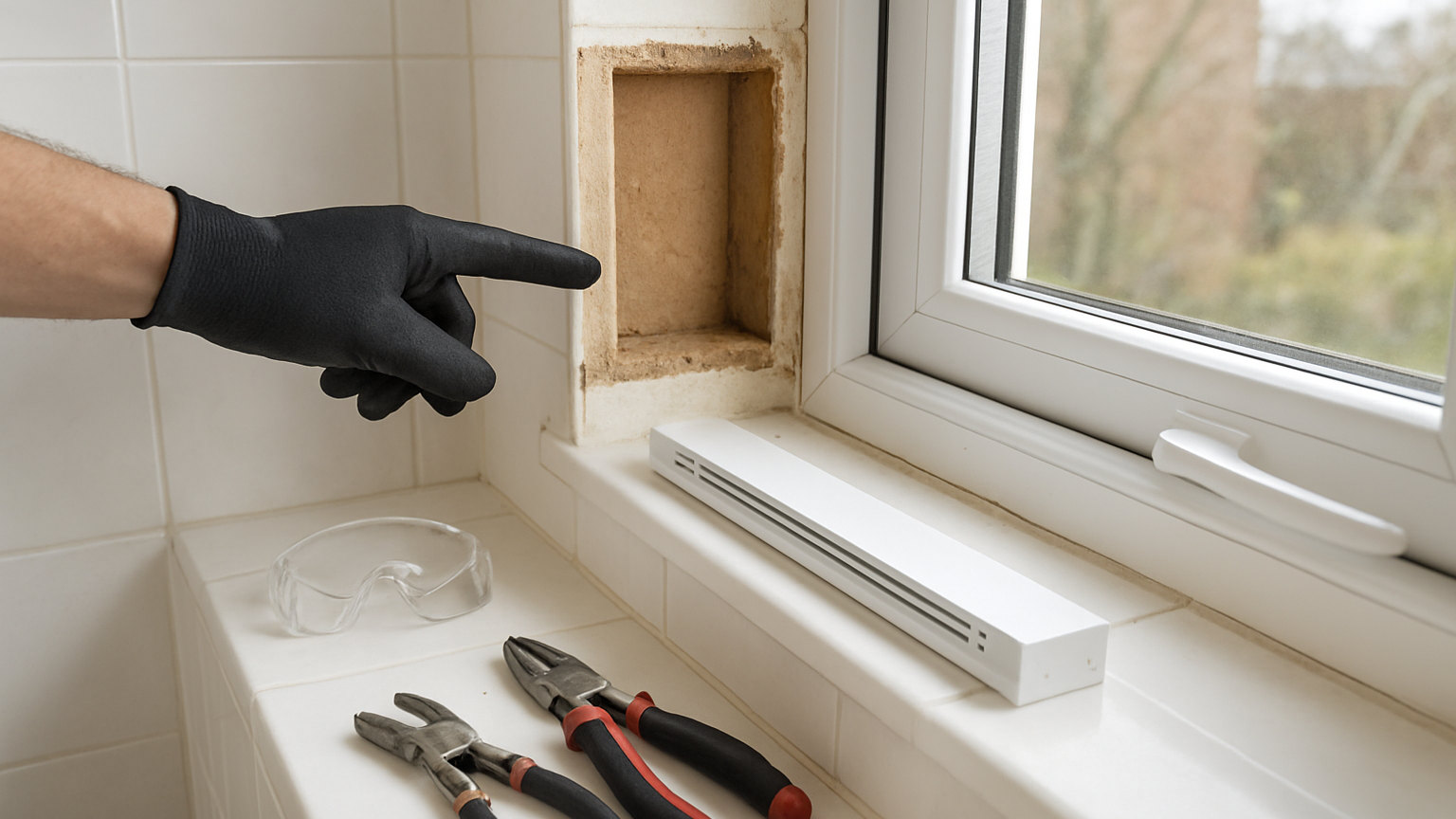
Modern windows are very well sealed, which is exactly the problem. A house that cannot breathe accumulates the moisture its occupants produce, and that moisture has to go somewhere.
Why background ventilation matters
A household produces a substantial quantity of water vapour every day, from breathing, cooking, washing, drying clothes and bathing.
Older houses lost it through draughts. Sealed modern windows and doors do not.
The result is condensation on cold surfaces and black mould, typically in corners, behind furniture on external walls, on window reveals and in bedrooms.
This is the single commonest cause of a house that was fine before new windows becoming damp afterwards.
Extract fans deal with the moisture generated in a kitchen or bathroom at the time. Background ventilation deals with the rest, continuously.
What trickle vents do
A trickle vent is a small controllable opening in the window frame or head.
It provides a low, continuous exchange of air without the draught of an open window.
They are rated by their equivalent area, measured in square millimetres, and the regulations specify a total for each room.
Most have a closable flap, and the intention is that they are left open.
When they are required
Replacement windows must generally provide background ventilation under the building regulations.
The requirement in England was strengthened in 2022. In most cases a replacement window must now include trickle ventilation, whether or not the window being replaced had any.
Previously the rule was broadly that you had to replace what was there, which is why so many houses lost their ventilation when windows were changed.
The requirements differ between England, Wales, Scotland and Northern Ireland, and they are revised, so check the current position.
Your installer should specify this as part of the quotation. Ask about it explicitly, since it is sometimes omitted to keep a price down or because the customer objects to the appearance.
The objections
People dislike trickle vents for two reasons, and both are worth addressing.
Appearance. A vent in the head of the frame is visible. Head vents, over-frame vents and vents concealed in the head detail all reduce this.
Draughts and noise. A vent lets in cold air, and near a road it lets in noise. Acoustic trickle vents are available.
The alternative to background ventilation is not a warmer house; it is a damper one, and damp air is harder and more expensive to heat than dry air.
Retrofitting vents
Possible in most windows.
Through the frame: slots are routed in the top of the frame and a vent fitted over them. This is the usual method on uPVC and timber, and it must not cut into a reinforcement or a drainage channel.
Through the glass: not possible in toughened or sealed units without replacing the pane.
Over-frame or through-wall vents: where the window cannot be modified, a wall vent achieves the same thing.
Check with the window manufacturer before cutting a frame, since it may affect the guarantee and the structural performance.
Using them
Leave them open. A closed trickle vent achieves nothing, and closing them all in winter is exactly when the moisture problem is worst.
Clean them periodically, since they clog with dust and insects.
Check the internal and external flaps both operate.
The wider picture
Trickle vents are one part of a ventilation strategy.
Extract fans in kitchens and bathrooms deal with the moisture at source, and they need to be ducted outside and actually used.
Dry laundry outside or in a vented tumble dryer rather than on radiators.
Keep furniture slightly off external walls so air can circulate.
Heat the house reasonably evenly, since unheated rooms are where condensation forms.
If condensation appears after new windows
Check whether the old windows had vents and the new ones do not.
Check the extract fans work and discharge outside.
Look at where the moisture is being generated and whether it is being removed at source.
Retrofitting trickle vents is usually straightforward and is the direct fix.
Wiping condensation off the glass every morning treats the symptom, and the moisture is still in the house.
Condensation between the panes
Different problem entirely. Misting inside a sealed unit means the seal has failed and the unit needs replacing.
It cannot be dried out or repaired reliably, and it is not a ventilation issue.


