
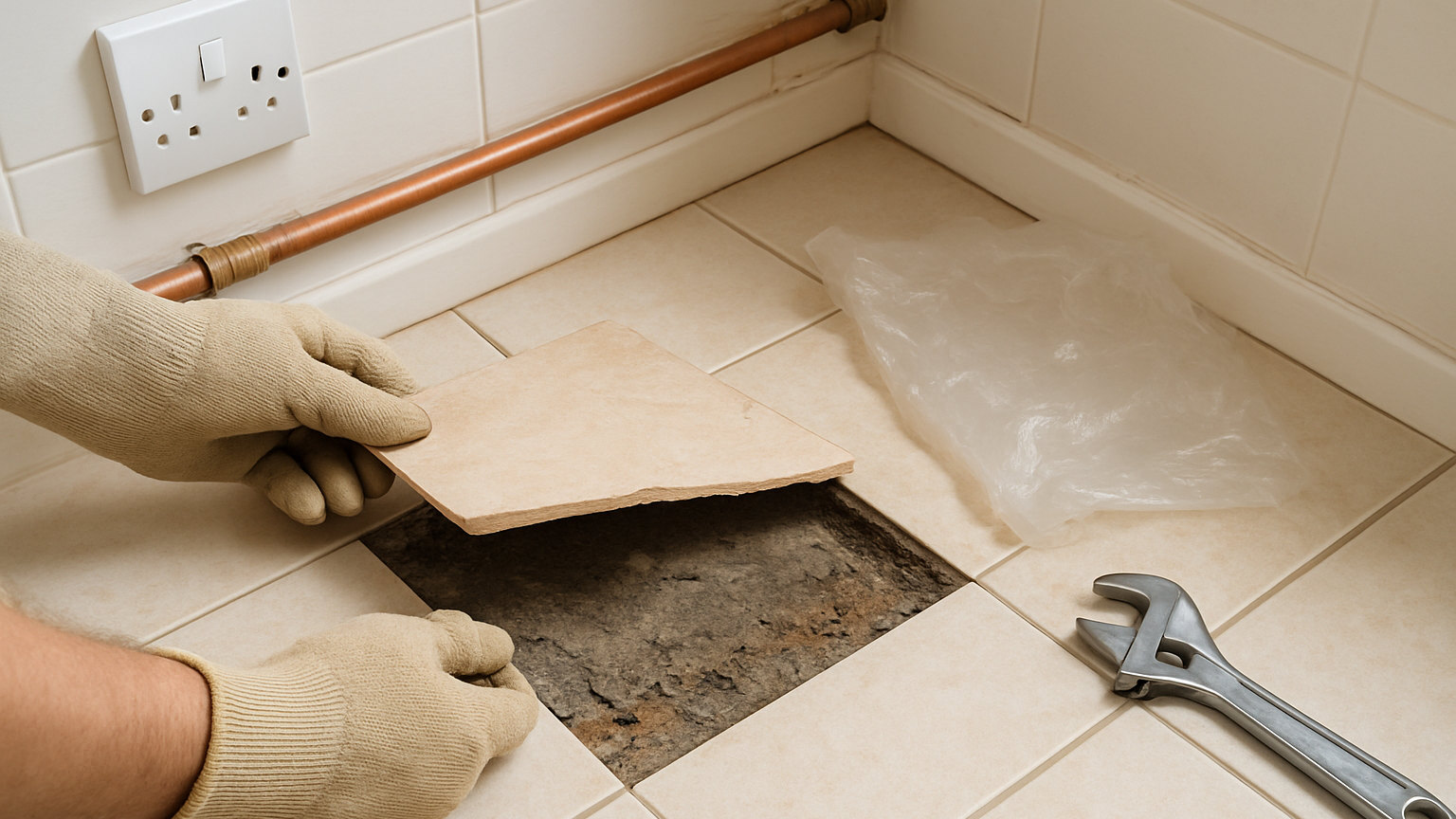
Moisture rises through a solid floor continuously, and anything impermeable laid over it traps that moisture at the joint. This is a common and avoidable cause of flooring failure.
When you need one
Over any solid concrete or screed floor, unless you have positively established there is an effective damp proof membrane already and the floor is dry.
Over new concrete or screed that has not fully dried.
In any ground floor room where the floor is solid.
Not over a suspended timber floor with a ventilated void beneath, where a membrane would trap moisture in the timber. Timber floors need ventilation, not a membrane.
Testing for moisture
Do this before deciding, rather than assuming.
The polythene test. Tape a square of polythene, around 500mm, tightly to the floor on all four edges and leave it for 48 to 72 hours. Condensation on the underside, or a darkened patch of concrete, indicates moisture movement.
Test in several places, including near external walls and in the middle of the room.
A hygrometer test gives a proper relative humidity reading and is what a contractor would use before laying an expensive floor.
Damp meters designed for timber give misleading readings on concrete.
How long concrete takes to dry
Longer than almost anyone expects.
The traditional guide is roughly a day per millimetre for the first 50mm of thickness, and considerably longer beyond that.
A newly laid 75mm screed can take several months.
Drying is slowed by cold weather, poor ventilation and any covering left on the floor.
Laying a floor too early is a common and expensive mistake, particularly on new builds and extensions.
Types of membrane
Sheet polythene DPM, typically 1000 gauge or heavier, laid loose over the floor with joints overlapped generously and taped, and turned up at the walls to above the finished floor level.
Integrated underlay, which combines a foam or fibre underlay with a moisture barrier on the underside. Convenient for a floating laminate or engineered floor, and the joints must still be taped.
Liquid applied DPM, a two-part epoxy or similar painted onto the concrete in two coats. Used where a floor covering is being bonded down and a sheet membrane cannot be used, and where moisture levels are high. Follow the coverage rate exactly, since these are applied by thickness rather than to a visual finish.
Fitting a sheet membrane
Sweep the floor and remove anything that could puncture it.
Roll it out with generous overlaps at joints, typically 200mm or more, and tape every joint with a suitable tape.
Turn it up the walls to above the finished floor height, and trim it once the skirting is on.
Do not puncture it. Any fixing through the membrane defeats it. This is why sheet DPM suits floating floors rather than fixed ones.
Take care not to tear it while laying the floor over it.
Underfloor heating
Where a membrane and underfloor heating are both present, the membrane normally goes below the heating and the insulation.
Check the heating system's instructions, since the build-up matters for both performance and warranty.
What a membrane does not do
It stops moisture reaching the floor covering. It does not fix a damp problem.
Where there is a wider damp issue, standing water, a failed damp proof course or a drainage problem, find and fix the cause.
Covering persistent damp simply moves it, frequently into the walls.
Practical points
Buy a membrane rather than using builders' polythene of unknown gauge.
Allow the floor covering's own acclimatisation period after the membrane is down.
Where the floor is being glued down, the adhesive manufacturer will state a maximum moisture level. That figure governs, not your judgement.
Suspended timber floors
These rely on airflow beneath to stay dry, which is why the airbricks in the external walls matter.
Check the airbricks are clear and not blocked by soil, render, decking or extensions.
Blocking underfloor ventilation is a common cause of rot in floor timbers, and no membrane will compensate for it.
Signs of a moisture problem
Lifting or curling floor covering, adhesive failure, a white powdery deposit on the concrete, a musty smell, or cupping in timber boards.
Any of these means testing before relaying, since the same thing will happen again.


