
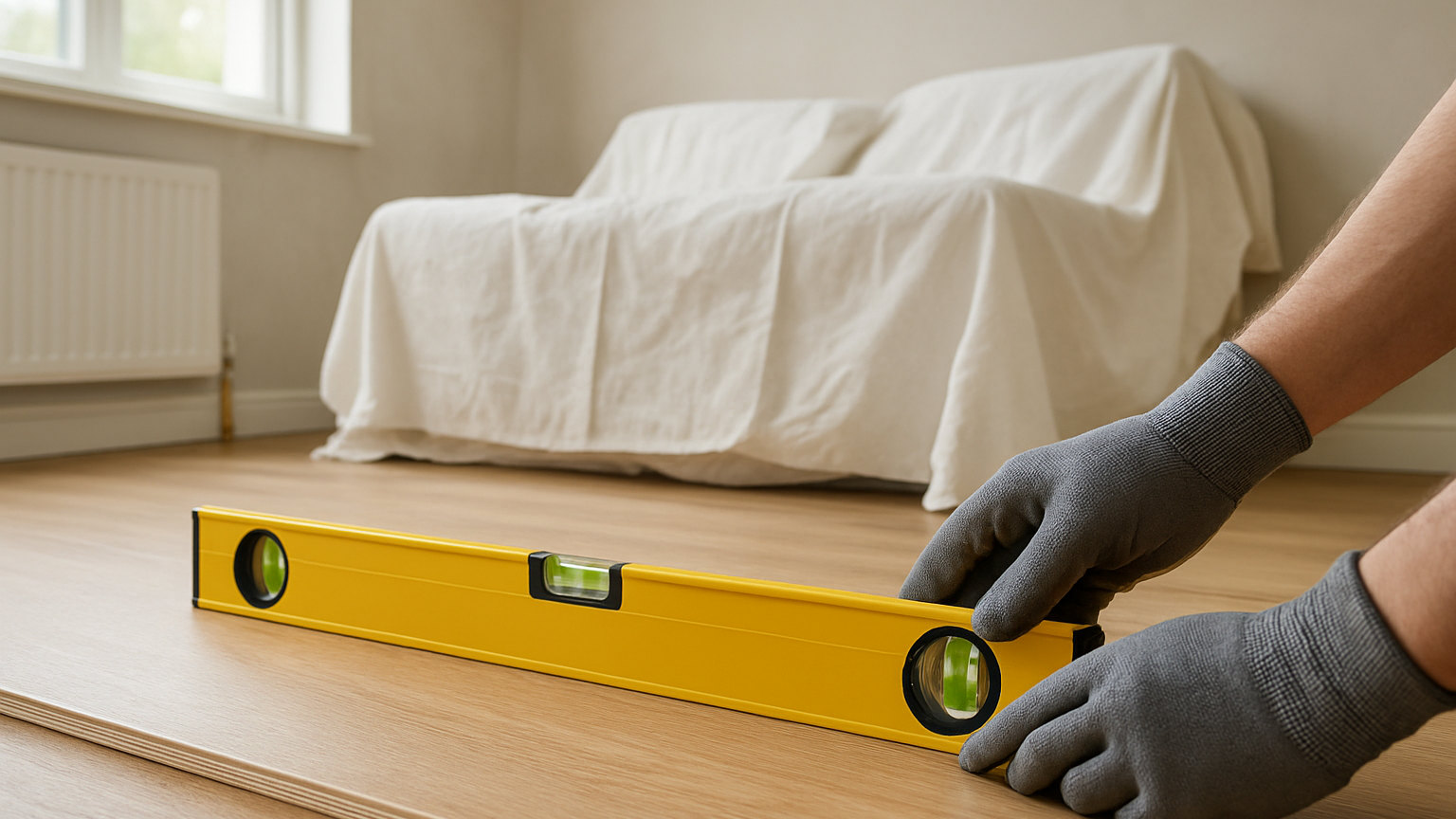
Underlay is cheap relative to the floor above it and has a disproportionate effect on how that floor feels, sounds and lasts.
What it does
Absorbs small irregularities in the subfloor, so the floor does not rock or click.
Reduces noise, both within the room and to the room below.
Adds comfort underfoot.
Provides insulation, which is welcome over a cold floor and unwelcome over underfloor heating.
Carries a moisture barrier where an integrated type is used over a solid floor.
It does not level a floor. Underlay accommodates millimetres, not dips.
Types
Foam, the cheapest, usually polyethylene. Adequate for laminate over a good subfloor. Thin foam does very little.
Fibreboard, rigid boards which are good at smoothing minor irregularities and give a solid feel underfoot.
Sponge rubber and crumb rubber, heavier, quieter and better at impact sound. The best acoustic performance and the highest cost.
Combination underlay with integrated DPM, foam with a polythene backing, for floating floors over concrete.
Carpet underlay, usually PU foam or crumb rubber, and a different product entirely from underlay for hard floors.
Matching it to the covering
Laminate: underlay is essential. Choose a thickness the flooring manufacturer approves, commonly 3 to 5mm. Thicker is not better, since a soft thick underlay flexes and stresses the joints.
Engineered wood, floating: as laminate, and a slightly denser underlay suits the extra weight.
Engineered or solid wood, glued or nailed: no underlay, since the floor is fixed to the subfloor.
Click LVT: only where the manufacturer permits it, and only a thin dense product designed for LVT. Most LVT should be laid on a hard flat subfloor with no underlay, since a soft layer beneath causes the joints to fail.
Glue-down LVT and sheet vinyl: no underlay. The subfloor must be flat.
Carpet: a good underlay transforms how a carpet feels and doubles its life. This is where spending money is most obviously worthwhile.
Tile: no underlay. A decoupling membrane serves a different purpose over a timber or cracked substrate.
Underfloor heating
Underlay insulates, which is exactly what you do not want over heating.
Check the total tog value of the underlay and floor covering combined, which is commonly required to be below around 2.5 tog for the system to work properly.
Use an underlay specifically stated as suitable for underfloor heating, which will be thin and dense.
Thick carpet with a thick underlay can render underfloor heating largely ineffective.
Acoustic requirements in flats
Many leases require carpet, or a specified acoustic performance, on upper-floor flats.
Check the lease before laying a hard floor, since this is a common source of dispute and a hard floor may have to come up.
Where hard flooring is permitted, an acoustic underlay with a stated impact sound reduction is normally required.
Laying it
Butt joints rather than overlapping, and tape them.
Run it in the same direction as the flooring, or as the manufacturer directs.
Where a DPM is integrated, overlap the polythene lip and tape it, and turn it up at the walls.
Do not double up underlay to gain thickness.
Only roll out what you will cover, so it is not walked on or damaged.
What the manufacturer says
Flooring warranties frequently specify the underlay, or exclude damage caused by an unsuitable one.
Check the flooring instructions before buying underlay, since the wrong choice can void the guarantee as well as spoil the floor.
Buying
Underlay is sold by the roll in square metres. Add a small margin for trimming.
The difference in price between the cheapest and a good product across an average room is modest, and the difference underfoot is not.
Over a suspended timber floor
Do not use a moisture barrier, which would trap moisture in the timber. The void needs to breathe.
Use a breathable underlay instead, and make sure the airbricks serving the void are clear.
Fitting it correctly
Run underlay at right angles to the flooring where the manufacturer directs, since this is sometimes specified and affects how the joints line up.
Butt the edges rather than overlapping, and tape them so they cannot separate as the floor is laid over them.
Trim it back to the expansion gap at the walls, or turn the integrated barrier up if there is one.
Reusing old underlay
Rarely worth it. Compressed foam underlay has lost most of its performance, and carpet underlay is unsuitable under a hard floor.


