
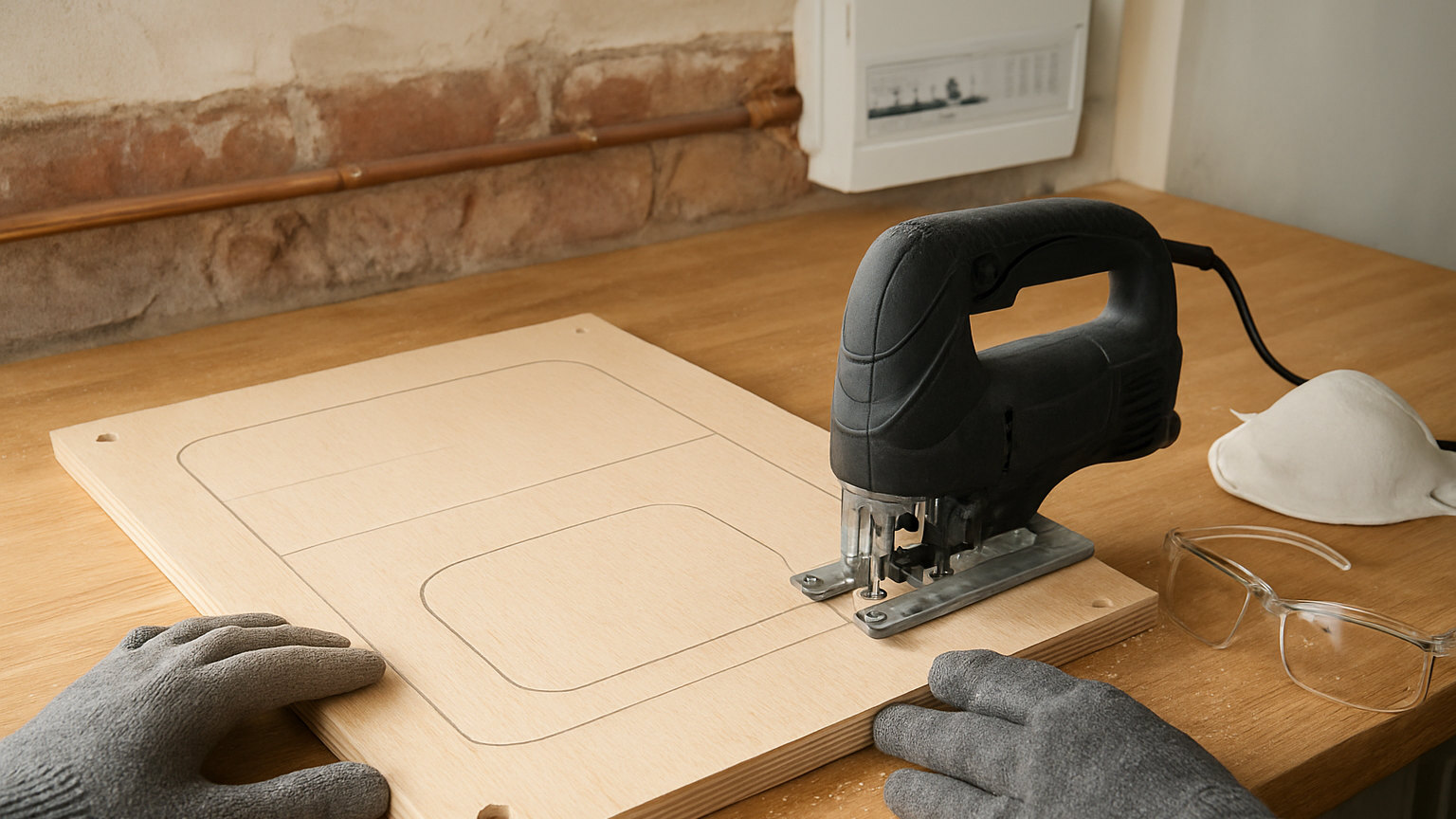
This is the cut that worries people, and reasonably so. There is one attempt, in the middle of an expensive piece of material, and it cannot be moved afterwards.
Before marking anything
Check the worktop is in its final position and fully scribed to the wall, since the cut-out position is relative to the finished top.
Check what is underneath. The sink cut-out must clear the unit sides, the waste position and any bracing rail. Hob cut-outs must clear the oven housing below.
Check the manufacturer's minimum clearances from the cut-out to the wall, to the front edge and to any adjacent hob or sink. These are stated in the instructions and are not advisory.
Check the hob instructions for the minimum distance to a side wall and to a tall unit, which is a safety requirement.
Marking out
Most sinks and hobs supply a paper template. Where they do not, invert the unit on the worktop and draw round it, then mark the cut line inwards by the amount stated in the instructions.
Do not simply draw round the rim and cut on that line, since the cut-out must be smaller than the rim by the specified amount so the unit is supported.
Position the template and check the measurements from the front edge and from each end, twice.
Think about where the taps and the drainer go, and which way the sink is handed.
Mark with a pencil or masking tape, and take a photograph before cutting.
Measure everything again before switching a tool on.
Reducing chipping
Laminate chips on the face where the blade exits.
Score along the cut line with a sharp knife and a straight edge, cutting through the laminate surface.
Apply masking tape along the whole cut line, which supports the surface and lets you mark on it.
Use a fine downcut jigsaw blade, which cuts on the down stroke and pulls the surface downwards rather than tearing it up.
Set the jigsaw to no pendulum action.
Making the cut
Drill a hole in each corner just inside the cut line, using a drill bit large enough to take the jigsaw blade, typically 10 to 12mm.
Drilling the corners gives a clean radius and a place to start and stop each straight run.
Support the waste piece from below so it cannot drop and tear the surface as the cut completes. Screw a batten across it and support it on something, or have a second person hold it.
Cut from corner hole to corner hole along each side, moving steadily and letting the blade do the work.
Keep the base plate flat on the surface throughout.
Cut the final side last and take the weight of the waste as it comes free.
Sealing the cut edges
The most important step and the one most often skipped.
The exposed core is chipboard, and water reaching it causes irreversible swelling. Sink cut-outs are where almost all laminate worktop failures begin.
Seal the whole cut edge, top and bottom faces of the cut and the raw core, with PVA, a proprietary sealer or silicone.
Let it dry before fitting the sink.
Seal again around the underside of the sink rim as the manufacturer directs.
Fitting the sink
Dry fit first and check the clearance all round.
Fit the tap and the waste to the sink before dropping it in, since access underneath is far easier on the bench.
Apply the sealant or gasket supplied, drop the sink in and fit the clips from below, tightening evenly around the perimeter.
Wipe off excess sealant immediately.
Fitting the hob
Follow the manufacturer's instructions exactly, since clearances and sealing methods vary.
Fit the supplied gasket or seal so water cannot reach the cut edge.
A gas hob must be connected by a Gas Safe registered engineer.
An electric hob may need a dedicated circuit, and new circuits are notifiable work.
If it goes wrong
A cut slightly oversize is usually hidden by the rim. A cut in the wrong place is not recoverable, which is why the measuring matters more than the cutting.
Practising first
Cut a test hole in an offcut before touching the worktop, to check the blade, the technique and how much the surface chips.
Ten minutes on scrap removes most of the anxiety.
Solid surface and stone
Granite, quartz and solid surface worktops are templated and cut by the supplier, not on site.
Do not attempt to cut them yourself, both because the material is unforgiving and because cutting engineered stone releases silica dust, which is a serious health hazard.


