
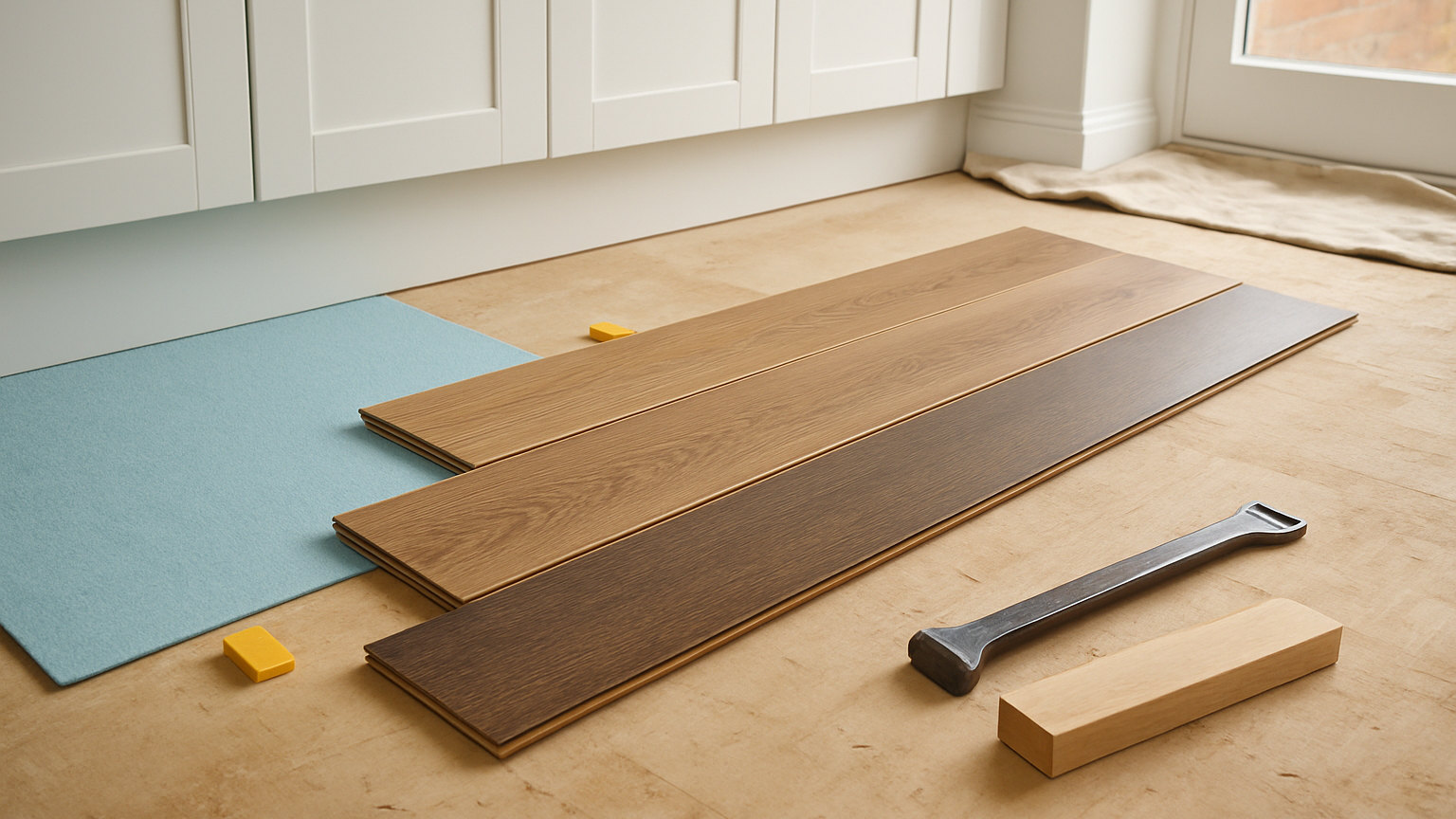
A kitchen floor gets water, grease, dropped pans and more traffic than any other room. Several popular flooring types cope poorly with at least one of those.
The options
Luxury vinyl tile and plank, known as LVT. Waterproof, warm underfoot, quiet, forgiving of dropped items and available in convincing wood and stone effects. Needs a very flat subfloor, since any unevenness telegraphs through. The common choice for kitchens now.
Sheet vinyl. Fully waterproof with no joints at all in a small room, cheap and easy to clean. Less convincing underfoot and can be cut or torn.
Ceramic and porcelain tile. Extremely durable and fully waterproof, cold and hard underfoot unless there is underfloor heating, and anything dropped on it breaks. Requires a rigid subfloor with no deflection.
Engineered wood. Handsome and more stable than solid wood, and it will still be damaged by standing water. Usable in a kitchen with care.
Laminate. Cheap and hard wearing on the surface, with a fibreboard core that swells permanently if water reaches the joints. Water-resistant laminates are considerably better than ordinary ones, and LVT is the safer choice.
Solid wood. Beautiful and the least suited to a kitchen, since it moves with humidity and is damaged by water.
Vinyl or rubber safety flooring for a utility or a practical kitchen, which is exceptionally durable and less domestic in appearance.
Under the units or up to them
A genuine decision with arguments on both sides.
Laying the floor first, with units on top, means the floor is continuous, appliances can be slid in and out without a lip, and a dishwasher can be removed easily. It uses more flooring, and replacing the floor later means removing the kitchen.
Laying up to the units uses less material and means the floor can be changed without touching the kitchen. It creates a joint at the plinth, and integrated appliances have to be lifted over the flooring edge.
For tile, laying under the units and appliances is generally preferred, since the height difference is significant.
For LVT and vinyl, either works.
Decide before ordering, since it affects the quantity and the appliance heights.
Subfloor preparation
The part that determines success, particularly with LVT and vinyl.
The subfloor must be clean, dry, sound and flat.
Use a self-levelling compound on an uneven solid floor.
On a timber floor, overboard with plywood or hardboard, screwed down at close centres, to give a flat stable base.
Check for movement and deflection, particularly before tiling, since a floor that flexes cracks tiles and grout. Additional noggins or a thicker overlay may be needed.
Check for damp in a solid floor before laying anything, and use a damp proof membrane where required.
Expansion gaps
Floating floors, including laminate, engineered wood and click LVT, expand and contract.
Leave the expansion gap the manufacturer specifies around the entire perimeter, including against units, pipes and door frames.
A floating floor with no expansion gap buckles, and this is the commonest failure.
Cover the gap with beading or the skirting.
Acclimatise the material in the room for at least 48 hours before laying.
Around obstacles
Undercut door frames and architraves with a flush cut saw and slide the flooring under, which looks far better than cutting round.
Use pipe collars where pipes come through.
Seal the perimeter in a wet area with silicone rather than leaving the gap open.
Underfloor heating
Check the flooring is rated for use over it and observe the maximum surface temperature.
Tile is the best conductor and the best match. Thick timber floors insulate and reduce output.
Practical points
Buy ten per cent more than the measured area, and keep the offcuts for repairs, since matching a discontinued batch is usually impossible.
Lay planks along the longest dimension of the room, or along the main light source, which makes the space look larger.
Check the floor height against the underside of doors and appliances before committing, since a thick floor can trap an integrated dishwasher.
Consider a mat or a rug at the sink, which is where most water lands.
Utility rooms
Treat these as harder-wearing kitchens: fully waterproof flooring, and a sealed perimeter, since a washing machine leak in a utility can run for hours before it is noticed.


