
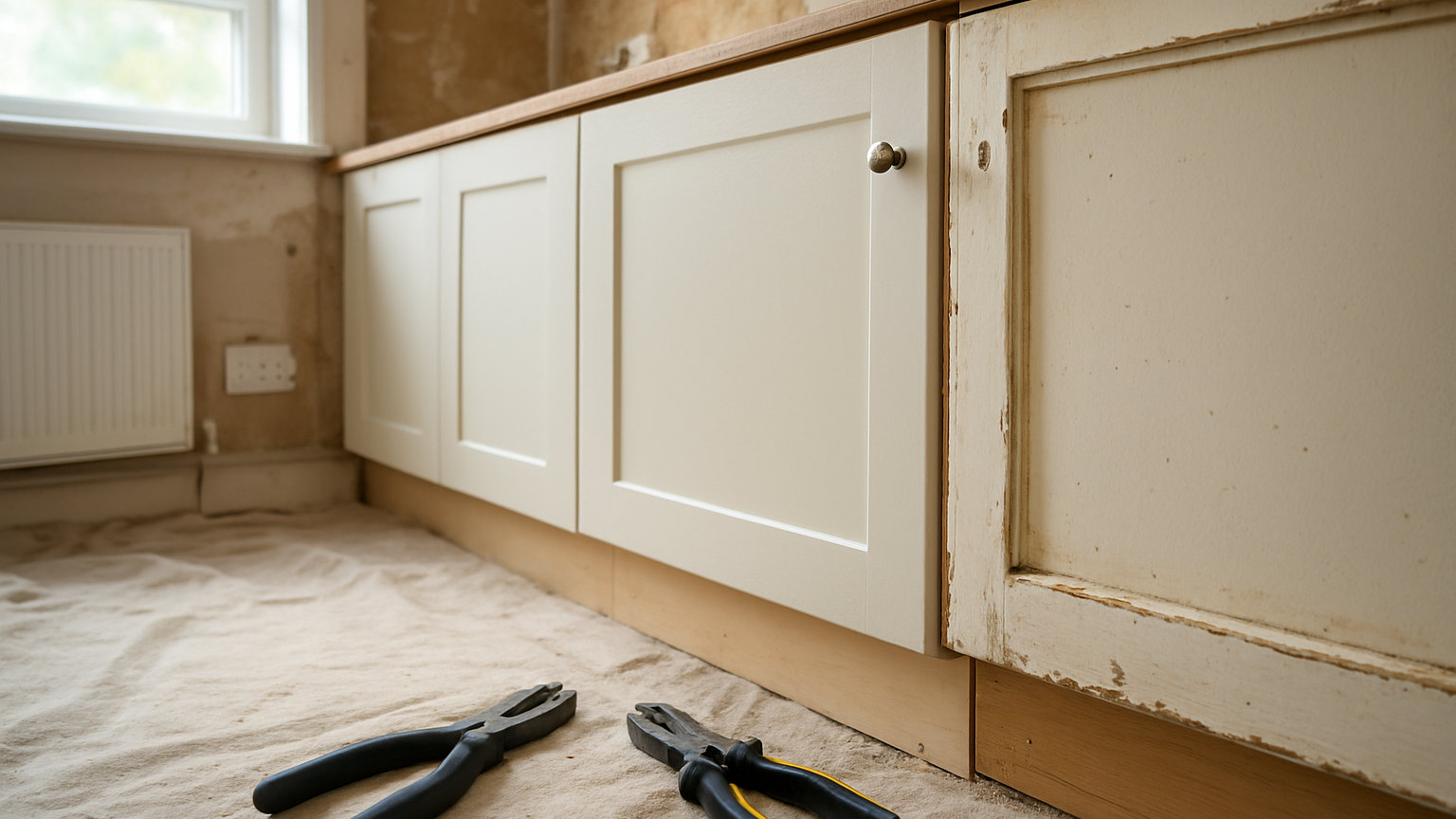
The carcases are usually the part that lasts and the doors are the part that dates. Where the boxes are sound, replacing the visible components transforms a kitchen for a small proportion of the cost of a new one.
Check the carcases first
This decides whether the approach is worth taking.
Are they square and level? Check with a level and by measuring the diagonals of the openings. Units that were fitted badly will not accept new doors any better than the old ones.
Is the material sound? Look for swelling at the base of the sink unit, water damage, delaminating edges and sagging shelves.
Are the fixings secure? Push and pull the units. Wall units in particular should not move.
Are the hinge fixings still good? Chipboard around hinge plates strips over time. Individual repairs are possible but widespread failure is a bad sign.
If the carcases are sound, proceed. If several are failing, the saving disappears.
Does the layout still work
The one thing this approach cannot change.
If the kitchen is in the wrong arrangement, replacing the doors makes a badly laid out kitchen look newer.
Be honest about whether the problem is appearance or function.
Measuring for replacement doors
Measure the existing doors, not the openings, since the overlay onto the carcase varies.
Measure height and width of each door to the millimetre, and record which unit each belongs to.
Note whether doors are handed and which way each opens.
Measure the hinge hole positions: the diameter of the boring, usually 35mm, the distance from the edge of the door to the centre of the hole, and the distance from the top and bottom of the door to each hole centre.
Count the hinges on each door, since tall doors may have three.
Measure drawer fronts separately, and note the fixing method.
Photograph everything with the measurements written on the photos.
Ordering
Many suppliers make replacement doors to any size, and will bore the hinge holes to your dimensions if you supply them.
Order a sample door first, fit it, and check it before committing to the whole kitchen.
Order matching end panels, cornice, pelmet and plinth, since the old ones rarely match new doors.
Order new hinges at the same time if the old ones are worn or the boring is a different standard.
What else to replace at the same time
The worktop, which makes as much visual difference as the doors and is the other thing that wears out.
Handles, which change the character entirely and cost very little.
The sink and tap, particularly if the worktop is coming off anyway.
The splashback.
Hinges and drawer runners, which transform how the kitchen feels to use.
Doing all of these still costs a fraction of a full replacement.
Painting instead
A cheaper alternative again, and it works on solid timber and on some laminate and vinyl-wrapped doors.
Take the doors off and work flat.
Clean thoroughly with a degreaser, since kitchen doors carry a film of grease that prevents adhesion.
Key the surface by sanding, and use a specialist primer suitable for the substrate.
Use a hard-wearing cabinet or satinwood paint, applied thinly in several coats.
Allow proper curing time before use, which is considerably longer than the touch-dry time. Paint that feels dry can still be marked for days.
Vinyl-wrapped doors that are already peeling will not paint successfully.
The decision
Sound carcases, a layout that works, and a budget that will not stretch: replace the doors and the worktop.
Failing carcases or a layout that does not function: replace the kitchen.
Vinyl wrapping and refacing films
Self-adhesive films are sold for covering doors and are a short-term cosmetic fix rather than a lasting one.
They lift at the edges, particularly near heat and steam, and rarely look convincing on a moulded door.
Paint or new doors give a far better result for a modest additional cost, and last considerably longer.
Timing
Doors and worktop can be changed over a weekend with the kitchen still usable, which is the other advantage of this approach.
Change the doors first, live with it, and do the worktop separately if the budget needs spreading over a longer period.


