
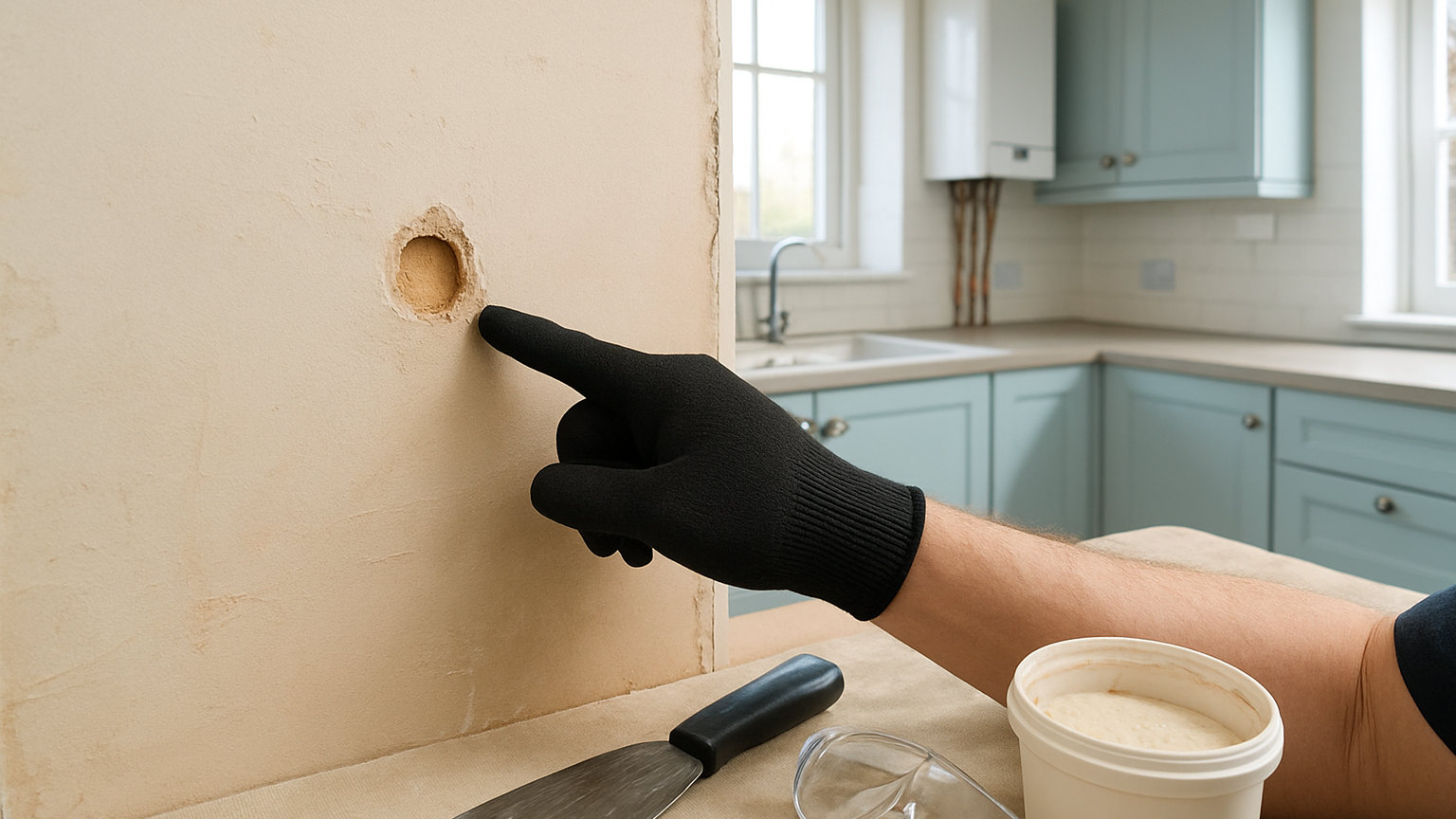
Every fixing decision starts with knowing what is behind the plaster. Getting this wrong is behind most failed shelves and fallen cupboards.
The four things it could be
Solid masonry: brick or block with plaster directly on it. Takes an ordinary plug and screw.
Timber stud wall: plasterboard on a timber frame, with a void behind. Fix into the studs.
Dot and dab: plasterboard stuck to masonry on blobs of adhesive, leaving a gap of around 25 to 30mm. Very common in houses built or refurbished since the 1980s.
Lath and plaster: thin timber laths with plaster pushed through them, in older properties. Unpredictable and weak.
Tapping
Crude and surprisingly informative.
A solid dull thud means masonry directly behind.
A hollow sound means a void, either a stud wall or dot and dab.
Tap along the wall horizontally at a steady height. On a stud wall the sound changes noticeably where you cross a stud.
On dot and dab the sound is hollow but flatter, and changes where you cross a dab.
Stud spacing
Studs are normally at 400mm or 600mm centres, measured centre to centre.
Once you have found one reliably, measure along in those increments and check.
There will also be studs at each corner, beside every door and window opening, and horizontal noggins somewhere in the height, often at mid height.
A stud is typically 38 to 50mm wide, so you have a modest target.
Socket and switch boxes
A useful clue on a stud wall.
Boxes are usually screwed to the side of a stud, so there is a stud immediately beside every socket and switch.
Turn off the circuit, remove the faceplate and look at which side the box is fixed.
Skirting boards are also fixed into the studs, so the nail or screw positions show where they are.
Using a detector
Electronic detectors find density changes, and they need using properly.
Calibrate it on a part of the wall you know is empty, following the instructions.
Sweep slowly and mark both edges of what it finds, then take the centre. A single beep is not a stud position.
Sweep from both directions to confirm.
Check at two different heights, since a single reading may be a pipe or a cable rather than a stud.
Always use the detector in its cable and pipe mode as well, and check before drilling anywhere. Detectors are not infallible, particularly on lath and plaster or with foil-backed board.
The test hole
The definitive answer, and it takes a minute.
Drill a small hole with a fine bit somewhere that will be hidden, low behind a sofa or where the fixing will go.
Look at the dust. White powder then a void means plasterboard with a cavity. White powder then red or grey grit means dot and dab, and the depth before you reach it tells you the cavity size. Continuous timber shavings mean a stud.
Feel the resistance as you drill, which is quite different through timber, plasterboard and brick.
A bent wire pushed through the hole and rotated tells you how deep the void is and where the obstruction starts.
Cables and pipes
Cables should run in safe zones, broadly vertically and horizontally from an accessory, and within 150mm of the top of a wall or an internal corner.
They are not always where they should be.
Assume there is something behind any point directly above or below a socket, switch or light.
Use a detector, drill shallow first, and stop if anything feels wrong.
What this determines
Masonry: plug and screw, and drill into the brick rather than the mortar for heavier loads.
Stud: fix into the timber wherever possible, or add a noggin.
Dot and dab: the screw must reach and grip the masonry behind the board.
Lath and plaster: fix into the studs only.
Adding a stud or a noggin
Where there is nothing to fix into and the load is substantial, the reliable answer is to create something.
Cut out a section of plasterboard, fit a timber noggin between the studs, screw it to them, and patch the board over it.
This is more work than a toggle fixing and gives a fixing that will never fail.
Do it before decorating rather than after, and note the position for later.
Recording what you find
Mark the stud positions lightly in pencil before you start, and photograph the wall.


