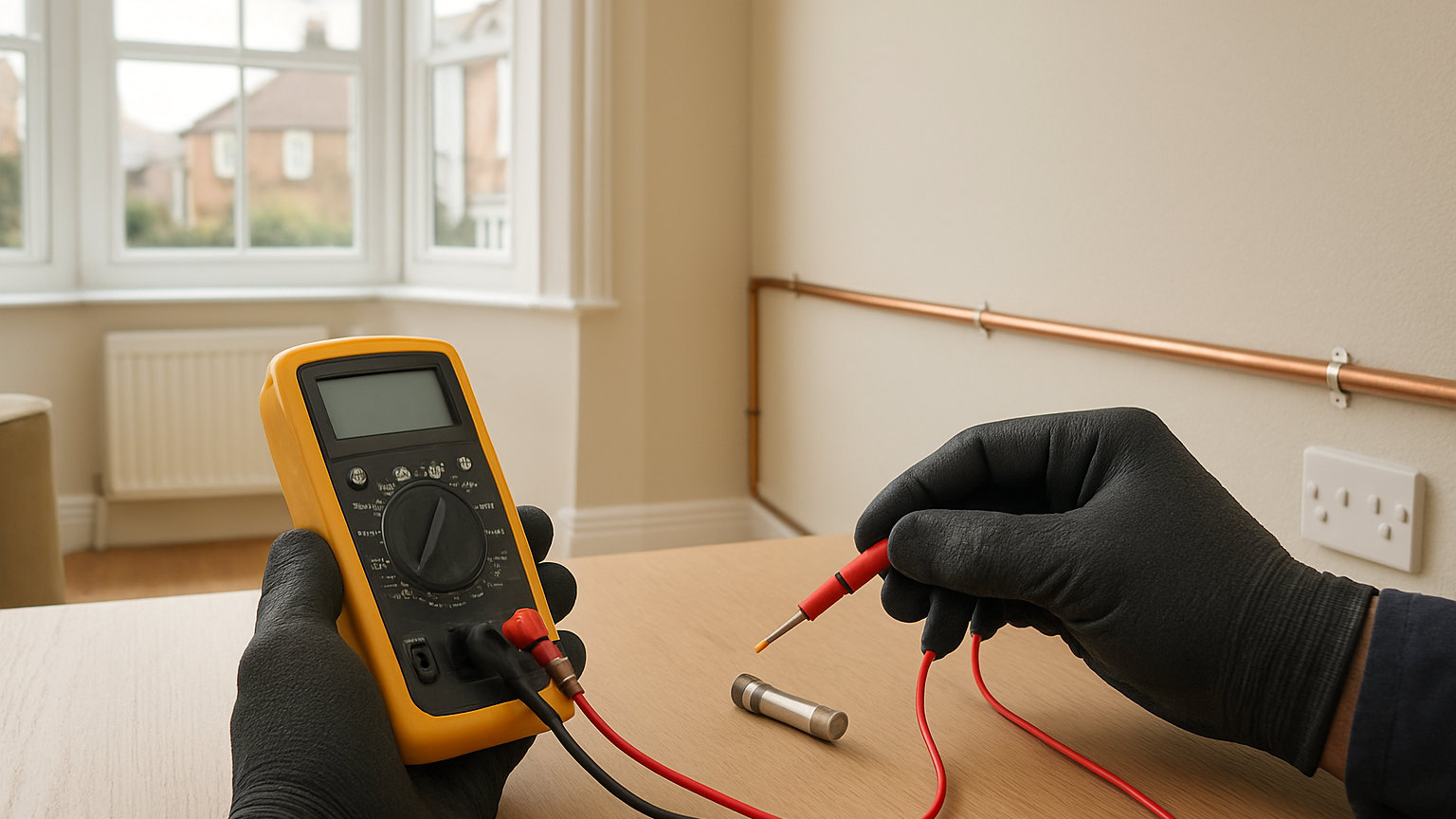
A multimeter is an inexpensive and genuinely useful thing to own, provided you are clear about the narrow set of jobs it is appropriate for in a domestic setting.
What it does
A multimeter measures voltage, current and resistance, and most have a continuity test that beeps when a circuit is complete.
For household use, three functions matter.
DC voltage, for checking batteries.
Continuity, for checking fuses, bulbs, cables and switches.
Resistance, for checking whether a component is open circuit.
Where it earns its place
Checking whether a battery is actually flat rather than guessing, which saves throwing away good ones.
Testing a plug fuse or a cartridge fuse for continuity, which tells you in seconds whether it has blown.
Checking whether an extension lead or an appliance cable has a break in it.
Testing a bulb or a heating element for continuity.
Checking low voltage garden lighting, doorbells and vehicle circuits.
Checking whether a switch is making contact.
Most of these are low voltage or dead tests, which is exactly where a multimeter belongs in a household toolkit.
What it must not be used for
This matters more than anything else here.
A multimeter is not a substitute for a qualified electrician, and it does not make you safe around mains electricity.
Most electrical work in a home is notifiable under the building regulations and must be done by a registered competent person or notified to building control.
Testing a circuit for the absence of voltage before working on it requires a proper approved voltage indicator and a defined procedure, not a cheap multimeter. A meter on the wrong range, with a damaged lead, or reading a phantom voltage, can tell you a live circuit is dead.
Never work on a live circuit. Isolate at the consumer unit, lock or label it off, and confirm with the correct equipment.
If the answer to your question requires probing live mains, the answer is to call an electrician.
Safety categories
Meters are rated by category, which describes the electrical environment they can survive.
CAT I and CAT II are for low energy circuits and domestic socket outlets.
CAT III and CAT IV are for distribution and supply, where fault energy is far higher.
An uncategorised or unbranded meter is not suitable for anything mains related, and cheap meters frequently have leads that are the weakest part.
Check the leads for damage before every use, and replace them if the insulation is nicked.
Choosing one
Auto ranging is worth having, since it removes the commonest user error of selecting the wrong range.
A continuity beeper, so you can test without looking at the display.
A clear display and a stand or magnet, since both hands are usually occupied.
Decent leads with shrouded probes.
Fused current inputs, which protect the meter and you if current is measured by mistake.
A recognised safety standard marking and a stated category rating.
Using it for the basics
To test a battery, set the meter to DC volts, touch red to positive and black to negative, and compare against the nominal voltage. A 1.5V cell reading well below that is spent.
To test a fuse, set it to continuity, touch a probe to each end, and listen for the beep. No beep means it has blown.
Always test continuity on something disconnected and dead, never in a live circuit.
Check the meter works by touching the two probes together before trusting a result.
An honest summary
Worth owning for battery, fuse and continuity checks, and for low voltage work in the garden and on vehicles.
Not the tool that lets you do your own electrics, and not a safety device.
Buy a reasonable one with a category rating and good leads, or do not buy one at all.
Looking after it
Turn it off after use, since leaving it on a resistance range flattens the battery.
Store it somewhere dry with the leads coiled loosely rather than tightly wrapped, which breaks the conductors inside the insulation.
Replace leads at the first sign of damage rather than taping them, because the leads are what stands between you and whatever you are measuring.