Falls from height cause the most serious injuries in home improvement, and most of them happen at heights people consider trivial. What you stand on is worth thinking about properly.
Start with the job
Most domestic work is below three metres, and for that a good pair of steps or a small platform is safer and more useful than a long ladder.
Duration matters as much as height. A quick task from a ladder is reasonable; two hours of painting at the same height is not.
If you need both hands, need to reach sideways, or will be up there a while, you want a platform rather than a ladder.
Step ladders
The most useful purchase for most households.
Look for a wide top platform you can stand on comfortably, rather than a narrow top step.
A handrail or safety rail above the platform gives something to hold and something to lean against.
Four or five treads suits ceiling work in a normal room. Buy the size that lets you work with your waist below the top, rather than standing on the very top.
Aluminium is light and cheap; fibreglass is heavier and does not conduct, which matters near electrics.
Platform steps and podiums
A small platform with a guardrail all round.
Far more stable and comfortable than steps, with room to put tools down and a rail to lean on.
Heavier and more expensive, and worth it for any sustained work such as decorating a ceiling or fitting coving.
They take up storage space, which is the main objection.
Extension ladders
For reaching gutters, roofs and upper windows.
Buy one that extends at least a metre above the highest point you will step to or work from.
Double or triple section, with the triple being shorter when closed and easier to store.
A stand off arm is worth buying at the same time. It holds the top away from the wall, spreads the load, avoids leaning on guttering and lets you work against the face rather than round the ladder.
Standards and ratings
Look for the current EN 131 standard marking, which has applied to domestic and trade ladders in recent years.
Ladders are classified for professional or non-professional use. Professional class ladders are built to a higher duty rating and are worth the extra even for domestic use.
Check the maximum load, which includes you, your clothing, your tools and anything you carry up.
Avoid unmarked ladders and be cautious with very old ones, which predate current standards.
Setting a ladder up
Firm, level ground. Use a levelling device on a slope rather than packing the feet with bricks.
One unit out for every four units up, around 75 degrees. Too steep and it tips back; too shallow and the feet slide.
Secure it: tie the stiles at the top, have someone foot it, or use a stability device.
Extend at least a metre above the stepping off point.
Maintain three points of contact and keep your belt buckle between the stiles. If you have to lean out, move the ladder.
What not to lean on
Plastic guttering, which breaks or deflects.
Glass and conservatory frames.
The top of a fence.
Anything that can move or rotate.
Overhead cables
Look up before positioning anything.
Service cables run into many houses at eaves level, and aluminium ladders conduct.
Keep well clear, use a fibreglass ladder where working near electrics, and contact the network operator rather than approaching a damaged cable.
Trestles and towers
A scaffold tower is the right answer for a long job at height, and hire is inexpensive.
Use the stabilisers, fit the guardrails and toe boards, lock the castors, and never move it with anyone on it.
A pair of trestles and a scaffold board is useful at low level and needs a proper board rather than any plank.
Looking after them
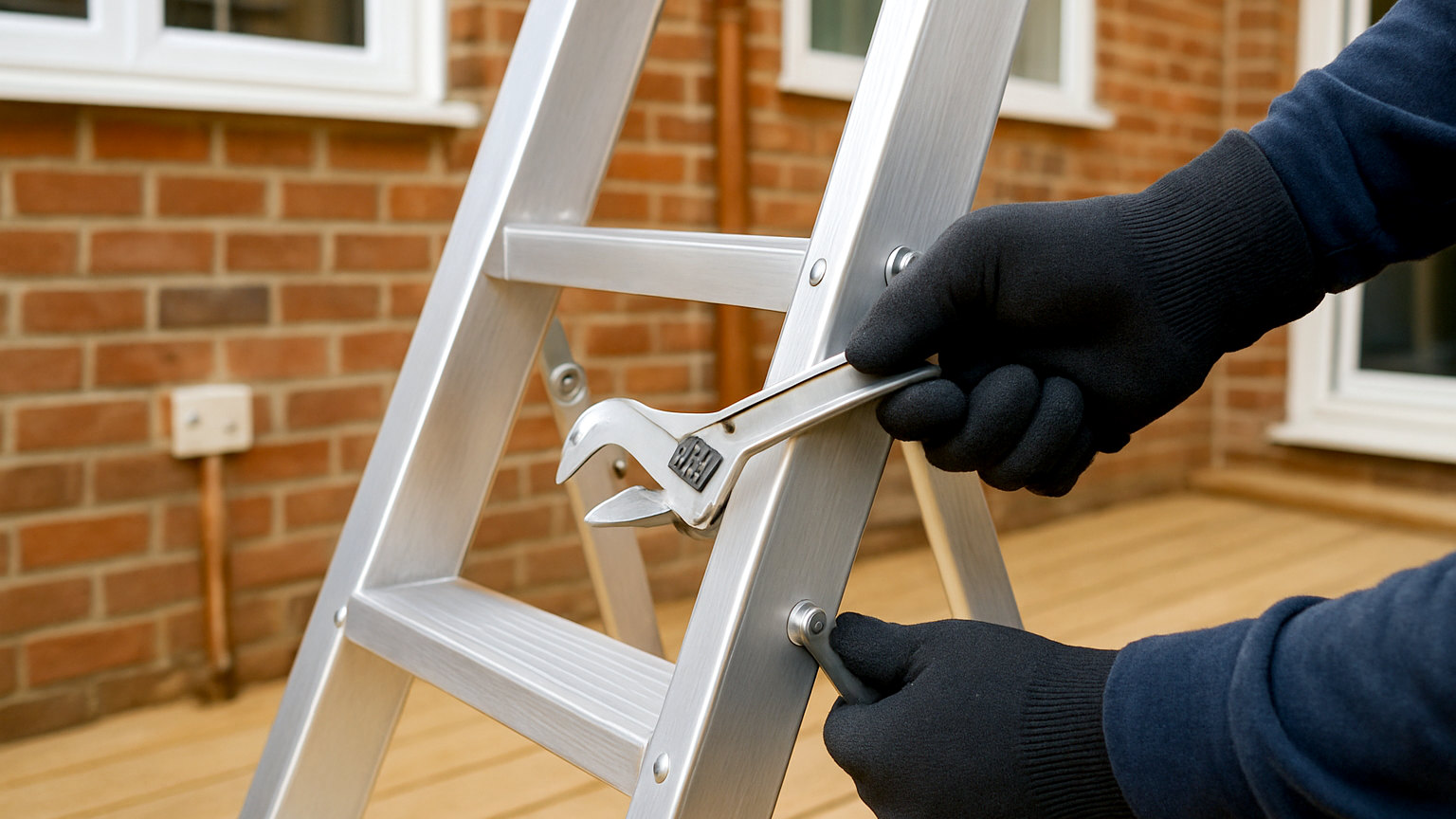
Check before each use for bent stiles, loose rivets, damaged feet and worn locking hooks.
Do not buy ladders secondhand, since the history is unknown and the failure mode is a fall.
Store under cover, and clean mud and paint off the rungs, which is a common cause of slipping.