
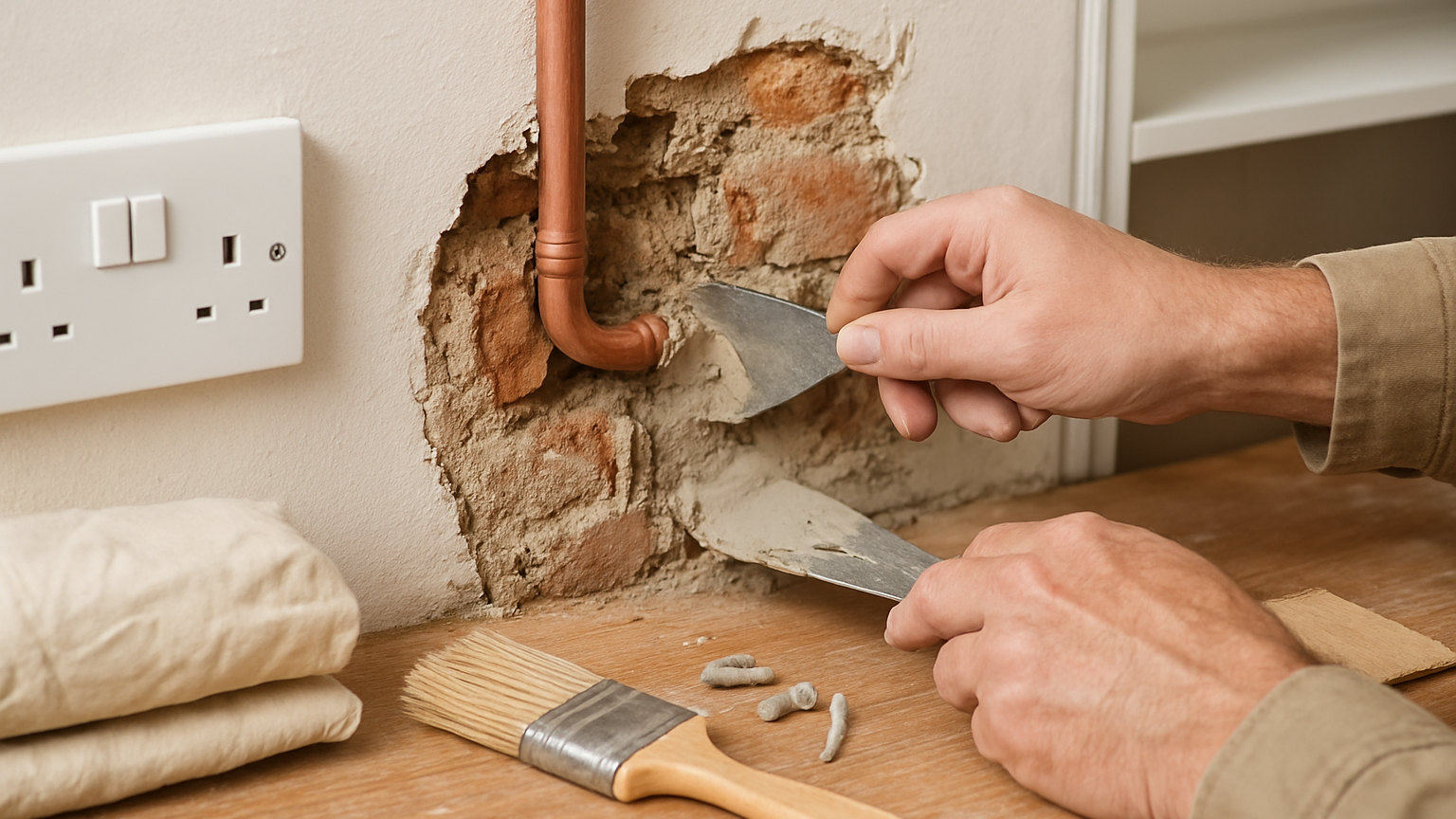
Brick and timber are forgiving. Tile, glass, aerated block and old crumbling masonry each fail in their own way, and each has a technique that works.
Ceramic tile
- Mark the position, and avoid drilling within about 15mm of an edge or into a grout line, both of which crack
- Stick masking tape over the spot, which stops the bit skating and marks clearly
- Use a spear point tile bit for ceramic
- Turn hammer action OFF. Hammer action cracks tile immediately
- Drill at slow speed with light steady pressure
- Once through the tile, switch to a masonry bit for the wall behind, and only then engage hammer if needed
- Use a plug that reaches into the substrate, not just the tile
Porcelain tile
Far harder than ceramic. A spear point bit will not touch it.
- Use a diamond tipped bit
- Slow speed, light pressure, no hammer
- Keep it cool with water: a sponge, a spray bottle, or a plasticine dam around the hole holding a puddle
- Heat destroys a diamond bit and cracks the tile
- Start at a slight angle to establish a groove, then bring the drill upright
- Be patient; it takes considerably longer than ceramic
Glass
- Use a diamond or spear point glass bit, very slow speed, constant water cooling
- Never hammer action
- Support the glass fully on a flat surface
- Ease off as you approach breakthrough, which is when it cracks
- Toughened glass cannot be drilled at all. It shatters completely into fragments. It must be made with the holes before toughening
- Wear eye protection and gloves
Aerated or lightweight block
Common in the inner leaf of cavity walls since the 1970s. Soft, and it crumbles easily.
- Use no hammer action, or the lightest setting. Hammer blows out an oversize hole
- Drill slowly
- Standard plastic plugs grip poorly; the material simply crushes
- Use a plug designed for aerated block: longer, with a coarse thread form that cuts into the material
- Frame fixings and aerated block screws work well
- For anything heavy, use a resin anchor
- Spread the load over several fixings
Hollow block and hollow brick
Blocks with voids inside. The drill breaks through into a cavity.
- A standard plug expands into the void and grips nothing
- Use a cavity fixing designed for hollow block, such as a toggle or a metal expansion anchor
- A resin anchor with a perforated mesh sleeve is the strongest answer: the resin extrudes through the mesh and keys into the voids
- Drill without hammer, which shatters the webs between the voids
Old soft brick and lime mortar
- Use light or no hammer action
- Drill slowly
- Fix into the brick where it is sound; in very soft brick the mortar may be better
- Use a longer plug in a deeper hole
- Resin anchors are the reliable answer in crumbling material
- Take care near the edge of a brick, which spalls
- Consider whether the material needs repointing or repair before fixing anything to it
Lath and plaster
Older ceilings and walls: thin timber laths with plaster pushed through.
- Fragile, and it crumbles and cracks in sheets
- Find a stud or a joist and fix into that
- Where you must fix to the lath and plaster itself, use a fixing designed for it, and only for light loads
- A toggle needs a hole through, and drilling a large hole through lath and plaster frequently cracks it
- Drill very gently, with no hammer
- Wear an FFP3 mask: a lath and plaster cavity contains a century of dust and soot
- Consider whether the ceiling is sound enough to carry anything at all
Metal
- Centre punch first, or the bit wanders
- Clamp the work securely; a spinning workpiece is dangerous
- HSS bits for mild steel, cobalt for stainless
- Slow speed and cutting fluid. Both dramatically extend bit life
- Steady firm pressure, producing a continuous curl of swarf rather than dust
- Drill a pilot then step up for a large hole
- Ease off at breakthrough, where the bit grabs
- Deburr afterwards
- For fixing into thin sheet, use a self-tapping screw, a rivet, or a nut and bolt with a penny washer
Plastic and uPVC
- Use a sharp bit at moderate speed; too fast melts it
- Support behind to prevent cracking
- Drill a clearance hole rather than forcing a screw, since plastic splits
- Allow for thermal movement, which is significant in uPVC
- Do not drill into a uPVC window or door frame without knowing what is inside: there is usually a steel reinforcement, and there may be a sealed unit or a lock mechanism
Concrete
- An SDS drill is far more effective than a hammer drill
- Reinforcement bar will stop a bit dead. If progress stops suddenly, move position rather than forcing
- Never cut reinforcement, which is structural
- Clear dust from the hole repeatedly
- Silica dust: use on-tool extraction or wet drilling, and an FFP3 respirator
Plasterboard over insulation
- Insulated plasterboard has rigid foam bonded behind, so the void is filled with material that grips nothing
- A cavity fixing has nothing to open into
- Fix into the studs, or through into the masonry with a long enough plug
- Measure the total thickness first, since it can be 50 to 100mm or more
General principles for difficult materials
- Slow down. Almost every difficult material responds better to slow speed
- Turn hammer action off unless you are sure it is needed
- Keep it cool where the material or the bit is heat sensitive
- Test in an inconspicuous spot where you can
- Use more fixings, spread out, rather than one large one
- Resin is the answer when nothing else grips
- Consider whether you can avoid the fixing entirely: adhesive, a different position, or a freestanding arrangement
If it goes wrong
Tile cracked: hammer action was on, the bit was wrong, or it was too close to an edge.
Hole blown out oversize: too much hammer in soft material. Use resin.
Plug spins in aerated block: use an aerated block plug, a frame fixing, or resin.
Drill stopped dead in concrete: reinforcement bar. Move position.
Lath and plaster cracked: it is fragile. Repair, and fix into a joist instead.


