
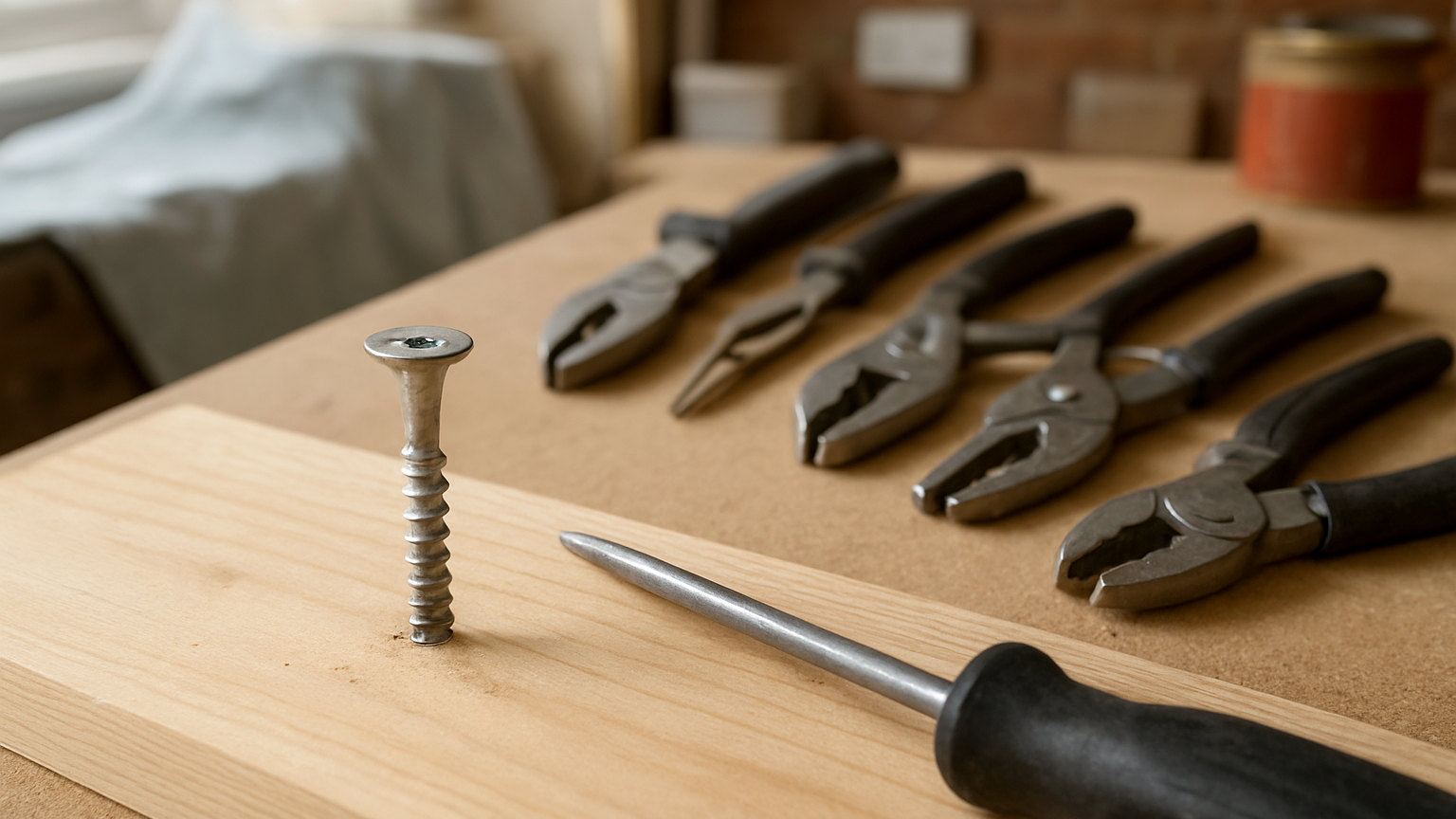
Pliers grip, twist and cut. The main mistake is using one type for a job another does far better, particularly using pliers where a spanner is needed.
The types
Combination pliers. The general purpose pair: flat serrated jaws for gripping, a curved section for round objects, and side cutters at the back. The one pair to own if you own one.
Long nose, or needle nose. Slim tapered jaws for reaching into confined spaces, holding small parts, bending wire and retrieving dropped items. Usually with small cutters. Very useful in electrical and plumbing work.
Water pump pliers, also called slip joint or by the brand name. Adjustable jaws with several positions, giving a wide grip range and strong leverage. For pipes, nuts and anything round. The most useful adjustable gripping tool in a household kit.
Locking pliers, commonly called mole grips. Jaws that clamp and lock with an over-centre action, set by a screw in the handle. They act as a portable vice, a clamp and an emergency handle. Excellent for gripping a rounded fastener.
Side cutters or diagonal cutters. Cut wire and small fasteners flush. For electrical work and cable ties.
End cutters or nippers. Jaws at right angles to the handles, for cutting wire flush to a surface and pulling small nails and tacks.
Pincers. Rounded jaws for pulling nails and tacks. Rolled against the surface for leverage.
Circlip pliers. Internal or external, for retaining rings.
Wire strippers. Purpose-made for removing insulation without nicking the conductor.
What to own
A sensible household set:
- Combination pliers, around 180mm
- Long nose pliers
- Water pump pliers, a large and a small pair
- Locking pliers, 175mm or 250mm
- Side cutters
- Wire strippers for any electrical work
Choosing pliers
- Forged, hardened jaws hold their shape; soft jaws round off
- Smooth action with no side play at the pivot
- Comfortable handles, and insulated handles are not the same as VDE insulated tools
- For electrical work, choose tools marked as insulated to the relevant standard, and still isolate and prove dead first
- Water pump pliers with a push-button adjustment are quicker to use than slot type
Step 1: grip correctly
- Open the jaws wide enough to sit fully over the workpiece
- Grip as close to the pivot as the job allows, where the leverage is greatest
- Grip the handles near their ends for maximum force
- Keep the jaws square to the work, not at an angle
- Pull rather than push where possible, so a slip does not drive your hand into something
Step 2: what pliers are not for
Pliers are not a spanner.
- Serrated jaws round off the corners of a nut or a bolt head
- Once rounded, no spanner will grip it and removal becomes far harder
- Use a spanner or a socket of the correct size
- Water pump pliers on a chrome fitting will mark it; wrap it in cloth or use a strap wrench
Other misuses:
- Not a hammer
- Not a pry bar
- Do not extend the handles with a tube for more leverage
- Do not cut hardened steel with ordinary cutters, which chips the edges
Step 3: locking pliers
The most versatile and the most misunderstood.
- Open the jaws by releasing the lever
- Set the adjusting screw in the handle so the jaws are slightly narrower than the workpiece
- Place over the work and squeeze the handles until they lock with a click
- Adjust the screw and repeat until the lock is firm but not so tight that it will not release
- Release with the lever
Uses: gripping a rounded nut, acting as a clamp, holding metal for cutting, as an emergency tap handle, and holding a snapped bolt.
Step 4: cutting safely
- Wear eye protection. Cut ends fly off at speed and this is a genuine and common eye injury
- Hold or shield the offcut with your free hand or a cloth
- Cut square to the wire, not at an angle
- Match the cutter to the material: ordinary cutters will chip on hardened wire or nails
- Never cut a live conductor
- Cut in stages for thick material rather than forcing in one go
Step 5: electrical work
- Isolate at the consumer unit, lock off and prove dead before touching anything
- Use insulated tools rated for the work
- Use proper wire strippers rather than cutters, since nicking a conductor weakens it
- Long nose pliers form neat hooks for terminal connections
- Never rely on insulated handles as protection on a live circuit
Care
- Oil the pivot occasionally. A stiff pivot makes pliers unpleasant and imprecise
- Wipe clean and keep dry
- Do not leave them in a damp shed or outside
- Keep cutting edges away from hard steel
- Check the pivot for play; excessive play means the jaws no longer meet
- Replace rather than repair worn cutters
If it goes wrong
Nut rounded off: pliers were used instead of a spanner. Locking pliers may still grip it, or use an extractor socket.
Jaws slipping: worn serrations, or the grip is too far from the pivot.
Cutters chipped: used on hardened material.
Marking a chrome fitting: use a cloth pad or a strap wrench.
Pivot stiff: clean and oil it.
A summary
- Combination pliers for general work, long nose for confined spaces
- Water pump pliers are the most useful adjustable gripping tool to own
- Locking pliers act as a portable vice and grip a rounded fastener
- Grip close to the pivot and hold the handles near their ends
- Pliers are not a spanner; serrated jaws round off nuts
- Wear eye protection when cutting, and shield the offcut


