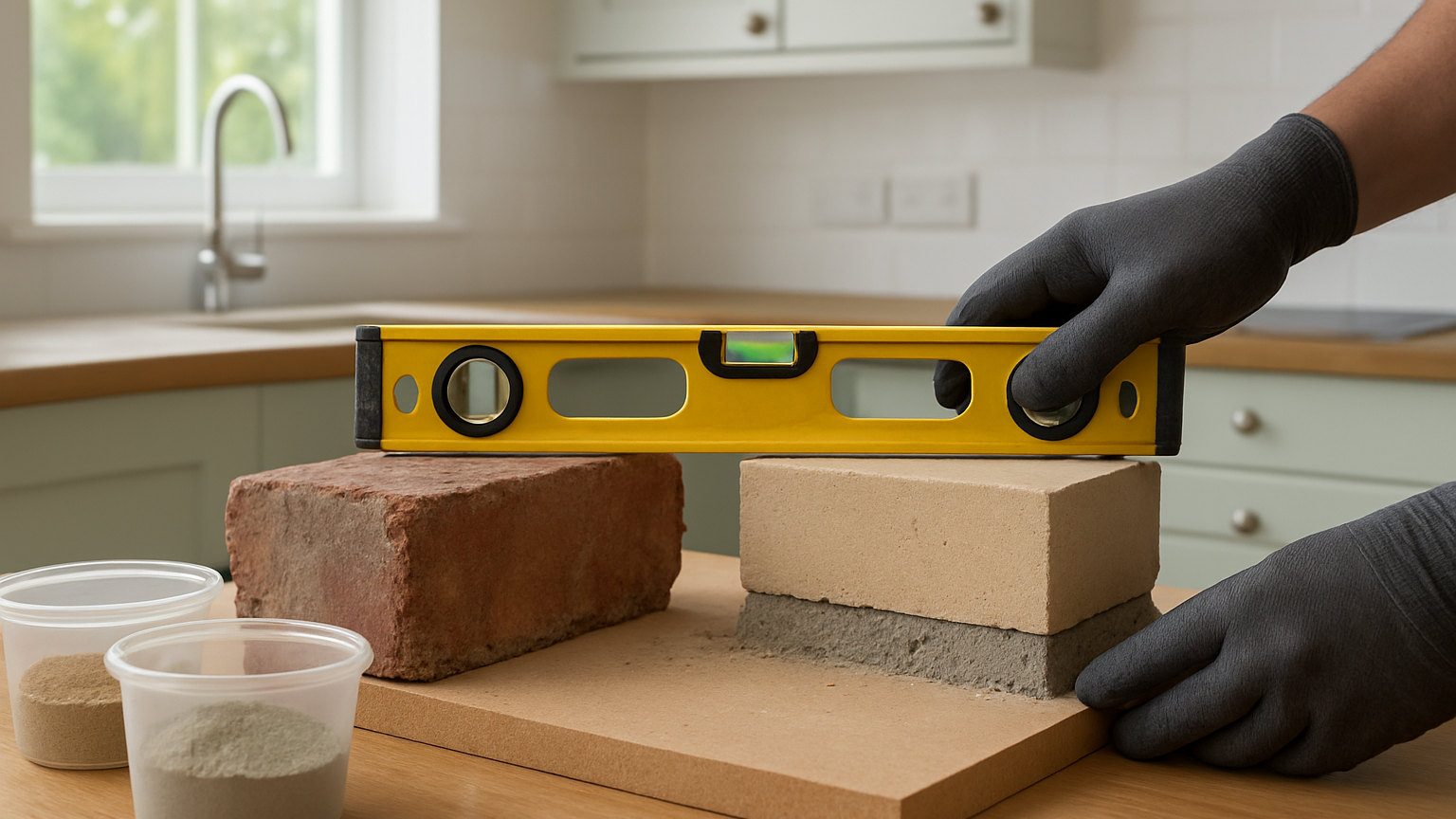
Cement based materials are mixed by proportion, and the proportions and the sand type both matter. So does what the material is going onto.
The components
Cement. The binder. Ordinary Portland cement is the standard. Reacts chemically with water to harden, a process called hydration.
Sand. The fine aggregate, and the type matters.
- Building sand, also called soft or bricklaying sand: fine and smooth. For mortar, where workability matters
- Sharp sand, also called concreting or grit sand: coarser and angular. For concrete, screed and render, where strength matters
- Kiln dried sand: for brushing into block paving joints
- Using building sand in concrete gives a weak result; using sharp sand in mortar gives an unworkable one
Aggregate. The coarse component in concrete: gravel or crushed stone, typically 10 or 20mm.
Ballast. Sand and aggregate pre-mixed, so you add only cement. Convenient.
Lime. Improves workability and gives flexibility. Traditional and increasingly used again.
Plasticiser. An additive improving workability, largely replacing lime in modern mortar.
Standard mixes, by volume
Proportions are by volume, measured with a bucket or a shovel used consistently.
Concrete:
- General purpose: 1 cement : 2 sharp sand : 4 aggregate. Paths, bases, footings
- Stronger: 1 : 1.5 : 3. Structural work, thin sections, driveways
- Foundations: 1 : 2.5 : 3.5 or as specified
- Or use ballast: 1 cement : 5 ballast for general work
Mortar for brickwork:
- General: 1 cement : 6 building sand, with plasticiser
- Traditional: 1 cement : 1 lime : 6 building sand
- Exposed or below DPC: 1 : 4, stronger
- Soft or old brick: 1 : 2 : 9 cement, lime and sand, or a pure lime mortar
Render:
- Base coat: 1 : 4 or 1 : 5 with sharp sand
- Top coat: weaker than the base coat
Screed:
- 1 cement : 3 or 4 sharp sand, mixed relatively dry
The rule about strength
Each successive coat or layer should be no stronger than the one beneath it.
- A strong render over weak masonry cracks and pulls the face off the substrate
- A strong top coat over a weaker base coat cracks and delaminates
- A strong mortar in soft brickwork does not accommodate movement, so the brick faces spall instead of the mortar
The mortar is meant to be the sacrificial element. It should be weaker than the brick, so that when something has to give, it is the mortar joint, which can be repointed. A hard cement mortar reverses that.
Lime mortar and old buildings
An important point for anyone with a pre-1919 house.
- Older buildings are typically solid walled and built with lime mortar
- They manage moisture by allowing it to move through the fabric and evaporate
- Lime is soft, flexible and breathable. It accommodates movement and lets moisture out through the joints
- Cement mortar is hard, rigid and relatively impermeable. Moisture cannot escape through the joints, so it goes through the brick face instead
- The result is spalling: the brick faces freeze, blow and crumble
- Cement pointing on an old lime-built wall causes damage over years, and is a common and expensive mistake
Repoint an old solid wall in lime mortar, matched to the original. Take advice, and specialist help where the building is listed.
Step 1: mixing
- Measure by volume with a consistent bucket or shovel
- Mix the dry materials together thoroughly first, until the colour is uniform
- Form a crater and add water gradually
- Mix to a workable consistency and no wetter
- Too much water dramatically weakens the result, and this is the commonest error
- Concrete should hold its shape when a ridge is formed, not slump
- Mortar should hold on the trowel without sliding off
- Mix only what you can use in the working time, roughly two hours
- Never add water to a mix that has started to stiffen. Discard it
Step 2: curing
Cement gains strength by chemical reaction with water, not by drying out. Keeping it damp is what makes it strong.
- Cover concrete with polythene or damp hessian for at least three days, and preferably seven
- Keep it damp in hot or windy weather, which dries the surface too fast and causes crazing and dusting
- Protect from rain for the first several hours, which washes the surface out
- Protect from frost. Do not lay concrete or mortar if frost is expected within 24 hours, or below about 5 degrees
- Reaches usable strength in a few days, and continues gaining strength for weeks
Concrete that has dried out too fast is permanently weak.
Step 3: quantities
- Volume equals length times width times depth, in metres, giving cubic metres
- A 25kg bag of ready-mixed concrete makes roughly 0.012 cubic metres, so around 80 bags per cubic metre
- Add around 10 per cent for compaction, spillage and uneven ground
- Above about 1 cubic metre, ready-mixed delivered is usually cheaper and far less work
- Mortar: roughly 1 tonne of sand and 8 to 10 bags of cement per 1000 bricks
Step 4: hiring a mixer
- Worth hiring for anything over a few barrow loads
- Far more consistent than mixing by hand, and much less effort
- Load in order: some water, then aggregate, then sand, then cement, then the rest of the water
- Let it mix for a few minutes after the last addition
- Clean it thoroughly before the mix sets, adding water and some aggregate and running it
Health and safety
Wet cement is corrosive and causes serious burns.
- It is strongly alkaline and can cause chemical burns that develop slowly and painlessly, so damage occurs before you notice
- Wear waterproof gloves, and boots if standing in it
- Cover skin; do not kneel in wet concrete
- Wash any contact off immediately with plenty of water
- Get medical advice for anything more than brief contact, and urgently for eyes
- Cement can also cause allergic dermatitis
Dry cement dust:
- Contains silica. Wear an FFP3 respirator when handling and mixing
- Eye protection
- Open bags carefully and avoid raising dust
Never wash cement or plaster down a drain, where it sets. Let it settle in a bucket and bin the solids.
If it goes wrong
Concrete crumbling or dusty: too much water, or it dried too fast. It cannot be repaired.
Mortar cracking: too strong a mix, or it dried too quickly.
Brick faces spalling: cement mortar in soft brickwork. It needs repointing in lime.
Mix went off before use: too large a batch, or hot weather. Mix smaller quantities.
Cement burn on skin: wash thoroughly and get medical advice.