
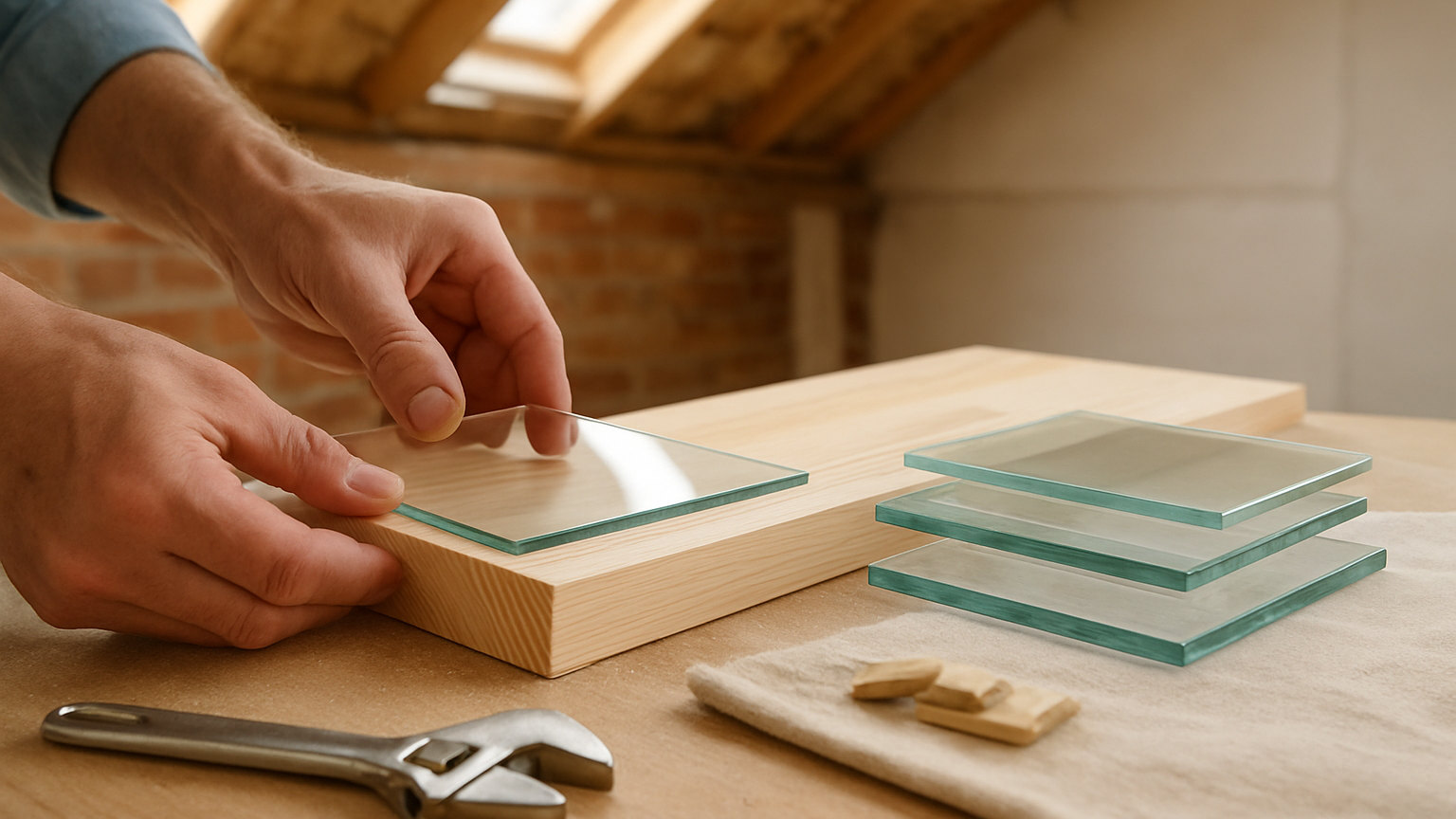
Glass is one of the few household materials where the specification is a legal requirement in defined positions. Getting it wrong is a safety issue.
The types
Float glass, sometimes called annealed. Ordinary glass. Breaks into large sharp shards, which is why its use is restricted in certain positions.
Toughened, or tempered.
- Heat treated so the surfaces are in compression
- Four to five times stronger than float glass of the same thickness
- Breaks into small blunt granules rather than shards, which is what makes it safety glass
- Cannot be cut, drilled or modified after toughening. Any attempt shatters the entire pane. It must be made to final size with all holes before treatment
- Vulnerable to edge damage, and a chipped edge can lead to spontaneous breakage later
Laminated.
- Two or more layers of glass bonded to an interlayer
- When broken, the fragments stay attached to the interlayer, so the pane remains in place
- The better choice where the glass must continue to provide a barrier after breaking, such as overhead glazing and balustrades
- Also provides security and sound reduction benefits
- Can be cut, by scoring both faces and cutting the interlayer, and it is a skilled job
Wired glass. A wire mesh embedded in the glass. Provides fire integrity. Not impact safety glass unless specifically rated, which is a common misconception.
Obscure and patterned glass. For privacy, available in various patterns and privacy levels, and in toughened or laminated form.
Critical locations
The Building Regulations require safety glass in defined positions, because these are where people are likely to fall against glass.
Broadly, the critical locations are:
- In a door, and in a side panel next to a door, below 1500mm from floor level
- In a wall or partition below 800mm from floor level
- Glazing in a bathroom or wet area at low level
- Overhead glazing
- Balustrades and barriers
Glass in these positions must be safety glass: toughened or laminated, of the appropriate classification, or protected by permanent screen protection.
Replacing glass in a critical location with float glass is both a Building Regulations breach and genuinely dangerous. Check before ordering, and take advice if uncertain.
Identifying safety glass
- Look for a permanent mark etched in a corner, showing the standard, the manufacturer and the type
- A kitemark or equivalent indicates independent certification
- Toughened glass viewed through polarised sunglasses shows a faint pattern of spots or stripes
- Laminated glass shows the interlayer as a fine line at the edge
- Unmarked glass in a critical location should be assumed not to be safety glass
Sealed units
Two or more panes with a spacer bar and a sealed cavity, usually gas filled.
- The cavity is filled with argon or another inert gas, improving performance
- The spacer bar contains a desiccant, absorbing residual moisture
- Warm edge spacers reduce heat loss at the perimeter and reduce edge condensation
- Triple glazing adds a third pane
Misting between the panes means the seal has failed.
- Moisture has entered and the desiccant is saturated
- The unit cannot be repaired reliably. Drilling and drying systems exist and generally do not restore performance
- The unit is replaced, not the whole window: a glazier removes the beads and fits a new unit
- Much cheaper than a new window
- Take accurate measurements, or have the glazier measure
Coatings and performance
- Low emissivity, low-E: a microscopically thin metallic coating reflecting heat back into the room. Now standard, and it substantially improves the U-value
- Applied to a specific face within the unit; fitting a unit the wrong way round reduces its performance
- Solar control: reduces heat gain, useful on south-facing and roof glazing
- Self-cleaning: a coating that breaks down organic dirt in sunlight and lets rain sheet off
- Window energy ratings band overall performance, and Building Regulations set minimum U-values for replacement windows
Step 1: measuring for glass
- Measure the rebate to rebate dimension in the frame
- Measure in three places both ways and use the smallest
- Deduct a clearance all round as the glazier advises, typically a few millimetres
- Check the frame is square by measuring the diagonals; if not, a template is needed
- State the thickness, the type and whether it is toughened or laminated
- State whether the glass is in a critical location
- Toughened glass cannot be adjusted, so the measurement must be right
Step 2: handling
- Cut-resistant gloves and eye protection
- Carry glass vertically, on edge, never flat, since it flexes and breaks under its own weight
- Two people for anything large, and suction cups make it far safer
- Stand it on timber battens, never on concrete, which chips the edge
- Lean it slightly against a wall rather than upright
- Keep it out of walkways and mark it so nobody walks into it
- Protect the edges, since edge damage is what leads to breakage
Step 3: broken glass
- Keep people and pets away
- Wear cut-resistant gloves and sturdy shoes
- Pick up large pieces first, then vacuum thoroughly
- Press damp kitchen paper or bread onto the area to lift small fragments the vacuum misses
- Toughened glass shatters into thousands of granules that travel a long way; search a wide area
- Wrap fragments securely in thick paper or card, label the parcel, and dispose of it as directed locally
- Never put loose broken glass in a bin bag
- Board up the opening securely until it is reglazed
Step 4: when to get a glazier
- Anything in a critical location
- Overhead or roof glazing
- Anything large or heavy
- Sealed unit replacement
- Anything at height
- Where the frame condition is uncertain
- Replacement windows, which are notifiable and normally done under a competent person scheme
Alternatives to glass
- Polycarbonate: effectively unbreakable, and it scratches. For sheds, greenhouses and guards
- Acrylic: clearer and more scratch resistant, and brittle
- Neither has the surface hardness, optical quality or longevity of glass
- Neither is a substitute where safety glass is specified unless it meets the relevant impact classification
If it goes wrong
Toughened glass shattered while being fitted: edge damage, or it was forced. It cannot be cut or eased.
Sealed unit misted: the seal has failed. Replace the unit, not the window.
Glass will not fit: the frame is out of square, or the clearance was not allowed.
Existing glass unmarked in a door: assume it is not safety glass and have it assessed.
Condensation on the room side: that is humidity, not a failed unit. Improve ventilation.


