Insulation materials differ in performance, cost, handling and how they behave with moisture. The last of those is what causes problems when the wrong one is used.
How performance is measured
Lambda value, the thermal conductivity. How readily heat passes through the material itself. Lower is better.
- Around 0.020 to 0.023 for the best rigid boards
- Around 0.032 to 0.044 for mineral wool and most bulk insulations
- The lower the lambda, the less thickness needed for the same performance
U-value. The performance of a complete build-up, including the insulation, the structure and the finishes. Lower is better. This is what Building Regulations specify.
R-value. Thermal resistance of a layer: thickness divided by lambda. Higher is better. Layers add up.
In practice: a low lambda material achieves the same result in less thickness, which matters when space is limited and not otherwise.
Mineral wool
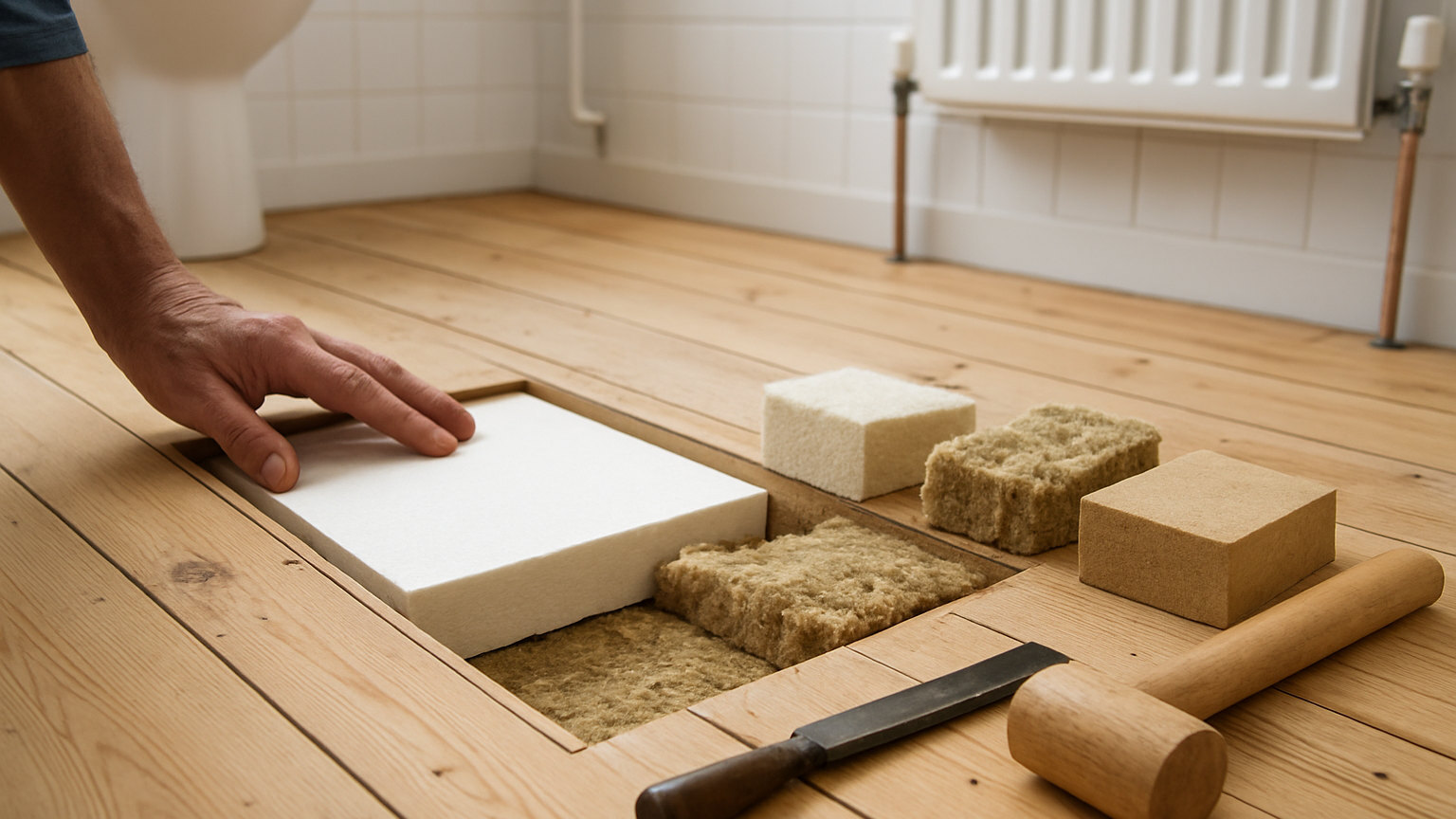
Glass wool or rock wool, in rolls, batts and slabs. Lambda around 0.032 to 0.044.
- Cheap, widely available, easy to cut and fit
- Excellent acoustic performance
- Non-combustible, particularly rock wool
- Vapour open, so moisture can pass through
- Fits irregular spaces well
- Loses performance completely if compressed or if it gets wet
- Irritates skin, eyes and airways. Cover up and wear an FFP3 mask
Uses: lofts, between joists and studs, acoustic separation, suspended floors.
PIR and PUR rigid board
Polyisocyanurate and polyurethane, foil faced. Lambda around 0.022, the best commonly available performance.
- Best performance per millimetre, so ideal where thickness is limited
- Rigid, so it can be structural in some applications
- The foil facing acts as a vapour control layer and reflects radiant heat
- Expensive
- Combustible, and it must be used within the relevant fire requirements
- Every gap matters enormously. Rigid boards must be cut accurately and gaps foamed or taped, or the performance drops sharply
- Dust is irritating; cut outside where possible
Uses: between and under rafters, floors, internal wall insulation, thermal laminate boards.
EPS and XPS
Expanded and extruded polystyrene. Lambda around 0.030 to 0.038.
- EPS: the familiar white beaded board. Cheap, light, used in cavity wall insulation, external wall insulation and under floors
- XPS: denser, closed cell, higher compressive strength and better moisture resistance. Used under floor slabs and in inverted roofs
- Both are combustible and must be used appropriately
- EPS beads are used for cavity wall injection
Phenolic foam
Lambda around 0.020, the best available. Rigid board, similar applications to PIR, with better fire performance and higher cost.
Natural and breathable insulations
Wood fibre board. Lambda around 0.038 to 0.045.
- Vapour open and hygroscopic: it can absorb and release moisture safely
- The appropriate choice for older solid wall buildings, which need to breathe
- Excellent at reducing summer overheating, because of its thermal mass
- Heavy and more expensive
Sheep wool. Lambda around 0.038. Vapour open, handles moisture well, pleasant to install with no irritation. Expensive, and needs moth treatment.
Cellulose, recycled paper. Blown or injected, filling irregular spaces completely. Vapour open, low embodied energy.
Hemp and other plant fibres. Similar performance and characteristics to sheep wool.
The moisture question
The most important thing to understand about insulation.
Insulating a wall or roof makes the outer part of the structure colder, because less heat reaches it. If warm moist air from inside reaches that colder zone, it condenses within the structure, where it cannot be seen and cannot dry.
This is interstitial condensation, and it causes rot in embedded timbers, particularly joist ends built into a solid wall.
Two approaches:
Sealed approach. A vapour control layer on the warm side of the insulation, preventing moisture reaching the cold zone. Used with rigid boards and mineral wool in modern construction.
- Must be continuous and sealed at every junction and penetration
- A gap in the vapour control layer concentrates moisture at that point
Breathable approach. Vapour open materials throughout, allowing moisture to pass through and evaporate rather than trapping it.
- Wood fibre, lime plaster, breather membranes
- The appropriate approach for older solid wall buildings
Do not mix the two approaches. A vapour-impermeable layer in the middle of a breathable build-up traps moisture at that point.
Solid wall insulation should be designed, not simply installed. Take advice.
Step 1: thickness and requirements
- Loft: around 270mm of mineral wool is the current recommendation
- Between rafters: limited by rafter depth, so a low lambda board is usually needed, and a ventilated gap may be required above
- Building Regulations specify U-values for new and refurbished elements, which the build-up must achieve
- Where a roof or wall is substantially refurbished, thermal upgrading is usually required
Step 2: fitting matters as much as the material
- Fit snugly with no gaps. A small gap disproportionately reduces performance
- Do not compress mineral wool, which destroys its performance
- Cut rigid boards accurately and seal gaps with expanding foam or tape
- Continue insulation across junctions to avoid thermal bridges
- Two layers with staggered joints beat one layer with aligned joints
- Do not leave insulation short at the eaves, and do not block the ventilation there
Step 3: what not to cover
- Do not insulate underneath a cold water tank in a loft; heat from below stops it freezing
- Do not cover recessed downlights unless rated for it. Use fire-rated covers
- Do not bury electrical cables in insulation where avoidable, since they carry less current safely
- Do not block eaves ventilation. Fit ventilation trays
- Keep clear of flues and chimneys
Health and fire
- Mineral wool irritates skin, eyes and airways. Cover up, wear gloves and an FFP3 mask, and wash separately afterwards
- Rigid board dust is irritating; cut outside
- PIR, PUR, EPS and XPS are combustible and must be used within the applicable fire requirements
- Fire requirements are stricter in some situations, including certain building heights and protected escape routes
- Any suspicion of asbestos in existing insulation: stop and get it tested
If it goes wrong
Condensation after insulating: ventilation blocked, or moisture reaching the cold zone.
Cold spots remain: gaps at the edges, or a thermal bridge at a junction.
Insulation compressed under boards: use a raised boarding system.
Mineral wool wet: it will not recover. Replace it and find the water source.
Mould at reveals after internal wall insulation: thermal bridging. It needs addressing.