Almost every problem with a building product is answered somewhere on the label or the datasheet. Two minutes reading prevents most of them.
Coverage figures
Stated coverage is a best case, achieved on an ideal surface. Real coverage is usually lower.
- Figures assume a smooth, sealed, non-absorbent surface
- Bare plaster, new timber and porous masonry absorb far more, sometimes half again
- Textured surfaces have a greater actual area than their measured area
- A dark colour over a light one needs more coats, and the reverse more still
- Add 10 to 20 per cent to any calculation, and more on absorbent surfaces
Running out mid-wall means a visible join and a second trip.
Drying times: three different figures
These are not the same thing and confusing them causes damage.
- Touch dry: it will not mark a finger. It is still soft
- Recoat time: when the next coat can go on. Recoating too early lifts and wrinkles the coat beneath
- Fully cured or hard dry: when it reaches full hardness and can be used normally. Frequently days rather than hours
All three are quoted at a stated temperature and humidity, typically around 20 degrees at moderate humidity.
- Cold or damp conditions extend every figure substantially, sometimes doubling them
- Below a stated minimum temperature, many products will not cure properly at all
- Some products have a maximum recoat time, after which the surface must be abraded for the next coat to key
Batch numbers
The detail that matters most and that people notice too late.
- Paint, tiles, wallpaper, flooring and laminate are manufactured in batches
- Colour and pattern vary slightly between batches, imperceptibly in the tin and obviously on a wall
- Check every container is the same batch before starting
- Buy all you need at once, with an allowance for waste
- Where you have mixed batches, box them: mix all the containers together in a larger vessel so any variation is uniform
- Record the batch number, colour name and finish somewhere you will find it later
- Keep a labelled sample for touching up
Hazard pictograms
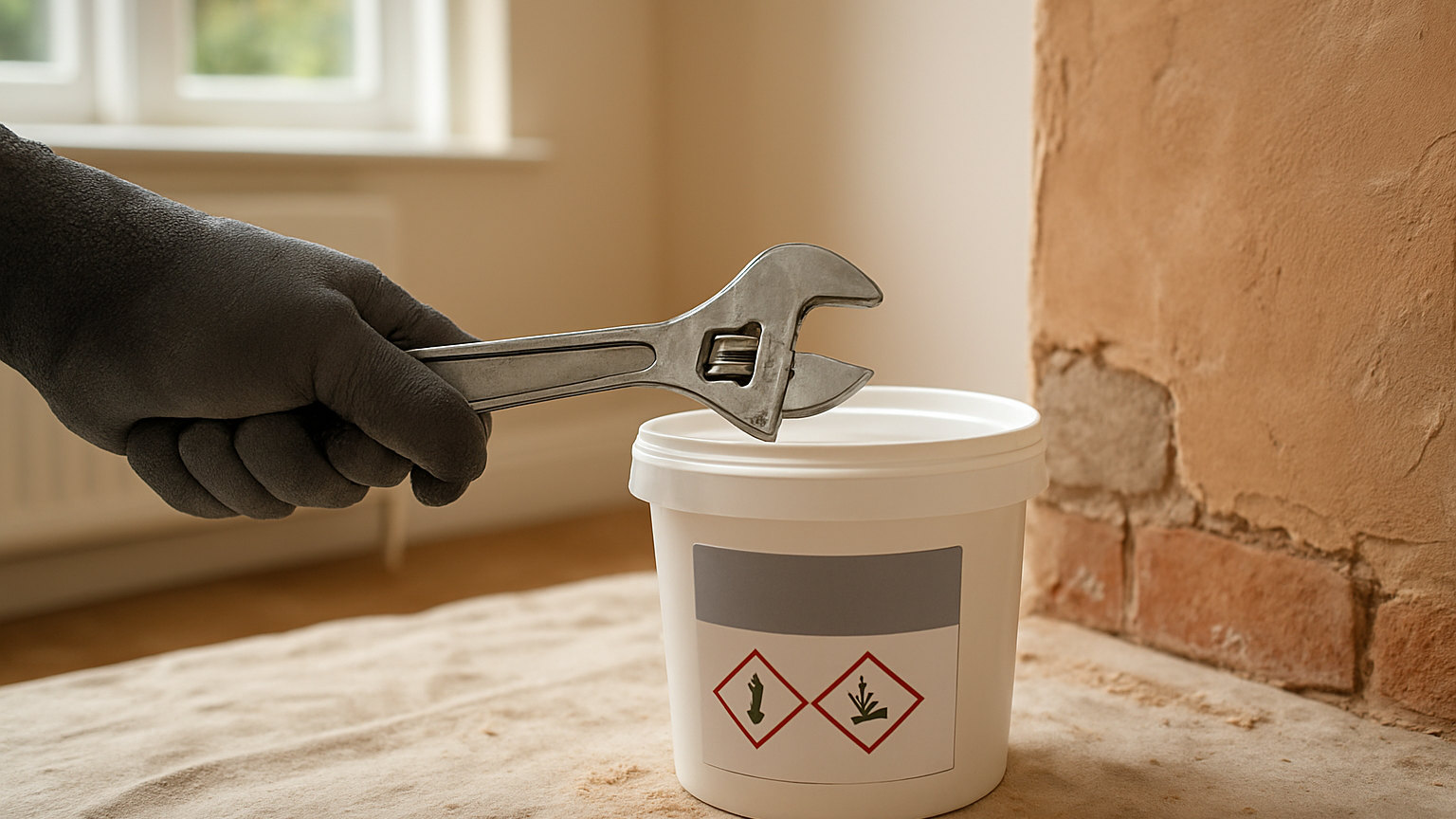
The red diamond symbols. Worth recognising.
- Flame: flammable. Keep away from ignition sources
- Corrosion: causes burns or damages materials. Cement, strong cleaners, some strippers
- Exclamation mark: irritant, harmful, or sensitising
- Health hazard, a figure with a starburst on the chest: serious longer-term health effects, including carcinogens and respiratory sensitisers. Take this one particularly seriously
- Skull and crossbones: acutely toxic
- Environment, a dead fish and tree: harmful to aquatic life. Never pour it away
- Gas cylinder: under pressure
Signal words: Danger is more severe than Warning.
Safety data sheets
A fuller document, available free from the manufacturer's website for any product.
- Sixteen standard sections covering composition, handling, first aid, fire measures and disposal
- Section 4 gives first aid measures, and it is worth knowing where to find it before an accident
- Section 8 specifies the personal protective equipment needed, including glove material and respirator type
- Section 7 covers safe storage
- Section 13 covers disposal
- Take the sheet or the container with you to A&E after any significant exposure
VOC content
- Volatile organic compounds, which evaporate as a product dries
- Labelled from minimal to very high
- High VOC products need good ventilation and are unpleasant to work with in an enclosed space
- Choose low VOC where you can, particularly for bedrooms, children's rooms and enclosed areas
- Ventilate during application and for some time afterwards
Shelf life and storage
- Most products have a shelf life, and an expired product may not perform
- Resin anchors, sealants, adhesives and fillers all deteriorate
- Check the manufacture or use-by date, frequently printed on the base or crimp
- Write the date on the container when you open it
- Note storage requirements: many products are ruined by freezing
- Discard anything separated, thickened, lumpy or smelling wrong
Application conditions
Frequently the reason a product fails.
- Minimum and maximum application temperature, for both air and surface
- Maximum humidity
- Surface moisture content limits
- Do not apply in direct sun, which many products specify, because it dries the surface before the body cures
- Do not apply if rain or frost is expected within the stated period
- Substrate preparation requirements, which are usually the real determinant of success
Step 1: what to look for before buying
- Is it suitable for this substrate? The commonest mismatch
- Is it suitable for interior or exterior use, or both?
- What preparation and priming does it require?
- What coverage, and therefore how much do I need?
- What are the temperature and weather limits?
- What protective equipment is required?
- What is the recoat and cure time?
- Is it compatible with what is already there?
Step 2: compatibility
- Products from different systems are not always compatible. A solvent-based product over an incompatible water-based one can lift it
- Check what the existing coating is before overcoating
- Silicone contamination prevents almost anything adhering, and it cannot be painted over
- Test in an inconspicuous area and let it cure fully before committing
- Where a manufacturer specifies their own primer, use it. Guarantees frequently depend on using the full system
Step 3: certification marks
- UKCA and CE marking indicate the product meets applicable requirements
- A declaration of performance gives the technical characteristics of a construction product
- Kitemark and similar indicate independent third party certification
- Where a standard is specified for a job, check the product meets it and keep the evidence
- Building control may ask for product documentation
Step 4: keeping records
- Photograph the label of everything you use, which takes seconds
- Note the room, the date and the batch number
- Keep a labelled sample of paint, tile and flooring
- Keep receipts and guarantees together with the house papers
- Note when consumables were opened
The person who redecorates in five years will be grateful, and it may well be you.
If it goes wrong
Ran out of paint mid-wall: coverage figures are optimistic. Buy extra and check batches.
Second coat wrinkled the first: recoated before the stated time.
Colour difference across a wall: different batches. Box them together next time.
Product never cured: applied below the minimum temperature, or past its shelf life.
New coating peeled off: incompatible with what was underneath, or the preparation was inadequate.