
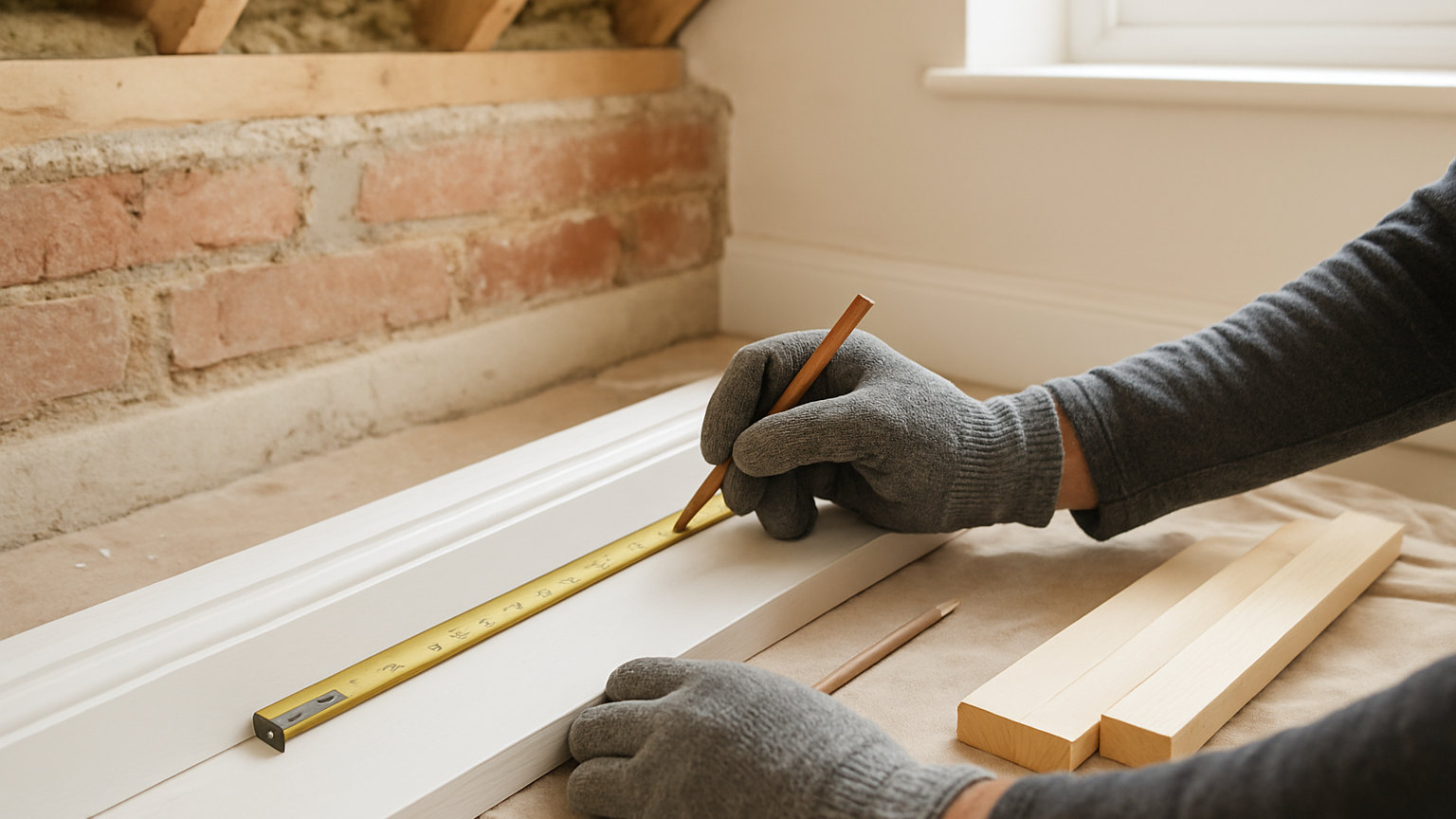
Running out of material halfway through a job is worse than buying too much, because the replacement is rarely an exact match. A margin is cheaper than a mismatch.
Step 1: measure the area
- Measure each wall or floor area separately: length times height, or length times width
- Add them together
- Measure and subtract large openings: doors, windows, a fireplace
- Do not subtract small openings, since the offcuts around them are usually waste anyway
- For an irregular room, divide it into rectangles and add them
- Write everything down, with a sketch
- Measure twice
Step 2: add the waste allowance
The step people underestimate.
- Tiles, straight layout: add 10 per cent
- Tiles, diagonal or brick bond: add 15 per cent
- Large format tiles: add 15 per cent, since a breakage costs more area
- Patterned tiles: add 15 to 20 per cent
- Laminate and engineered flooring: add 10 per cent, 15 for a diagonal or complicated room
- Wallpaper: add a full roll beyond the calculation, and more for a large pattern repeat
- Timber and sheet material: 10 to 15 per cent depending on the cutting layout
- A complicated room shape, many cuts or an inexperienced hand: add more
The allowance covers cuts, breakages, mistakes and the offcuts that are too small to use.
Step 3: buy the same batch
The single most important point when ordering.
- Tiles, wallpaper, paint, laminate and carpet are made in batches, also called dye lots or shade numbers
- Different batches differ in colour, sometimes subtly, sometimes obviously
- Once the batch sells out, an exact match may be impossible
- Check every box or roll carries the same batch number before leaving the shop
- Buy all of it at once, including the waste allowance
- Note the batch number and keep it with your records
- Keep leftovers for future repairs
Paint
Coverage is stated on the tin, commonly 10 to 14 square metres per litre per coat for emulsion on a prepared surface.
- Calculate the wall area
- Multiply by the number of coats, normally two
- Divide by the coverage figure
- Round up to the next tin size
Coverage is lower on:
- Bare plaster, which absorbs heavily. A mist coat is essential
- Textured or rough surfaces
- Porous surfaces
- Dark colours covering light, or the reverse, which may need three coats
- Anything applied with a long-pile roller
Tinted or grey basecoat under a dark colour reduces the number of topcoats needed considerably: two coats over a tinted base beats four over white.
Wallpaper
A standard UK roll is 10.05m long and 53cm wide, about 5 square metres.
Calculate in drops, not in square metres.
- Measure the wall height and add 100mm top and bottom for trimming
- Where there is a pattern repeat, round the drop length up to the next whole multiple of the repeat. A 2.4m wall with a 64cm repeat needs a 2.56m drop
- Divide the roll length, 10.05m, by the drop length. Round down to a whole number: that is how many drops you get from a roll
- Measure the total wall length and divide by 53cm to get the number of drops needed
- Divide drops needed by drops per roll, and round up
- Add one roll
A large pattern repeat can dramatically increase the number of rolls, which is why calculating in square metres gives the wrong answer.
Tiles
- Area divided by tile area, plus the waste allowance
- Or divide the wall dimensions by the tile dimensions to get rows and columns, which shows the cuts
- Adhesive: coverage varies with the notch size and the tile. As a rough guide, a 6mm notched trowel uses in the region of 3 to 4kg per square metre, and a 10mm notch considerably more. Read the bag
- Grout: depends on tile size and joint width, and the bag gives a table. Small tiles with wide joints use much more
- Buy spacers, and silicone for the movement joints
Concrete, mortar and aggregate
- Volume equals length times width times depth, all in metres, giving cubic metres
- A 25kg bag of ready-mixed concrete makes roughly 0.012 cubic metres, so around 80 bags per cubic metre
- Mixing your own is far cheaper in quantity: a common concrete mix is 1 part cement to 2 sand to 4 aggregate by volume
- Add around 10 per cent for compaction, spillage and uneven ground
- Above about 1 cubic metre, ready-mixed delivered is usually cheaper and far less work
- Mortar for bricklaying: roughly 1 tonne of sand and 8 to 10 bags of cement per 1000 bricks, as a rough guide
Timber and sheet
- Draw a cutting plan on paper before ordering sheet material. It frequently shows you need fewer sheets, or a different sheet size
- Standard sheets are commonly 2440 x 1220mm
- Timber is sold in standard lengths; check whether the length you need is standard, since an odd length means buying the next size up
- Note the difference between nominal and actual sizes: 50 x 100mm sawn timber is nominally that but planed timber is smaller. Measure what you are buying
- Allow for waste at the ends and for defects
Fixings
- Calculate the number needed and add half as many again
- Running out of screws at 4pm on a Sunday is a familiar experience
- Buy the larger box, which is usually far better value per unit
- Buy the right length: roughly two thirds of the screw in the receiving material
Step 4: buy extra deliberately
- Keep spare tiles for future breakages. A box of matching tiles is worth its storage space
- Keep a roll of wallpaper
- Keep a labelled sample of paint, with the colour, finish, brand and date on the tin
- Keep offcuts of flooring
- Note batch numbers with the records
Step 5: check the returns policy
- Many merchants accept unopened returns within a period, so buying generously carries little risk
- Keep receipts and packaging
- Special order and cut-to-size items are usually non-returnable
- Ask before ordering, not after
If it goes wrong
Ran out mid-job: check the batch number of the replacement, and consider using the new batch on a less visible wall.
New batch does not match: use it in a cupboard, a small room, or below a dado.
Paint not covering: a mist coat was needed, or a tinted basecoat under a dark colour.
Wallpaper short: the pattern repeat was not allowed for in the drop length.
Far too much left over: check the returns policy, and keep some for repairs.


