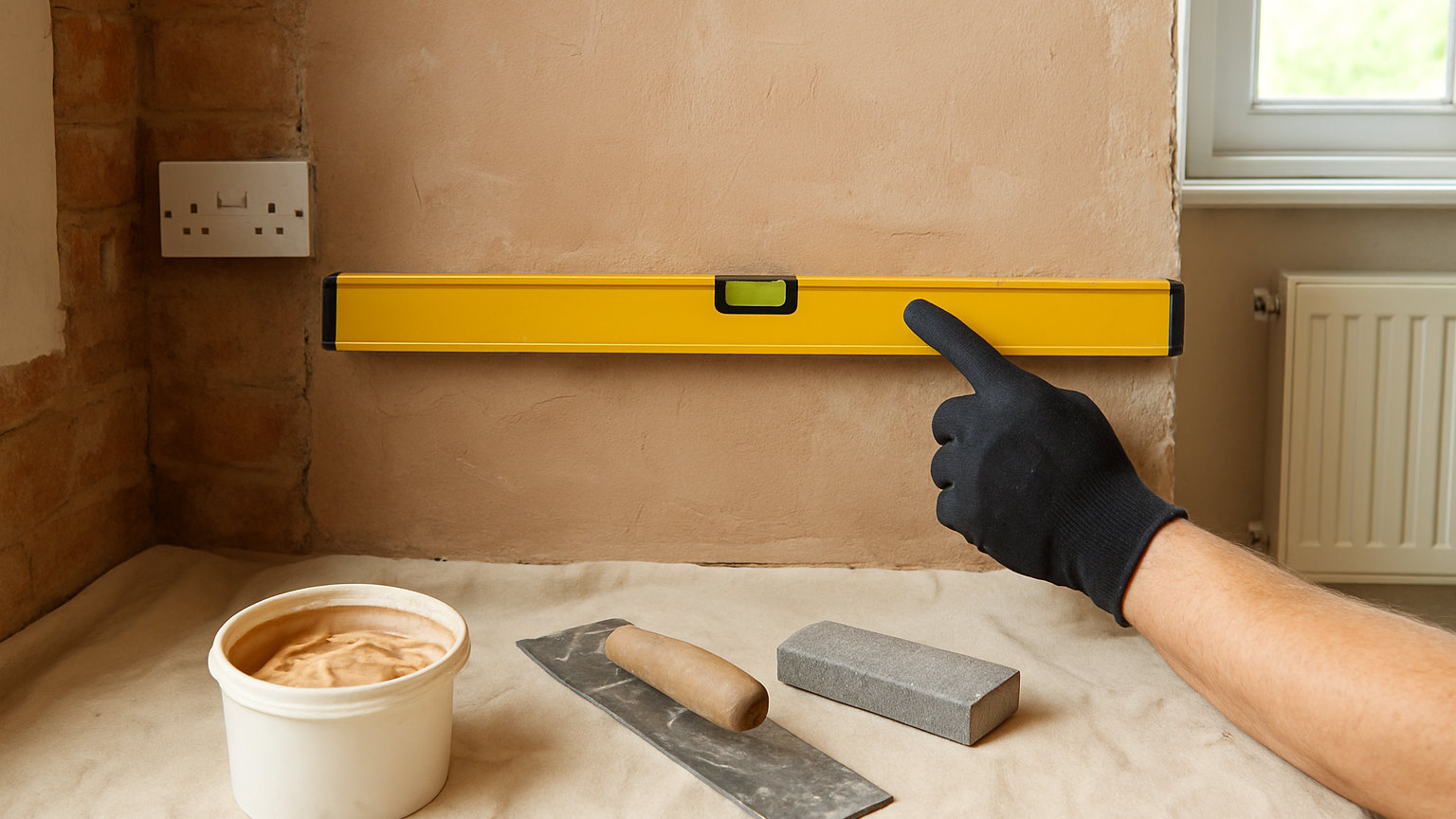
A level tells you whether something is horizontal or vertical. Like a square, it is worthless if it is not accurate, and levels go out more often than people check.
Reading the vial
- The bubble sits between two lines. Level is when the bubble is exactly centred between them
- Read with your eye directly in line with the vial, not from above or to one side
- Read the vial nearest the centre of the level, which is the reference one
- Let the bubble settle before reading
- Note which way it is off, and by how much: half a bubble is a definite slope
Checking a level: the reversal test
Do this before trusting any level, and periodically thereafter.
For the horizontal vial:
- Place the level on a reasonably flat surface
- Note exactly where the bubble sits, and mark the level's position on the surface with pencil
- Rotate the level end for end, 180 degrees, and place it back in the same marked position
- The bubble should read exactly the same
- If it reads differently, the level is out by half the difference
For the vertical vial: the same, against a wall or a door frame, turning the level to face the other way.
A surface does not need to be level for this test. You are comparing the level against itself.
- Some levels have adjustable vials with a small screw or a set of grub screws, and can be corrected
- Most cannot, and an inaccurate level should be replaced
- Test a new level in the shop before buying
Choosing lengths
A longer level is a more accurate level, because it spans local irregularities and shows a slope over a greater distance.
- Torpedo or boat level, 230 to 300mm: confined spaces, pipework, appliances. Convenient and easily misled by a bump
- 600mm: general household work, shelves, radiators
- 1200mm: the most useful single length. Door frames, walls, worktops
- 1800mm and 2m: long runs, door linings, stud walls, tiling
A 300mm level held against a bumpy wall reads whatever the bumps say. A 1200mm level reads the wall.
Types
- Box section aluminium: rigid, durable, the standard
- I-beam: lighter, less rigid
- Magnetic: holds to steelwork and radiators, freeing both hands
- Digital: gives a numerical angle reading, useful for setting falls
- Post level: straps to a post and reads two planes at once
- Line level: a small vial hung on a string line
- Water level: a clear tube of water. Water finds its own level regardless of distance or obstruction, so it transfers a datum round corners and between rooms with no line of sight. Cheap and remarkably accurate
Step 1: use it properly
- Wipe the surface and the level clean. A crumb of plaster under one end throws the reading
- Place the level flat and let the bubble settle
- Read with your eye in line
- Check in both directions where it matters: rotate end for end and confirm the reading agrees
- Support a long level along its length, not just at the ends
- On a surface with high spots, use a straight edge and put the level on that
Step 2: plumb
Vertical rather than horizontal.
- Use the vertical vials at the ends of a spirit level
- Check by reversing, turning the level to face the other way
- Check plumb in two planes at right angles, or a post can be plumb one way and leaning the other
A plumb bob is a weight on a string, and gravity does not go out of calibration.
- Suspend it from the point to be transferred
- Let it stop swinging completely, which takes longer than you expect
- In a draught, hang it in a bucket of water to damp the movement
- Mark the point directly below the tip
- For a plumb line on a wall, hold the string against the wall at the top and mark where the string sits at the bottom
A plumb bob is the most reliable way to transfer a point vertically over a long drop, and it costs very little.
Step 3: levelling over a distance
Beyond the length of your level.
Level and straight edge: place the level on a long straight batten, and step it along. Errors accumulate, so check by reversing.
String line with a line level: quick, adequate for garden work, and affected by sag.
Water level: a clear tube filled with water. Both ends read the same height regardless of distance or shape. Ideal for transferring a datum between rooms.
- Fill the tube, excluding all air bubbles, which is the only difficulty
- Hold one end at the known datum
- The water surface at the other end is at exactly the same height
- Mark it
Laser level: the quickest for a room, and covered separately.
Step 4: deliberate falls
Not everything should be level.
- Guttering: falls towards the outlet, roughly 3mm per metre
- Waste pipes: a fall towards the drain, and there are specified minimums for different pipe sizes
- Patios and paths: a fall away from the house, commonly around 1 in 60 to 1 in 80
- Flat roofs: a designed fall, at least 1 in 80
To set a fall with a spirit level, tape a packing piece of the right thickness under one end. With the packer in place and the bubble centred, the surface has the required fall.
Care
- Do not drop a level. One drop can put a vial out
- Do not use it as a straight edge for cutting against, or as a lever, or a hammer
- Store hanging or flat, never leaning where it can slide down
- Keep the edges clean and undamaged, since the reading depends on them
- Retest by reversal after any knock
If it goes wrong
Two levels disagreeing: reverse-test both. One is out.
Reads level one way and not the other: the level is inaccurate. Replace or adjust it.
Shelf level but looks wrong: the ceiling or the floor is not level, and the eye reads the relationship rather than true level.
Post plumb but leaning: check plumb in both planes.
Reading changes when you move the level: debris under it, or the surface is not flat.