Stairwells combine the two hardest things in decorating: working at height over a drop, and a continuous tall wall that must be painted without stopping.
The safety point
Never rest a ladder on a staircase. The treads are not level, the ladder foot sits on a nosing, and there is nothing to stop it sliding sideways.
Falls from height in the home are a leading cause of serious injury, and stairwells are where most of them happen.
Do not improvise with planks between a stepladder and a stair tread.
Access options that work
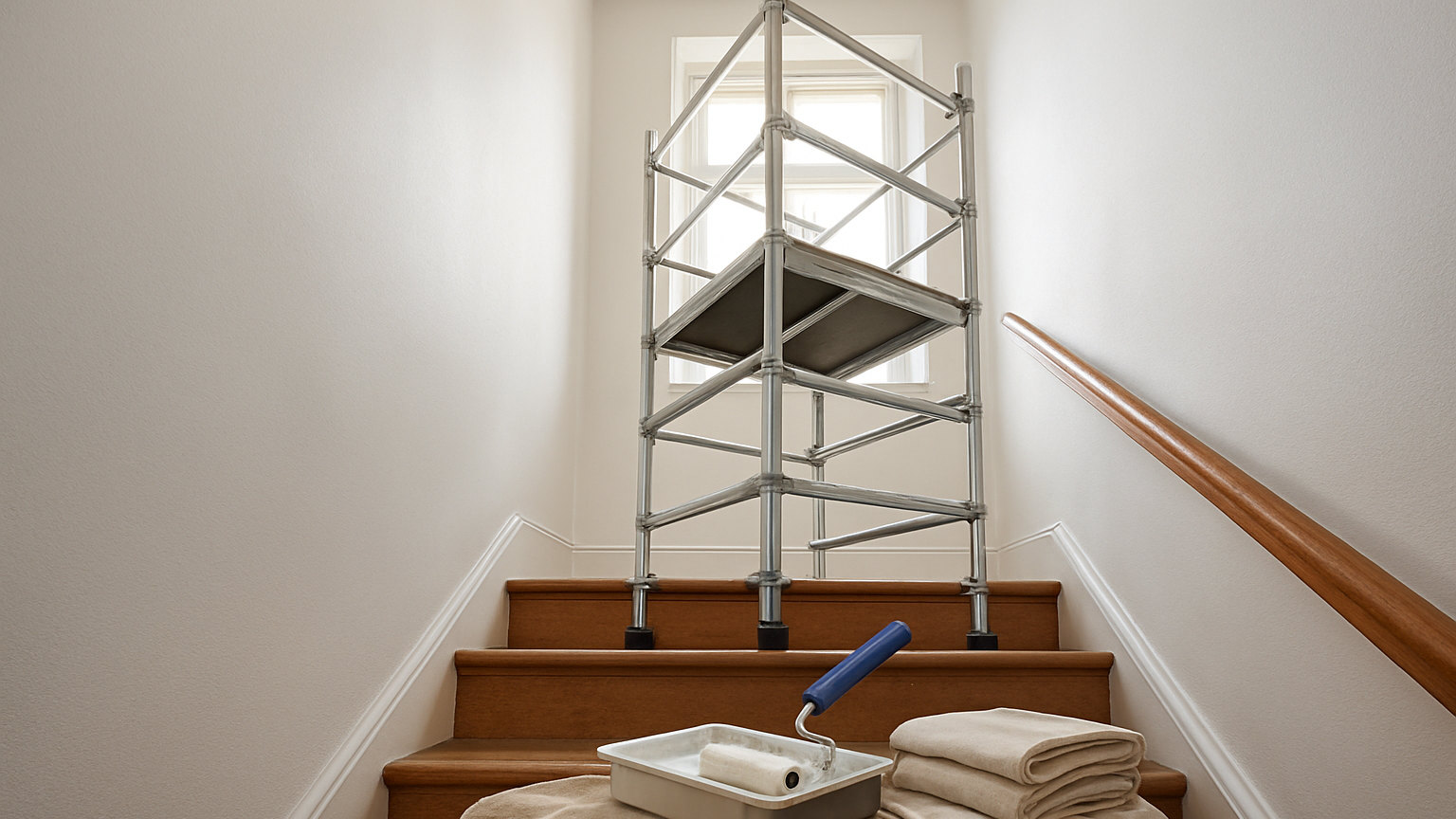
- A stairwell platform or podium. Purpose-made, with adjustable legs so it stands level across the flight. Available from hire shops for a day or a weekend, and the right answer for most stairwells
- A combination ladder with levelling legs, designed to stand on stairs with independently adjustable feet
- A scaffold tower with adjustable legs, for a large stairwell
- Stair ladders, with one long leg and one short, that sit securely on a flight
Hiring the right equipment for a weekend costs a fraction of the alternative and makes the job faster as well as safer.
Setting up safely
- Check the equipment is rated for the height and the load
- Set all legs so the platform is genuinely level, and check with a spirit level
- Make sure every foot bears weight and is on a solid surface, not on the edge of a tread
- Fit the guardrails if the platform has them
- Never stand on the top step of a stepladder or on the platform rail
- Keep the working area below clear
- Have someone else in the house
- Do not overreach: move the platform instead
The wet edge problem
A stairwell wall can be four or five metres tall, and it must be painted as one continuous surface.
Stopping halfway up leaves a horizontal line that shows through both coats.
How to manage it
- Work with two people if you possibly can: one cutting in, one rolling, so the wet edge is never lost
- Use a long extension pole, which lets you reach a full wall height from one position
- Work in vertical strips of about a metre, floor to ceiling, and complete each strip before moving on
- Do not stop until the wall is finished
- Have all the paint mixed and ready before starting, in a scuttle rather than a small tray
- Cut in the top of the wall first, working along the whole length, then roll immediately
Choose a paint with a longer open time where you can, and avoid painting in direct sun or with the heating on.
The order of work
- Clear the stairs and the landing completely
- Cover the treads with dust sheets taped down, and the balustrade
- Set up and check the access equipment
- Ceiling first: cut in the perimeter, then roll it in one session
- Then the tall stairwell wall, as one continuous surface
- Then the remaining walls
- Then the woodwork: skirting, strings, spindles, handrail
- Then any stair covering
Practical points
Do not block the stairs with equipment while anyone is in the house, and never leave a platform on a flight overnight.
Work when the house is empty if possible.
Take everything down each evening rather than leaving a hazard on a staircase.
Keep tools in a pouch or on the platform rather than on the treads.
Use a paint kettle with a hook rather than balancing a tray.
Spindles and balustrades
Slow, fiddly work with a lot of edges.
- Use a 25mm or 38mm brush
- Work top down, so drips fall onto unpainted areas
- Do the underside and back of each spindle first, then the front
- Thin coats: paint pools in the angles and runs
- Check for runs after ten minutes and brush them out
A mini gloss roller on the flat faces, with a brush for the detail, is quicker.
Lighting
Stairwells are frequently dark, and the wall is tall.
Set up a work light on the floor pointing up, which shows missed patches and runs that overhead light hides.
If it goes wrong
Horizontal line across the wall: the wet edge was lost. Sand lightly and repaint the whole wall in one go, with help.
Runs on the spindles: paint applied too thickly. Sand out when hard and recoat thinly.
Cannot reach the apex: the wrong access equipment. Stop and hire the right thing rather than improvising.
Paint on the treads: cover them properly and tape the sheets down.
Preparation at height
All the preparation has to happen at height too, and it is easy to forget when hiring access equipment for one day.
Plan to do filling, sanding, priming and painting from the same setup, over consecutive days if needed, rather than putting the platform up twice.
Hire for the weekend rather than the day.
Colour choice
Stairwells are usually the darkest part of a house, with little natural light and a lot of wall.
Lighter colours and a matt finish make the space feel less enclosed, and matt hides the imperfections that a tall wall inevitably has.
Durable matt is worth using, since hallway and stairwell walls take constant scuffing from bags and shoulders.
How long it takes
A stairwell and landing takes two to three days including preparation, largely because of the setting up and the working at height.
Allow a full day for the tall wall alone if you are working on your own.