Skirting is awkward because it is low down, it runs the whole length of a room, and it has a wall above it and a floor below. Both are easy to get paint on.
What you need
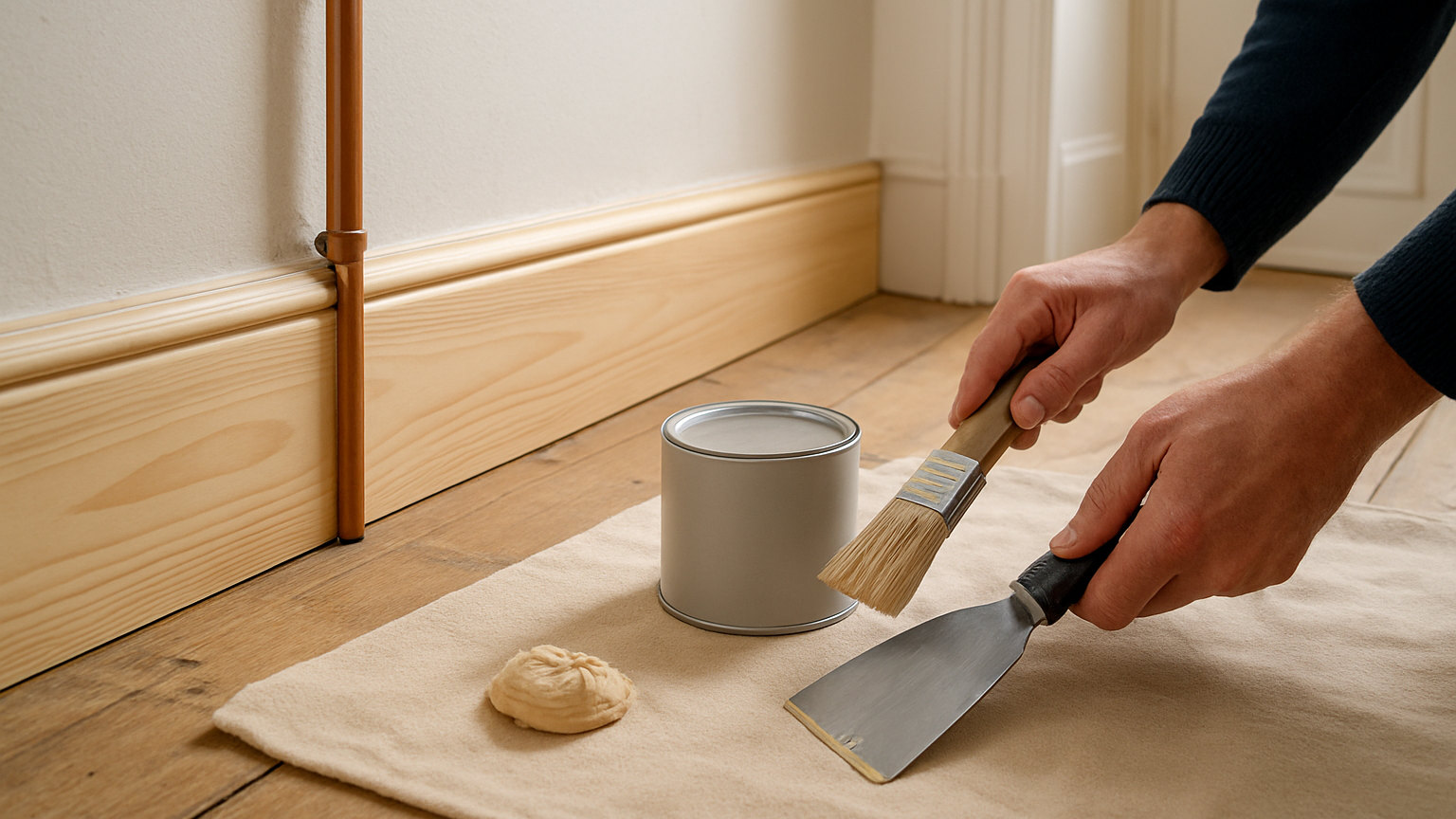
- A 50mm angled brush, and a 38mm for tight corners
- Paint kettle
- Low-tack masking tape and a filling knife
- Self-adhesive carpet protection film, or card and dust sheets
- 180 and 240 grit abrasive, and a sanding sponge for the moulding
- Sugar soap, sponges, tack cloth
- Filler, caulk and a skeleton gun
- A kneeling pad
Step 1: protect the floor
Do this properly, since paint on carpet is permanent.
Carpet: use self-adhesive carpet protection film and press the edge right up to the skirting. Better still, tuck the carpet edge down off the gripper with a filling knife, then tape card along the base of the skirting.
Hard floor: mask along the base with tape, pressing the edge down hard with a filling knife so paint cannot creep under. Cover the rest with dust sheets taped at the edges.
Push a strip of card along the base as you work as an extra guard.
Step 2: prepare
- Wash with sugar soap. Skirting collects dust, scuffs and vacuum cleaner marks
- Rinse and let it dry
- Sand with 180 until the shine has gone uniformly. Use a sanding sponge on the moulded profile so you do not round the detail off
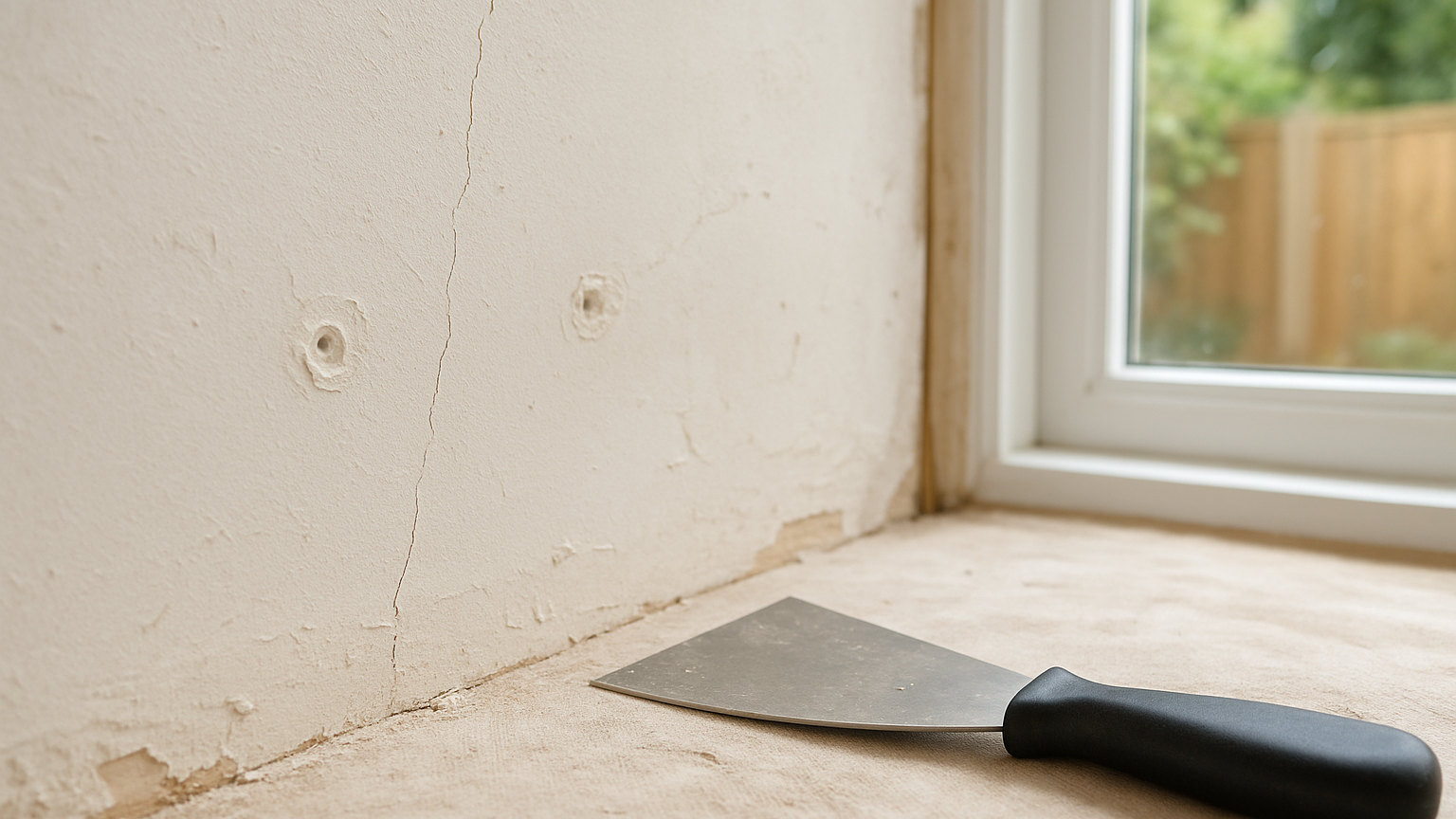
- Fill dents, splits and nail holes, sand flush and spot-prime
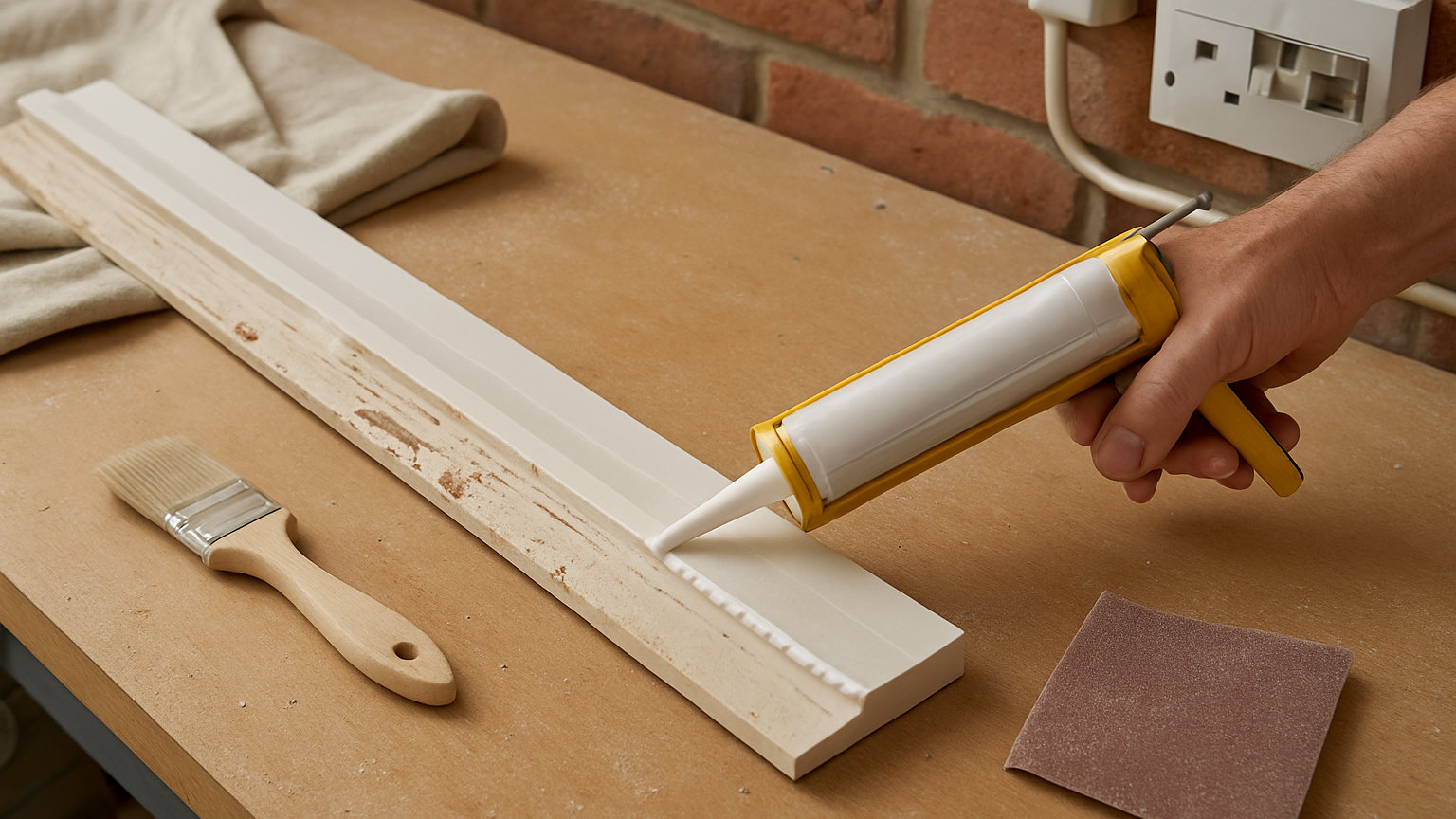
- Caulk the gap along the top where the skirting meets the wall, in one continuous bead smoothed in a single pass
- Let the caulk skin, then dust off and wipe with a tack cloth
Caulking before painting is what makes the top line look crisp rather than ragged.
Step 3: cut the top line
Work along the top edge first, using the two-pass method.
- Load the brush a third of the bristle depth and tap off the excess
- First pass: lay paint on 10mm below the top edge, along about 500mm
- Second pass: come back with the partly unloaded brush and take the paint up to the line
- Move along and repeat
Rest your little finger against the wall as a guide. Move your whole arm, not your wrist.
Keep a damp cloth to hand and wipe any overrun onto the wall immediately.
Step 4: paint the face
Work in sections of about a metre.
- Do the moulded profile at the top with the tip of the brush
- Then the flat face, brushing along the length
- Then the bottom edge, using very little paint
- Lay off along the length in one direction with a nearly dry brush
- Move on, joining into the wet edge
Keep the paint thin at the bottom edge. Paint collects there and runs down onto the floor.
Step 5: check for runs
Skirting runs more than any other woodwork, because the surface is vertical and the profile has ledges.
Go back along the run after ten minutes and look along it at a low angle.
Brush out any sagging while it is still wet. Once it has skinned, leave it and sand it out when hard.
Step 6: coats
Two coats over sound existing paint.
On bare timber: knotting, primer, undercoat, two finish coats.
Sand lightly with 240 between coats and wipe with a tack cloth.
Remove masking tape while the paint is dry to touch but not fully cured, pulling slowly at a shallow angle.
Which paint
- Water-based satinwood: the usual modern choice. Low odour, fast drying, does not yellow
- Water-based eggshell: a lower sheen, hides imperfections better
- Oil-based gloss: hardest wearing and the traditional finish, and it yellows over time and smells strongly
Skirting takes knocks from vacuum cleaners, shoes and furniture, so a harder finish is worth having.
Order within the room
Woodwork is painted after the walls and ceiling.
A small overrun from the skirting onto the wall is easily corrected; the reverse is not, because wall paint on a sheen finish shows.
If it goes wrong
Paint on the carpet: blot immediately, do not rub. Warm water and washing-up liquid may lift water-based paint if caught at once.
Runs along the bottom: too much paint at the lower edge. Sand out when hard and recoat with less.
Wavy top line: brush overloaded, or moving too fast. Use the two-pass method and rest your hand.
Paint bled under the tape: the edge was not pressed down with a knife.
Brush marks in the finish: overworked, or the paint was too thick. Sand with 240 and apply a thinner coat.
Working along a long run
A hallway skirting can be ten metres long, and it must be painted without visible joins.
- Work in one continuous direction from one end to the other
- Always join into the wet edge of the previous section
- Do not stop mid-run for a break
- Stop at a natural break such as a door opening or an internal corner if you must
- Keep the kettle beside you and move it as you go, rather than walking back to it
Corners and mitres
Internal corners collect paint. Load the brush lightly and work out of the corner rather than into it.
External corners are where the paint gets rubbed off first, so make sure they are properly covered without being flooded.
Check the mitres are filled and sanded before painting, since a gloss finish highlights an open joint.