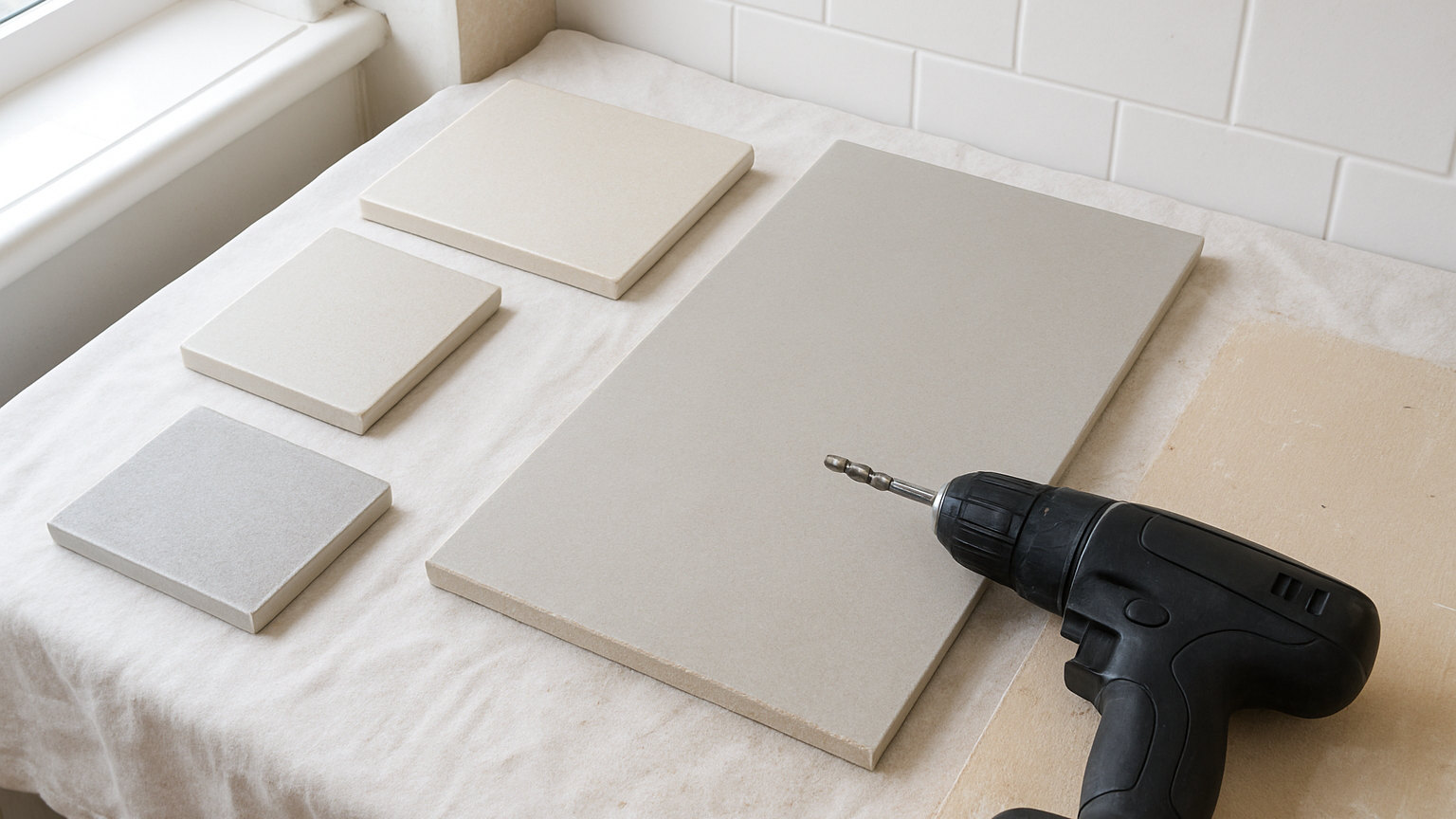
The type of tile determines how you cut it, what adhesive it needs, and whether the wall can carry it. Decide that before choosing a colour.
The main types
Ceramic. Fired clay with a glazed face. Softer, easier to cut with a manual score-and-snap cutter, and cheaper. Suits walls and light-use floors. Absorbs more water, so not for outdoors.
Porcelain. Fired at higher temperature, denser and much harder. Very low water absorption, so suitable for floors, wet areas and outdoors. Requires a diamond blade wet cutter; a manual cutter will not reliably snap it.
Natural stone. Marble, travertine, slate, limestone. Beautiful and demanding: porous, needs sealing before and after grouting, varies in thickness, heavy, and needs a solid bed of adhesive.
Mosaic. Small tiles on a mesh or paper sheet. Forgiving on curves and awkward areas, and there is a great deal of grout, which needs sealing in a wet area.
Glass. Usually mosaic or splashback panels. Needs white adhesive, since a grey one shows through.
Quarry and terracotta. Unglazed, traditional, porous and needs sealing.
Wall weight limits
The point most people miss, and it governs what you can tile onto.
- Plaster or plaster skim: around 20kg per square metre
- Plasterboard: around 32kg per square metre
- Tile backer board: considerably more, typically 40kg or above depending on the board and fixing
- Solid masonry rendered: effectively unlimited for domestic tiling
Add the tile weight and the adhesive weight together. A 10mm porcelain tile is around 20kg per square metre before adhesive.
Large-format porcelain on a plastered stud wall can exceed the limit. Check the tile's weight per square metre, which the supplier states, and add roughly 4 to 6kg for adhesive and grout.
Where it is close or over, overboard with tile backer board.
Sizes
- Small, up to 150mm: more grout lines, busier, forgiving of an uneven wall
- Medium, 200 to 400mm: the usual domestic range, easy to handle
- Large format, 600mm and above: fewer joints and a calmer look, and they show every deviation in the wall and need a very flat substrate and a solid bed
- Plank and metro formats: laid in brick bond or stack bond for a specific look
A large tile needs a flat wall. A tile cannot bend, so any hollow or hump shows as lipping between tiles.
Finishes
- Gloss: reflects light, makes a small room feel larger, shows water marks
- Matt: softer, hides marks, less slippery
- Satin: between the two
- Textured and structured: more grip, harder to clean
- Rectified: mechanically ground to a precise size, allowing very narrow joints. Needs accurate work
Floor tiles and slip resistance
Floor tiles carry a slip rating.
- R9: dry domestic areas
- R10: kitchens, bathrooms, hallways. A sensible domestic minimum where floors get wet
- R11 and above: wet rooms, commercial, outdoors
Wall tiles must never be used on a floor. They are not strong enough and have no slip rating. Floor tiles can be used on walls if the wall can carry the weight.
What to check before buying
- Calculate the area and add 10 per cent for cuts and waste, or 15 per cent for a diagonal or brick-bond layout
- Buy all tiles in the same batch and check the batch numbers
- Check the thickness, which affects trim and door clearances
- Check the weight per square metre against the wall's limit
- Open several boxes and mix the tiles, since shade varies
- Keep a few spare tiles for future repairs
Natural stone specifics
If choosing stone, know what it involves.
- Seal before grouting, or the grout stains the face permanently
- Seal again after grouting, and periodically thereafter
- Use a white adhesive, since grey shows through pale stone
- Lay on a solid bed with no voids, since stone is translucent and voids show
- Thickness varies between tiles, so more adhesive adjustment is needed
- Do not use acidic cleaners on marble or limestone
If it goes wrong
Tiles a different shade across the wall: different batches, or boxes not mixed. Mix from several boxes as you work.
Large tiles lipping at the edges: the wall is not flat enough for that size.
Ran out of tiles: insufficient waste allowance. Always order 10 per cent extra.
Manual cutter will not snap the tile: it is porcelain. You need a wet cutter.
Grout staining stone tiles: they were not sealed first.
How much to order
- Measure the area in square metres, height by width for each wall
- Deduct large openings such as a window, and nothing smaller
- Add 10 per cent for cuts and breakages
- Add 15 per cent for a diagonal, herringbone or brick-bond layout, which produces more cuts
- Round up to whole boxes
- Keep the offcuts and a few whole tiles for repairs
Seeing them before buying
Buy or borrow a single tile and take it home.
Look at it against the flooring, the worktop and the wall colour, in daylight and under the room's artificial light.
Gloss tiles in particular look completely different under a downlight than under a showroom's lighting.
Grout colour
Decide it at the same time as the tile, because it changes the appearance of the whole wall.
- Matching grout makes the surface read as one and plays down the grid
- Contrasting grout emphasises the pattern, which suits metro and geometric layouts
- Dark grout on a floor stays looking clean far longer than white
Suppliers keep grout colour cards; hold one against the tile before ordering.
Grout dries lighter than it appears when wet, so judge from the card rather than the mixed sample.