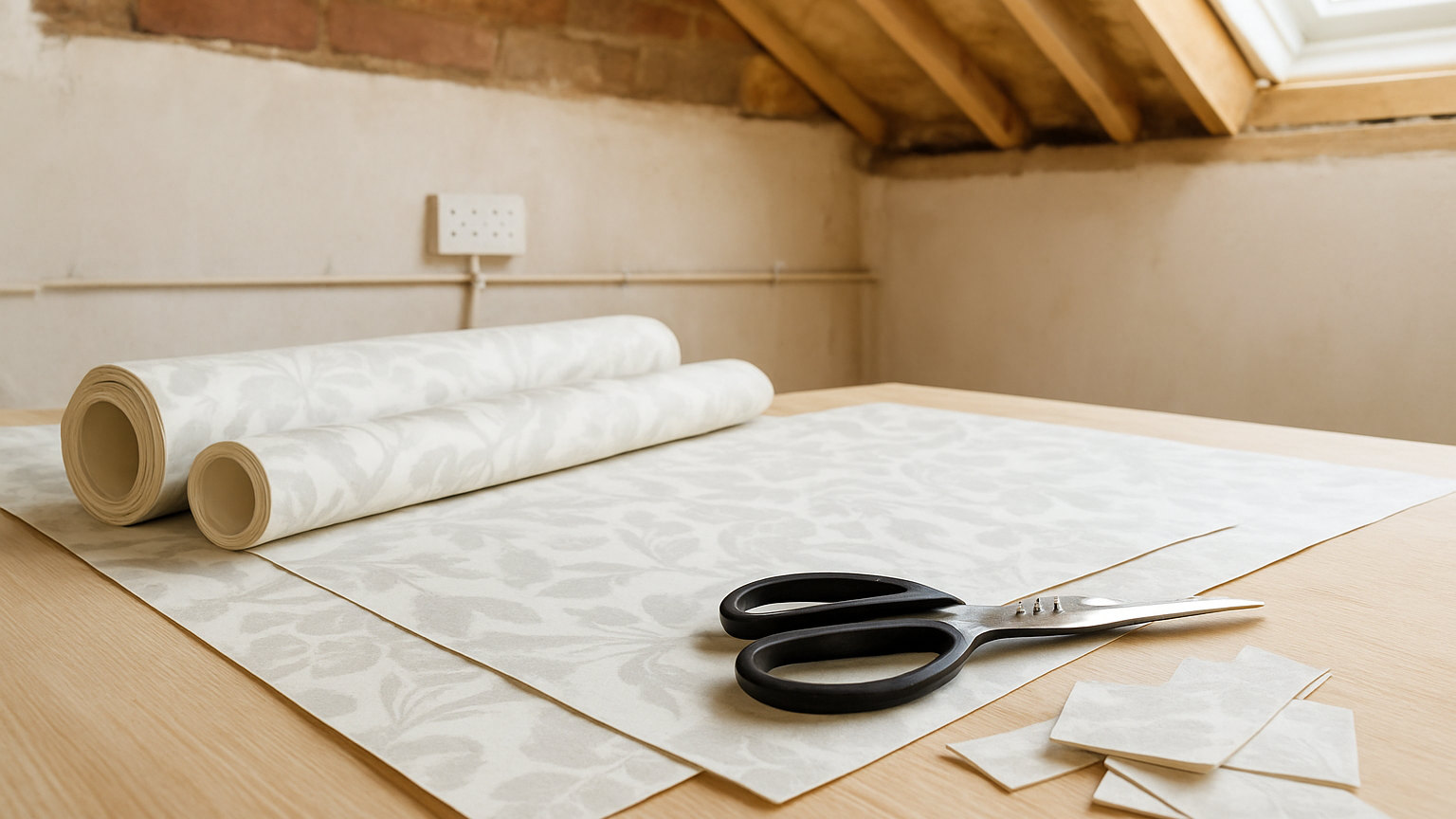
Calculating by square metres gives the wrong answer, because a pattern repeat means part of every drop is wasted. Work in drops.
What you need
- A tape measure
- A calculator and paper
- The roll length, roll width and pattern repeat from the label
Step 1: measure the room
Measure the perimeter: the total length of all the walls you are papering, added together.
Measure the height from skirting to ceiling, or to the picture rail or coving if that is where the paper stops.
Measure the height in several places, since floors and ceilings are rarely parallel. Use the largest figure.
Step 2: work out the drop length
The drop length is the wall height plus a trimming allowance.
Add 100mm: 50mm top and 50mm bottom. This gives room to trim accurately against an uneven ceiling and skirting.
So a 2.4m wall needs a 2.5m drop.
Step 3: allow for the pattern repeat
This is the step people miss.
Free match, no repeat: the drop length is simply the height plus 100mm.
Straight or offset match: each drop must start at the same point in the pattern, so you lose up to one repeat per drop.
Round the drop length up to the next whole multiple of the pattern repeat.
Example: 2.5m required drop, 64cm repeat. 2.5 ÷ 0.64 = 3.9, so round up to 4 repeats. 4 × 0.64 = 2.56m per drop.
With an offset match, allow an extra half repeat on top for the staggering.
Step 4: drops per roll
Divide the roll length by your drop length and round down.
A standard British roll is 10.05m.
Example: 10.05 ÷ 2.56 = 3.9, rounded down to 3 drops per roll.
Note how much a large repeat costs you: with a free match at 2.5m you would get 4 drops per roll.
Step 5: drops needed
Divide the room perimeter by the roll width and round up.
A standard roll is 53cm wide.
Example: a room 4m by 3m has a perimeter of 14m. 14 ÷ 0.53 = 26.4, rounded up to 27 drops.
Step 6: rolls needed
Divide the drops needed by the drops per roll, and round up.
Example: 27 ÷ 3 = 9 rolls.
Then add one spare roll. That gives 10.
Doors and windows
Do not deduct for anything small.
Deduct one drop for a standard door, and one for a large window, only if you are being tight.
The offcuts above and below openings are frequently used, so the saving is smaller than it looks.
With a large pattern repeat, do not deduct at all.
Feature walls
Measure that wall only.
Wall width divided by roll width, rounded up, gives the drops. Then drops divided by drops per roll, rounded up.
Add a spare roll even on a single wall, since a damaged drop with no spare means reordering.
Lining paper
Calculate the same way, and lining paper has no pattern repeat, so there is almost no waste.
Cross-lining, hung horizontally, is calculated on the same principle using the wall length as the drop.
Practical points
Buy all rolls from the same batch and check the numbers as they arrive.
Buy the spare roll at the same time. It costs one roll now and saves the whole job later.
Most retailers will take back unopened rolls, so ask about the returns policy before deciding to be economical.
Keep the label from one roll, with the batch and the pattern name, for future reference.
Worked summary
- Perimeter ÷ roll width, rounded up = drops needed
- Wall height + 100mm = required drop
- Round that up to a whole number of pattern repeats = actual drop length
- Roll length ÷ actual drop length, rounded down = drops per roll
- Drops needed ÷ drops per roll, rounded up = rolls
- Add one spare roll
If it goes wrong
Ran out with one wall left: check the retailer for the same batch immediately. A different batch will show, so use it in the least visible position.
Far too much left over: return unopened rolls if the retailer allows, keeping one spare.
Pattern will not repeat as expected: you may have an offset match rather than a straight one. Check the label symbol.
A second worked example
A hallway with a perimeter of 9m, a height of 2.6m, and a free match paper.
- Drops needed: 9 ÷ 0.53 = 16.9, rounded up to 17 drops
- Drop length: 2.6 + 0.1 = 2.7m, with no repeat to allow for
- Drops per roll: 10.05 ÷ 2.7 = 3.7, rounded down to 3
- Rolls: 17 ÷ 3 = 5.7, rounded up to 6 rolls
- Plus a spare: 7 rolls
Note that a 2.7m drop gets only three per roll, wasting nearly two metres each time. A slightly lower ceiling would have given four.
Tall rooms
Where the ceiling height is over about 3.3m, you get only three drops per roll and the waste rises sharply.
Check whether the paper is available in a longer or wider roll before ordering.
Checking as the rolls arrive
- Open the packaging but not the rolls
- Check every batch number is identical
- Check the pattern name and colourway match the order
- Check the quantity
- Report any discrepancy before you start, not after two walls
Keep one label with the batch and pattern name somewhere safe, so a future repair can be matched.
Wide-width rolls
Some papers come in widths of 68cm or a metre rather than 53cm.
They cover a wall in fewer drops with fewer joints, and the calculation is identical with the different width substituted.