
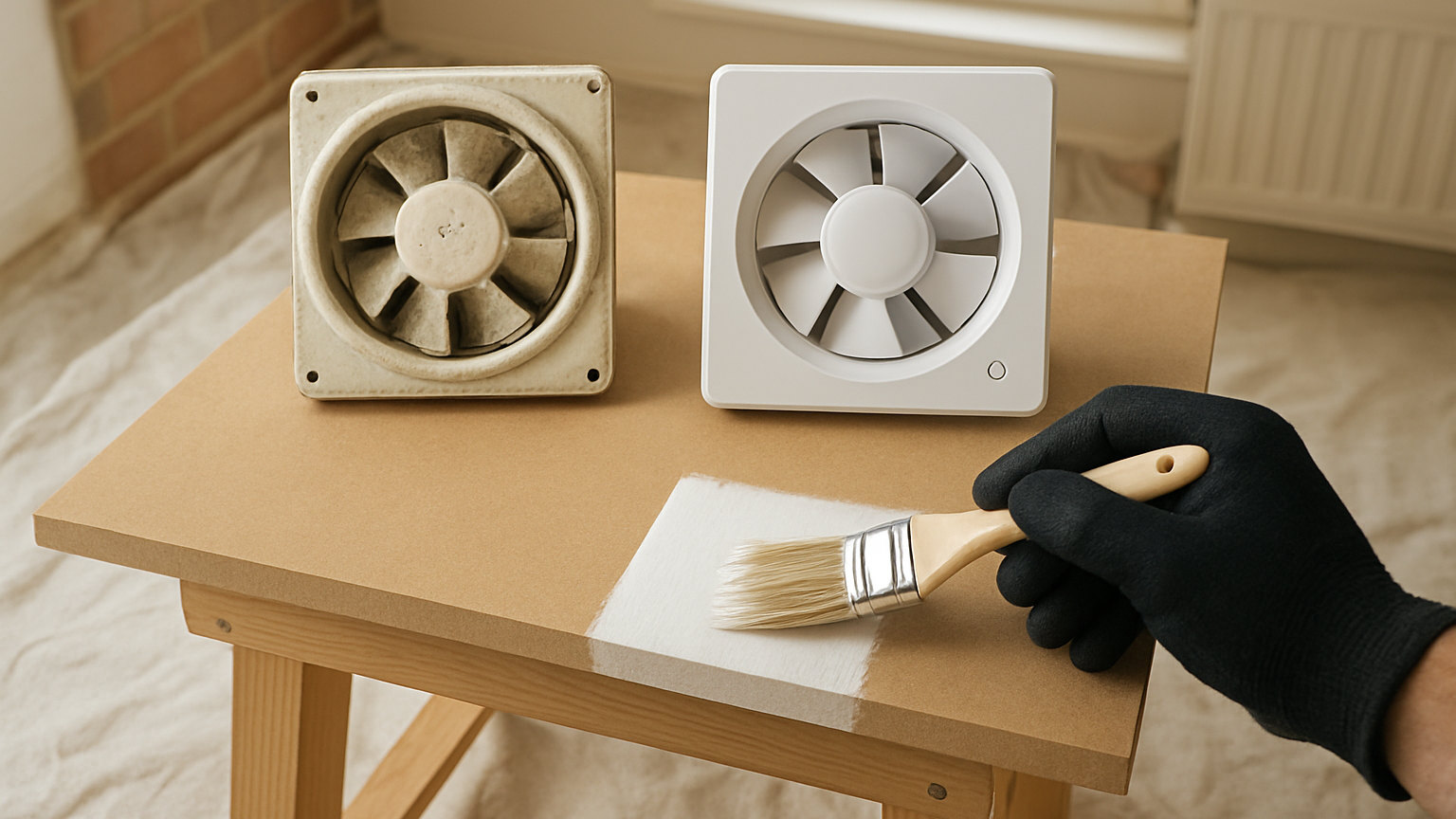
An extractor fan that cannot move enough air, or that is not run for long enough, achieves very little. The specification matters more than the price.
The electrical position
Electrical work in a bathroom or shower room is notifiable under Building Regulations in England and Wales.
Bathrooms are special locations with defined zones, and the rules on what may be installed where are strict.
- Installing a new fan on a new circuit, or work within the bathroom zones, must be done by a registered electrician or notified to building control
- Wales, Scotland and Northern Ireland have their own arrangements, so check locally
- Replacing a like-for-like fan on an existing circuit is generally simpler, and the isolation and testing still need doing properly
The sensible approach: choose the fan yourself, have an electrician install it, and get the certificate.
Extract rate
The most important figure, quoted in litres per second or cubic metres per hour.
Building Regulations minimum rates for new installations in England and Wales:
- Bathroom or shower room: 15 l/s
- Kitchen, over the hob: 30 l/s
- Kitchen, elsewhere in the room: 60 l/s
- Utility room: 30 l/s
- WC: 6 l/s
To convert: multiply litres per second by 3.6 to get cubic metres per hour. So 15 l/s is 54 m³/h.
Check the rate the fan achieves against the duct run you actually have, not the free-air figure. A long or bendy duct reduces the output considerably.
Axial or centrifugal
Axial fans: a propeller-type impeller. Cheap, quiet and effective over short duct runs, up to about 1.5m through an external wall. The standard bathroom fan.
Centrifugal fans: a caged impeller that generates more pressure. Needed for longer duct runs, ducting through a loft, or where there are several bends. More expensive and generally noisier.
Fitting an axial fan on a 5m loft duct is a common mistake: it will run and move almost nothing.
Controls
- Basic: switched with the light. Runs only while the light is on, which is rarely long enough
- Timer or overrun: continues running for a set period after the light goes off, typically adjustable from 1 to 20 minutes. Worth having as a minimum
- Humidistat: senses relative humidity and runs when it rises, regardless of the light. The most effective option, and it catches moisture even when nobody switched anything on
- Continuous running: runs at a low trickle rate all the time and boosts when needed. Very effective for whole-house moisture control
- Pull cord: for a fan that is not tied to the light circuit
A humidistat with an overrun timer is the combination that solves most bathroom condensation.
Noise
Quoted in decibels at three metres.
- Under 30 dB is quiet
- Over 40 dB is intrusive and people switch it off
- An inline fan mounted in the loft, with only a grille in the ceiling, is the quietest arrangement
A noisy fan gets turned off, which makes it useless. Quiet is a functional consideration, not a luxury.
Ducting
The part that most often lets a fan down.
- It must duct to outside, through a wall, a soffit or a roof tile vent. Never into a loft or a void
- Keep the run as short and straight as possible
- Rigid duct performs far better than flexible
- Every bend reduces the output; minimise them
- Insulate any duct passing through a cold loft, or moist air condenses inside it and drips back
- Fall the duct slightly towards the outside so any condensate runs out
- Fit an external grille with a backdraught shutter
Replacement air
A fan can only extract if air can get in.
Leave a gap of about 10mm under the bathroom door, or fit a vented door, or the fan will run against a closed room and move very little.
Choosing in practice
- Identify the room and its required extract rate
- Measure the duct run and count the bends
- Choose axial for a short run through a wall, centrifugal or inline for anything longer
- Check the quoted rate against your duct length, not the free-air figure
- Specify a humidistat and an overrun timer
- Check the noise figure
- Have it installed by an electrician and keep the certificate
Maintenance
- Clean the grille and the impeller every few months; dust reduces the output substantially
- Isolate the electricity before removing any cover
- Check the external grille is not blocked or seized
- Check the duct is still connected in the loft, since they work loose
If it goes wrong
Fan runs but the room still steams up: the duct is too long for the fan, crushed, or discharging into the loft.
Tissue paper does not hold to the grille: the fan is not moving air. Check the duct and clean the impeller.
Damp patch in the loft: the duct is discharging into the loft, or is uninsulated and condensing internally.
Fan too noisy and gets switched off: fit a quieter or inline model.
Fan does not clear the room after a shower: no overrun timer, or no replacement air under the door.
Cooker hoods
Worth distinguishing between the two types.
- Extracting hoods duct the air outside, removing moisture and cooking smells
- Recirculating hoods pass the air through a charcoal filter and return it to the room. They remove some smell and none of the moisture
A recirculating hood is not ventilation. Where a kitchen has one, a separate extract fan is needed for moisture control.
A summary
- Match the extract rate to the room, from 6 to 60 litres per second
- Axial for a short duct through a wall, centrifugal or inline for anything longer
- Specify a humidistat and an overrun timer
- Duct outside, short and straight, insulated through cold loft space
- Leave a gap under the door for replacement air
- Have it installed by an electrician and keep the certificate


