
Damp on a chimney breast has a small number of causes, and the pattern of the staining usually identifies which.
The four causes
1. Salts from soot. Years of combustion leave hygroscopic salts in the brickwork of the flue. Those salts absorb moisture from the air and bring it through to the plaster face. Shows as brown or yellow staining with white deposits, frequently in patches.
2. A sealed flue with no ventilation. A fireplace blocked up at the bottom and capped at the top traps moist air in the flue. It has nowhere to go and condenses inside, appearing as damp on the breast.
3. Rain entering the stack. Defective flaunching, cracked pots, open joints, or an uncapped flue letting rain straight down.
4. Failed flashing. Where the stack passes through the roof. Usually shows as damp at ceiling level or in the loft.
Step 1: identify which
- Brown or yellow staining with white crystals, worse in humid weather, not related to rain: salts
- General damp on a blocked-up breast, musty smell: unventilated flue
- Damp worse after rain, running down from high level: rain entering the stack
- Damp at ceiling level or visible in the loft around the stack: flashing
Check the loft: go up and look at the stack where it passes through, and at the timbers around it, during and after rain.
Step 2: ventilate a disused flue
The most commonly missed step, and the cheapest.
A disused flue must be ventilated at both ends.
- At the top: fit a vented cap or cowl that keeps rain out while allowing air movement. Never cap a flue solidly
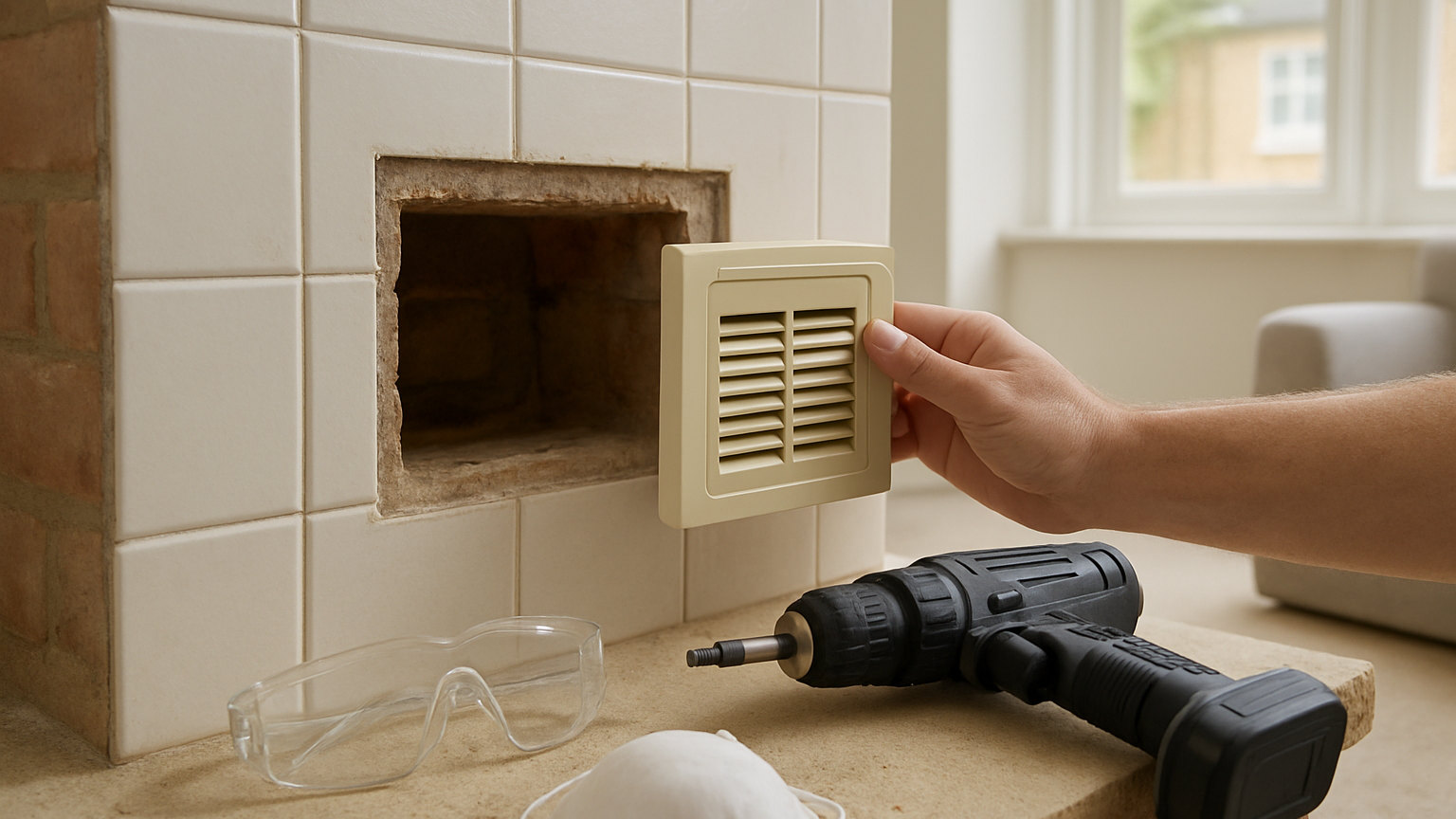
- At the bottom: fit an air vent in the blocked-up fireplace opening, or in the breast
- Make sure the vent is not blocked by furniture, wallpaper or a decorative cover
- Air can then move gently up the flue, carrying moisture away
Sealing both ends of a flue is one of the most reliable ways to create damp on a chimney breast.
Step 3: deal with the stack
Work at roof level, and generally a job for a roofer or a builder rather than a DIY task.
- Flaunching: the mortar fillet holding the pots. Cracked or missing flaunching lets water straight into the stack
- Pots: cracked or broken, or missing where the flue is open
- Capping: a vented cap keeps rain out while ventilating. A solid cap causes the problem described above
- Pointing: stacks are exposed on all sides and the pointing erodes faster than elsewhere
- Flashings: lead soakers, apron and back gutter. Mortar fillets are a common cheap substitute and they crack
- Damp proof course: a stack should have a tray or DPC to stop moisture tracking down
Never work at roof level without proper access equipment. Scaffolding or a tower, not a ladder resting on the roof.
Step 4: treat salt staining
Where the cause is salts rather than active water ingress.
- Make sure the flue is ventilated and any stack defect is fixed
- Let the breast dry out
- Hack off the contaminated plaster, which is the only reliable route. Salts remain in the plaster indefinitely
- Replaster using a salt-retardant or renovating plaster system, or a foil-backed board
- Ordinary gypsum plaster over a salted background will stain again
Painting over salt staining does not work. The salts continue drawing moisture and the stain returns through any number of coats.
Step 5: sealing the stain if replastering is not practical
A partial measure where a full replaster is not possible.
- Let the area dry fully
- Brush off any surface salt deposits dry, wearing a mask
- Apply a stain-blocking primer, shellac based for preference, two coats
- Check for bleed-through in good light before painting
- Paint the whole breast
Expect this to be a delaying measure rather than a permanent fix if the salts remain active.
Removed chimney breasts
Where a breast has been removed downstairs and the stack left above, check it has been properly supported with gallows brackets or a beam.
Damp can also appear where the remaining flue above is no longer ventilated at the bottom.
An unsupported stack is a structural matter and needs a builder or engineer, not a decorator.
Open fires and stoves
A flue in regular use stays warm and dry, which is why damp on a chimney breast frequently begins after a fire stops being used.
Where a flue is lined for a stove, the void around the liner should still be ventilated.
If it goes wrong
Stain returning through the paint: salts. It needs replastering with a salt-retardant system.
Damp worse after blocking the fireplace: the flue is sealed at both ends. Fit vents.
Damp only after heavy rain: rain entering the stack or a failed flashing.
Musty smell from the fireplace: no ventilation. Fit an air vent.
Damp in the loft around the stack: flashing. Get a roofer to look at it.
Fitting a vent to a blocked fireplace
- Choose a vent with a reasonable free area, not a decorative grille with almost no opening
- Position it low in the blocked-up opening, or in the breast below the old opening
- Cut the opening carefully, checking for cables and pipes first
- Fix the vent and make good around it
- Make sure nothing is placed in front of it: furniture, a picture, a fire screen
A summary
- Identify the cause from the pattern and whether it responds to rain
- Ventilate any disused flue at both ends, never seal it
- Have the stack, flaunching and flashings checked by a roofer
- Salt-contaminated plaster needs replacing, not painting over
- Replaster with a salt-retardant system where salts are present


