
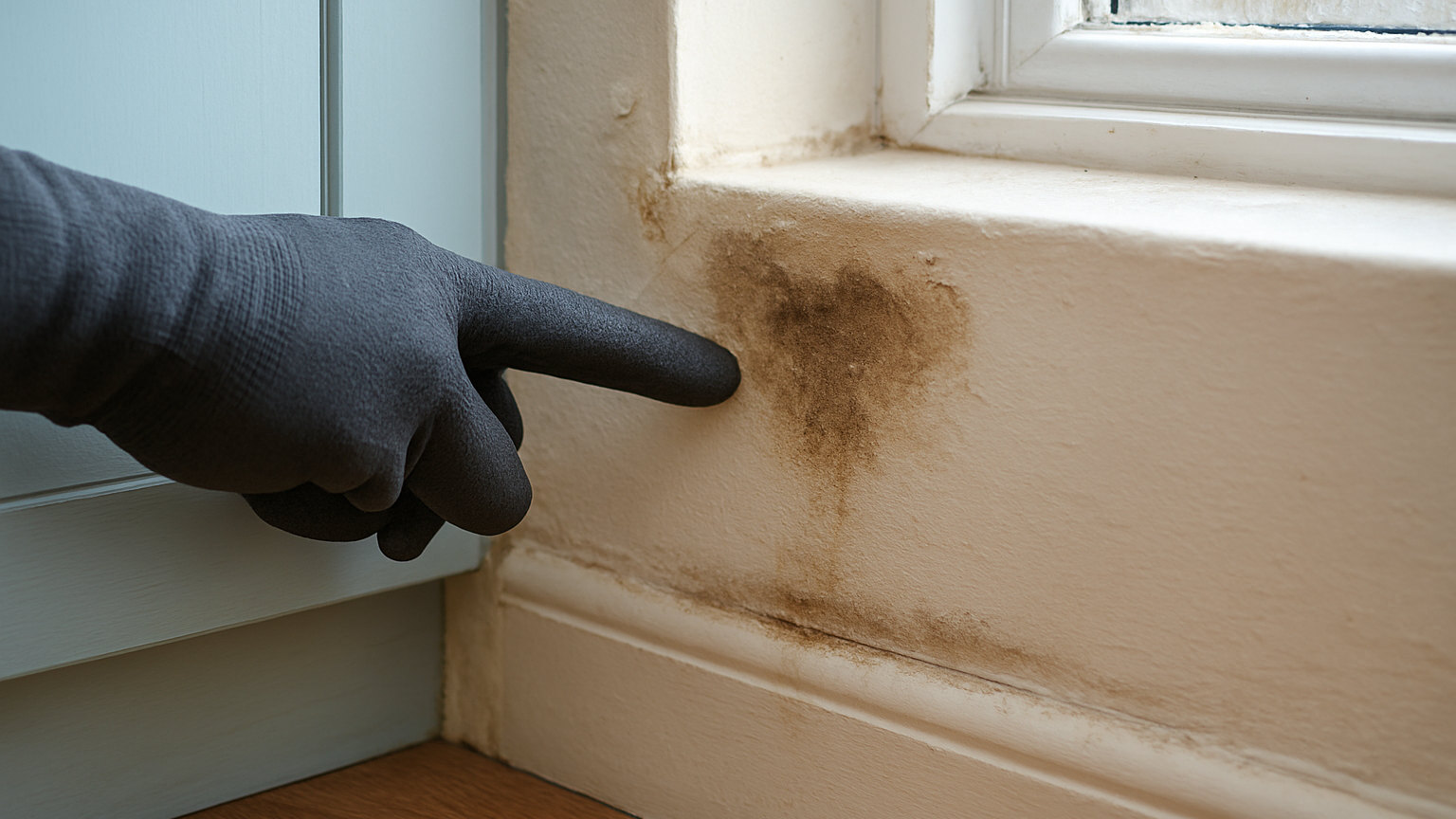
Almost all damp treatment that fails, fails because the damp was misdiagnosed. The three types look similar on a wall and have nothing else in common.
Condensation
By a very wide margin the most common cause of damp in British homes.
Warm moist air meets a cold surface, cools below its dew point, and the moisture it was carrying turns to water on that surface.
How to recognise it:
- Black spot mould, particularly in corners, behind furniture and around window reveals
- Worse in winter and better in summer
- Worse in bathrooms, kitchens and bedrooms
- Water running down window glass and frames in the morning
- Affects cold surfaces: external walls, corners, behind wardrobes, cold spots in the structure
- Musty smell, damp bedding, clothes in wardrobes feeling cold
- Little or no staining of the plaster itself, just surface mould
The pattern is the giveaway: it appears where air cannot circulate and where the wall is coldest.
Penetrating damp
Water coming in from outside through a specific defect.
How to recognise it:
- A defined patch rather than general mould
- Frequently at high or mid level, not just at the bottom of the wall
- Worse after rain, and particularly after driving rain from one direction
- Often on one wall only, usually the most exposed elevation
- Staining and tide marks on the plaster
- Plaster may be blown, soft or crumbling
- May correspond to something outside: a downpipe, a gutter joint, a cracked sill, a chimney
Test: watch it during and after heavy rain. Penetrating damp responds to weather; condensation responds to heating and ventilation.
Rising damp
Groundwater drawn up through the masonry by capillary action.
It is genuinely uncommon and heavily over-diagnosed. Many properties reported as having rising damp turn out to have condensation or a penetrating defect.
How to recognise it:
- Only ever at the base of a wall, with a tide mark typically no higher than about a metre
- A horizontal tide mark, fairly level along the wall
- White powdery or fluffy salt deposits at or above the tide line
- Blown or crumbling plaster at low level
- Skirting boards rotting or lifting
- Present all year, not markedly seasonal
Damp above about a metre is not rising damp. Water cannot rise higher than that through masonry against gravity.
Step 1: map the damp
- Draw a rough plan of the room and mark exactly where the damp is
- Measure the height of the top of the affected area from the floor
- Note which walls: external, internal, party wall
- Note which elevation faces the prevailing weather, usually south-west in the UK
- Photograph everything with a date
Step 2: note the timing
- Worse in winter, better in summer: condensation
- Worse after rain, regardless of season: penetrating
- Constant all year: possibly rising, or a continuous leak
- Appeared suddenly: a leak, not rising damp
- Worse when the heating is on and windows shut: condensation
Step 3: look outside
Go outside and look at the wall from the same position as the damp inside.
- Blocked, leaking or overflowing gutters
- A cracked or displaced downpipe, or one discharging against the wall
- Cracked or missing pointing
- Cracked or hollow-sounding render
- A damaged or missing window sill, or a blocked drip groove underneath it
- Defective flashing at a roof junction or a chimney
- Ground level, paving or a flowerbed above the damp proof course
- Render carried down over the damp proof course
Step 4: rule out plumbing
Before anything else, eliminate a leak.
- Check every waste and supply connection in the room and the room above
- Check the seal around a bath or shower tray
- Check radiator valves and the boiler
- Turn off all water and watch the meter, if there is one
- A sudden damp patch is far more likely to be a leak than rising damp
The quick guide
- Black mould in corners, worse in winter: condensation. Fix ventilation, heating and insulation
- Defined patch, worse after rain: penetrating. Find and fix the external defect
- Tide mark at low level with salts, all year: possibly rising. Get it properly investigated
- Sudden wet patch, no weather pattern: a leak
If it goes wrong
Damp returned after treatment: almost always misdiagnosis. Reassess the pattern and the season.
Two types at once: common. A penetrating defect makes a wall cold, which then causes condensation.
Not sure which it is: monitor for a season, recording the weather and the heating, before spending anything.
Told it is rising damp: check the height. Above a metre it is not, and a second opinion is worth having.
Interstitial condensation
A less obvious fourth possibility, where moisture condenses inside the structure rather than on the surface.
- Warm moist air passes into a wall or roof and condenses when it reaches a cold layer
- Symptoms appear as damp with no obvious surface cause
- Common where internal insulation has been added to a solid wall without a proper vapour control layer
- Also seen in roofs where insulation has blocked the eaves ventilation
- Needs professional assessment, since the fix depends on the build-up of the wall
More than one cause at once
Very common, and it is why treatments fail.
A penetrating defect wets a wall, which makes it colder, which then produces condensation on top of the original problem.
Fixing the external defect removes both, but only if it is found.
A summary
- Map exactly where the damp is and how high it goes
- Note whether it responds to rain or to heating and ventilation
- Rule out a plumbing leak first
- Go outside and look at the same spot from the other side
- Above a metre it is not rising damp


